

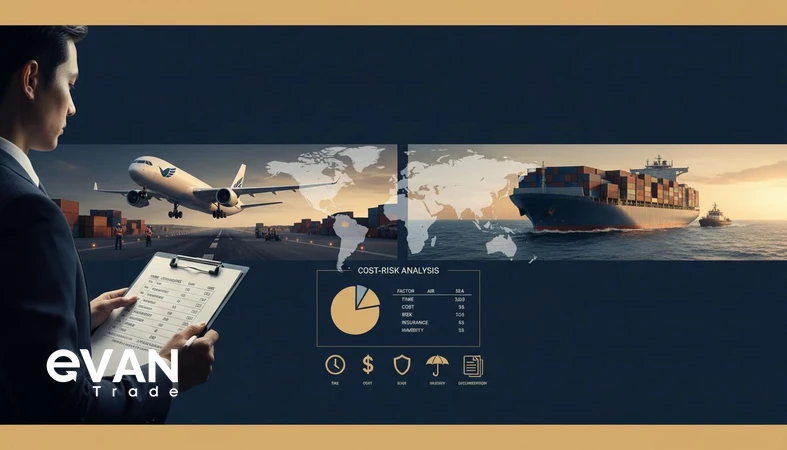
Choosing between sea and air freight from Iran is rarely a “cost vs speed” decision in isolation. For importers, the real question is how shipping mode affects total landed cost, lead-time variability, damage/claim probability, and documentation/compliance sensitivity—especially when routing may involve transshipment and indirect lanes. If you pick the wrong mode, the penalty is not only higher freight; it is stockouts, missed seasonal windows, extra inspection cycles, avoidable packaging upgrades, or a shipment that becomes hard to clear because documents were prepared for the wrong workflow.
This article provides a decision framework for sea vs air freight from Iran based on product characteristics, order profile, and route constraints. It also explains how Incoterms shift cost visibility and risk ownership in each mode, and closes with a risk management checklist you can use before booking. The goal is not to push a mode; it is to help you choose the one that best matches your product, cashflow, and risk tolerance.
Start with the product: value density, fragility, shelf life, and sensitivity
The fastest way to reduce decision uncertainty is to begin with what you are actually shipping. Many buyers start by asking “What’s cheaper?” but the more predictive question is: What is the shipment’s value per kg and operational sensitivity? Shipping mode should protect the product’s economics and integrity.
1) Value per kg (value density)
Higher value density can justify air because freight becomes a smaller share of the goods’ value and because the cost of capital tied up in inventory is often larger than the freight difference. Lower value density (bulky, heavy goods) typically favors sea freight because air costs scale quickly with chargeable weight.
2) Fragility and damage tolerance
Fragile goods may benefit from air due to fewer handling steps and less time in transit, but only if packaging and palletization are designed for air networks. Sea freight can still be safe for fragile items when you invest in bracing, shock protection, and moisture control—yet you must accept longer exposure and more handling points (warehouse, port, container loading, transshipment).
3) Shelf life, temperature sensitivity, and humidity exposure
For products with limited shelf life or strict temperature ranges, time in transit and uncontrolled environments matter. Sea lanes expose cargo to longer humidity cycles and container “sweat,” while air networks can expose cargo to short but intense temperature swings on the tarmac. The right choice depends on whether the product is more sensitive to duration (often sea risk) or to peaks (often air risk). If you need temperature control, decide early whether you need insulated packaging, gel packs, data loggers, or refrigerated solutions—then validate feasibility with the forwarder before you commit.
4) Seasonality and market timing
If your selling window is seasonal (e.g., promotional cycles, holiday demand, harvest-related timing), speed is not just convenience—it is revenue protection. In those cases, a blended strategy (air for the first replenishment, sea for the bulk) can reduce risk while protecting margin.
For related process guidance, keep your shipping decision aligned with your broader export logistics planning so mode choice does not conflict with packing, labeling, or document flow.
Then evaluate the order profile: MOQ, replenishment frequency, and cashflow
After product fit, the next determinant is your order pattern and financial constraints. Even when air is “more expensive,” it can be the cheaper option if it reduces inventory holding costs and avoids expensive stockouts.
MOQ and shipment size (LCL vs FCL vs air consolidation)
Small orders often move as LCL (less-than-container load) by sea, which introduces extra handling, consolidation cutoffs, and sometimes higher variability. If you are below efficient LCL breakpoints, air consolidation can be operationally simpler and sometimes competitively priced for modest weights—especially when your goods are compact and high-value.
Replenishment frequency and demand uncertainty
If you replenish frequently, the predictability of lead time may matter more than the average lead time. Air typically provides tighter delivery windows, but it can also be disrupted by capacity constraints, screening, or missed flights. Sea can be predictable on stable lanes, but transshipment and port congestion can amplify variability. Your decision should match the cost of being wrong: if a late delivery causes lost sales, air or a hybrid strategy is often rational.
Cash conversion cycle and working capital
Sea freight’s long transit ties capital up in inventory. If your cashflow is tight, you may prefer air for smaller, more frequent shipments so you pay suppliers and monetize inventory faster. Alternatively, if you can negotiate payment terms and can hold buffer stock, sea may reduce freight cost per unit.
To reduce surprises, buyers should standardize order and documentation routines early—especially packing lists and carton markings. A disciplined approach to export documentation will make both air and sea workflows more reliable.
Route and operational constraints from Iran: nodes, transshipment, and documentation reality
Routing from Iran often requires additional planning compared with more direct export corridors. Without giving legal advice, it is practical to acknowledge that some lanes may involve indirect routing, extra screening, and stricter documentation checks. Those realities affect which mode is “safer” for your timeline and clearance process.
Ports, airports, and transshipment effects
Sea freight may involve feeder services and transshipment hubs, increasing the number of handoffs and exposure time. Air freight may also route through intermediate hubs; that can be efficient, but it adds complexity in screening, warehouse cutoffs, and document coordination.
Compliance and documentation sensitivity (without legal advice)
Regardless of mode, documentation consistency is essential: invoice values, HS codes, packing list weights, and the description of goods must match. Air shipments are often cleared faster when documentation is clean, but they can also be held quickly if something is inconsistent because timelines are tight and storage costs can escalate. Sea shipments give more time to correct issues, but mistakes can surface at discharge—when fixing them is slower and sometimes costlier.
Damage and exposure environments
Sea freight containers can face salt air, humidity cycles, and longer stacking times. Air cargo typically faces more frequent handling and transfers but shorter exposure duration. If your goods are moisture-sensitive, sea requires a strong moisture-control plan (e.g., liners, desiccants, sealed cartons). If your goods are crush-sensitive, focus on pallet integrity, corner protection, and clear handling marks—especially for air networks.
If you are building your process from scratch, it helps to map your steps end-to-end—from supplier packing to consignee delivery—using a consistent export supply chain checklist so that routing complexity does not turn into avoidable delays.
Sea vs air freight from Iran: a comparison table that reflects real trade-offs
The table below is designed to help you decide using criteria that matter in practice—not only rate per kg or per container. Use it as a structured conversation tool with your supplier and forwarder.
| Decision factor | Sea freight (LCL/FCL) | Air freight | What to ask / verify before booking |
|---|---|---|---|
| Value density (value per kg) | Best for low-to-medium value density; freight is efficient for heavy/bulky goods | Best for high value density; freight cost can be acceptable vs inventory/cash cost | Calculate freight as % of goods value; model inventory carrying cost for transit time |
| Lead time and variability | Longer transit; variability increases with transshipment and port congestion | Shorter transit; generally tighter windows but can face capacity/screening delays | Request realistic door-to-door lead time ranges, not only averages; ask for cutoff times |
| Incoterms cost visibility | Common: FOB/CFR/CIF; local port charges and destination fees can be opaque in some deals | Common: FCA/CPT/CIP; airport handling and security charges need clarity | Ask for a cost sheet separating origin, main carriage, destination, and last-mile charges |
| Risk ownership points (Incoterms lens) | FOB shifts risk at loading; CIF adds insurance but not necessarily broader coverage | FCA shifts risk at handover to carrier; CIP requires higher insurance level than CIF | Confirm exact handover point; confirm insurance clauses and claim process |
| Damage/claims risk profile | Longer exposure to vibration, moisture, stacking; fewer touches if FCL, more if LCL | More handling steps but shorter total exposure; higher risk if poorly palletized | Define packaging standard; specify pallet type, strapping, corner boards, and shock/moisture protection |
| Temperature/humidity exposure | Higher humidity-cycle risk; container sweat is a known issue for moisture-sensitive goods | Shorter duration but can face temperature peaks during ramp handling | Decide on desiccants/liners vs insulated packaging; consider data loggers for sensitive loads |
| Documentation and clearance sensitivity | More time to correct errors, but issues may surface late and delay discharge/clearance | Fast workflows; inconsistencies can cause immediate holds and storage charges | Lock HS code alignment, weights, and product descriptions; ensure packing list discipline |
| Insurance practicality | Often essential for moisture/damage risk; claims can be complex if evidence is weak | Often essential for high-value items; faster claims handling depends on documentation quality | Confirm coverage scope, exclusions, required evidence (photos, survey, temperature logs) |
| Disruption sensitivity | Port congestion, schedule changes, transshipment rollovers can create multi-week impacts | Flight cancellations/capacity constraints can delay days; sometimes longer if rerouting is needed | Build buffer stock rules and escalation plan; define alternate hubs and reroute options |
Incoterms decision lens: how risk and cost shift in sea vs air
Incoterms do not set the price; they set who controls the shipment, who pays which legs, and where risk transfers. When shipping from Iran, Incoterms choice is tightly linked to your ability to manage forwarders, insurance, and document quality.
Sea-focused Incoterms: FOB, CFR, CIF
- FOB (Free On Board): You take control once goods are loaded on the vessel. This can improve transparency if you choose your own freight and insurance, but you must manage the main carriage and destination costs.
- CFR (Cost and Freight): Supplier pays ocean freight to destination port, but risk often transfers earlier. Buyers sometimes underestimate destination charges and local handling fees.
- CIF (Cost, Insurance and Freight): Adds insurance arranged by seller. However, the buyer should confirm the coverage level and clauses; “insured” does not automatically mean “fully protected.”
Air-friendly Incoterms: FCA, CPT, CIP
- FCA (Free Carrier): Often practical for air because the handover point (named place) can be clearly defined (e.g., terminal/warehouse). You control onward carriage and insurance.
- CPT (Carriage Paid To): Seller pays carriage to a named destination, but risk transfers earlier. Useful when you want simplified pricing but still need risk clarity.
- CIP (Carriage and Insurance Paid To): Like CPT but with insurance; typically requires a higher insurance level than CIF. Still, you should verify scope and claims mechanics.
Regardless of mode, request three things from the supplier/forwarder: (1) a leg-by-leg cost breakdown, (2) the exact handover point where risk transfers, and (3) document drafts before cargo is tendered. If you need a structured way to validate documentation readiness, align your internal team with an export compliance review routine (focused on consistency, not legal interpretation).
Risk management checklist: lock these before you book
Most “shipping problems” are actually pre-booking problems. The following checklist reduces mode-specific surprises and helps you compare sea vs air based on controlled variables.
- HS code alignment: Confirm HS code consistency across proforma invoice, commercial invoice, packing list, and any certificates. Misalignment can trigger holds and rework.
- Product description discipline: Use clear, non-ambiguous descriptions (material, use, form). Avoid overly generic terms that invite questions.
- Weights and dimensions: For air, chargeable weight can change if dimensions are off. For sea, incorrect weights can disrupt container planning and port acceptance.
- Packing list rigor: Carton count, net/gross weight, and marks must match physical goods. Decide whether you want carton-level detail or pallet-level detail.
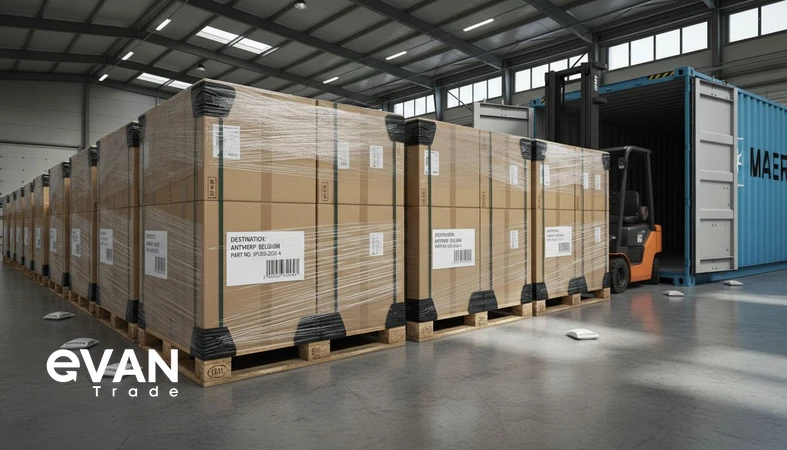
- Packaging standard: Specify pallet type, fumigation/ISPM 15 needs where applicable, strapping, corner protection, inner cushioning, and moisture barriers.
- Temperature/humidity controls: Choose desiccants/liners for sea; insulated packaging and planned handover timing for air. Consider data loggers for sensitive cargo.
- Insurance terms and evidence plan: Confirm coverage scope, exclusions, deductible, and claim evidence requirements (photos at loading/unloading, survey reports, logs).
- Inspection/sampling timing: Decide whether to inspect pre-pack, pre-shipment, or at consolidation. Late inspection reduces your options.
- Buffer stock logic: Define how many days/weeks of buffer you need based on lead-time variability, not only average transit time.
- Disruption playbook: Agree on reroute triggers, alternative hubs, and who authorizes extra costs if the plan changes mid-transit.
Practical rule: if your decision relies on “best-case transit time,” you are underestimating risk. Plan on a range and build process controls that keep you inside that range.
Practical scenarios: how the decision plays out
Below are generic examples to show how the framework works. Treat them as decision patterns rather than templates.
Scenario 1: High-value, low-weight goods (value density is high)
An importer sources compact, high-value items where stockouts would be costly and storage is expensive. In this case, air freight can make sense because the shipment value per kg is high and faster turnover reduces working capital pressure. Key controls: accurate dimensions for chargeable weight, strong tamper-evident packaging, and insurance that matches value concentration.
Scenario 2: Bulky, low-value goods (value density is low)
A buyer imports heavy, bulky goods where freight is a major portion of unit cost. Sea freight—often FCL if volumes justify it—typically provides the lowest freight per unit. Key controls: moisture protection (liners/desiccants), bracing to prevent shifting, and clear Incoterms to avoid hidden destination charges.
Scenario 3: Time-sensitive replenishment (hybrid approach)
A buyer faces a seasonal selling window and cannot afford late shelves. A common approach is to ship an initial smaller quantity by air to cover immediate demand while shipping the bulk by sea to protect margin. Key controls: consistent labeling/SKU mapping across both shipments, synchronized documentation, and a buffer-stock rule that accounts for sea variability.
To keep scenario planning grounded, coordinate packaging and quality gates early—especially if you are also finalizing supplier qualification. A structured supplier selection process reduces downstream logistics risk.
FAQ: common buyer questions about sea vs air freight from Iran
1) Is air freight always faster door-to-door?
Air is usually faster in transit, but door-to-door speed depends on booking lead time, cargo screening, warehouse cutoffs, and documentation readiness. If documents are incomplete or cargo needs re-checks, air can lose its advantage quickly. For predictable speed, ensure invoice/packing list accuracy, confirm cutoff times, and align pickup and handover windows.
2) When does sea freight become “worth it” compared with air?
Sea becomes attractive when your goods are heavy or bulky (low value per kg) and when you can tolerate longer lead times with buffer stock. It is also often preferable when you ship consistent volumes that can fill a container efficiently. The tipping point is best found by modeling total landed cost, including capital tied up during transit.
3) Which Incoterm is safer for buyers: CIF/CIP or FOB/FCA?
“Safer” depends on control and transparency. CIF/CIP can simplify procurement because carriage and insurance are arranged by the seller, but buyers must verify insurance scope and destination charges. FOB/FCA can improve control and cost visibility if you can manage a forwarder and insurance. In either case, define the exact handover point and request a cost breakdown.
4) What documentation issues most often delay shipments?
Common issues include HS code inconsistencies, mismatched weights between packing list and physical cargo, vague product descriptions, and missing carton/pallet marks. Air shipments may be held quickly because the process is fast-paced; sea issues can appear later at discharge and still cause expensive delays. Document drafts should be reviewed before cargo is tendered.
5) How should I think about insurance for sea vs air?
Insurance is not just a checkbox; it is a process. For sea, moisture and handling damage are frequent concerns, so packaging evidence and photos matter. For air, value concentration and theft/tamper risk can be more prominent. Confirm coverage clauses, exclusions, deductible, and the evidence you must collect (photos, surveys, temperature logs) before shipment.
6) Can packaging be “good enough” for both air and sea?
Sometimes, but not always. Sea often needs stronger moisture control and longer-duration protection; air often needs robust pallet integrity and protection against frequent handling. If you plan a hybrid strategy (air + sea), design packaging to the stricter requirement where feasible, or create two packing specs. Standardization reduces errors across multiple shipments.
Conclusion: decide with a framework, not a preference
Sea vs air freight from Iran is a decision about economics under uncertainty: value per kg, damage tolerance, shelf life, replenishment rhythm, and route complexity all matter. Start with product characteristics (value density, fragility, sensitivity), then validate your order profile (MOQ, frequency, cashflow), and finally stress-test route constraints (transshipment, documentation readiness, disruption exposure). Use Incoterms to make cost and risk transfer explicit—FOB/CFR/CIF on sea lanes and FCA/CPT/CIP on air lanes—then lock your pre-booking checklist (HS code alignment, packing discipline, insurance terms, temperature controls, inspection timing, and buffer stock logic).
For buyers who want a clearer, execution-focused workflow—without guesswork—Evan Trade (EvanTrade) supports practical coordination across documentation, packaging readiness, and shipment planning so mode choice becomes a controlled decision rather than a last-minute gamble.