
You can share this page with your friends using the options below.

Iranian pistachios are a high-value tree nut category traded globally in multiple commercial types (in-shell and kernels), with buyers typically specifying variety/style, size count, defect tolerances, food safety limits, and packing configuration. EvanTrade operates as a full-service export specialist and trade strategist, aligning sourcing, quality controls, documentation, and delivery planning so import programs stay auditable and clearance-ready.
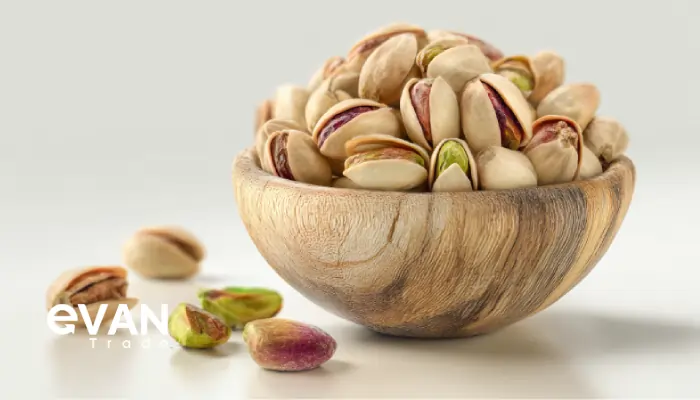
Most importer programs fall into two tracks: in-shell for retail/foodservice (visual grade + size count + low defect) and kernels for manufacturing (uniform kernel size/color + tighter foreign matter control + validated aflatoxin plan). Powder/ground formats are uncommon for pistachios in B2B due to authenticity and allergen cross-contact risk; buyers usually prefer kernels or pieces for industrial use.
Typical use cases: snack packs, bakery, confectionery, ice cream, granola/cereals, sauces/spreads, HORECA, ingredient supply.
Iran is one of the world’s best-known origins for pistachios, supplying both in-shell and kernel programs across retail and ingredient channels. From a buyer’s perspective, the practical differentiation is not “marketing story”, it’s how origin characteristics interact with variety mix, kernel color profile, sizing yield, and defect distribution, and how reliably a supplier can control mycotoxin risk (aflatoxins), foreign matter, moisture, and storage conditions.
In trade, Iranian pistachios are often purchased by commercial style + size count + processing state (raw vs roasted/salted) and supported by a lot-based COA. For importers, the most important value lever is standardization: defining a repeatable spec that covers product identity (style/size/variety), safety limits, defect tolerances, packing, and documentation so every shipment stays comparable and clearance-ready.
When Iranian origin is a fit, it is usually because the buyer can lock in a stable spec and a controlled QC plan. When it fails, it’s usually because spec gaps (unclear size basis, unclear defect definitions, missing aflatoxin decision rules, weak packaging controls) lead to non-conformities and disputes.
Pistachios are specified differently depending on whether you buy in-shell or kernels. In-shell programs prioritize open rate, shell integrity, size count, and appearance. Kernel programs prioritize kernel size/caliber, color, splits, foreign matter, and processing hygiene. If you intend to re-pack under your brand, you also need alignment on roast profile, salt %, allergen labeling, and shelf-life validation.
Iranian export varieties
Variety is not a “grade,” but it influences shape, market positioning, and pack presentation, so it should be stated alongside style and size/count to prevent mix-related disputes.
Use this as a starting point, your destination market and application may require tighter limits.
| Spec Item | In-Shell (Example) | Kernels (Example) | Notes (how buyers control risk) |
| Style | NO / MO / CS | Whole / Halves / Pieces | Define exact commercial name + allowed mix % |
| Size / Count | e.g., 22–24, 24–26, 28–30 (per oz) | Kernel caliber (e.g., 18/20, 20/22) | Confirm counting standard used in contract |
| Moisture | target ≤ X% | target ≤ X% | Moisture drives texture + mold risk; agree method |
| Open rate (in-shell) | min % open | — | Specify what counts as “open/partially open” |
| Defects | stains, shell damage, insect, shriveled | splits, broken, dark kernels | Use clear defect definitions + max % per defect |
| Foreign matter | max mg/kg or “none visible” | max mg/kg, metal detection | Add sieving + magnets + metal detector statement |
| Aflatoxin plan | COA + decision rule | COA + decision rule | Align to destination limits (see compliance section) |
| Micro (if needed) | as agreed | as agreed | Often buyer-specific for kernels used as ingredient |
| Roasting (if applicable) | roast level, salt %, oil policy | roast level, salt %, oil policy | Lock method + sensory acceptance protocol |
| Packaging | bags/tins + carton | vacuum/MAP bags + carton | Barrier packaging for humidity/odor control |
| Traceability | lot code, crop year, facility | lot code, crop year, facility | Must match COA + packing list + labels |
Iran’s pistachio supply is regionally distributed, and importers typically experience this through crop timing, lot availability, and price movement rather than geography narratives. In practice, what matters is that the exporter can identify the crop year, the lot composition, the processing facility, and storage conditions, then link those to COA results and shipment documents.
Seasonality is a key planning variable: after harvest, the market sees greater lot availability and more flexible sizing/grades. Later in the season, availability may narrow to specific sizes or kernel grades, and prices can shift based on carry stock quality, storage costs, and demand from major buyer markets. If your program is retail private label, early planning is essential because packaging materials, artwork approvals, and shelf-life validation add time and cost.
For importers running year-round manufacturing, the safest approach is to structure supply as multiple lots across the year with consistent testing and packaging rules, rather than trying to solve variability through one “big buy.” This reduces risk of quality drift, moisture pickup, and sensory changes, especially for kernels and green kernel segments used in premium confectionery.
A pistachio shipment is only as strong as its pre-shipment QC logic. Because nuts are high-risk for mycotoxins (aflatoxins) and sensitive to humidity and odor migration, importers should treat QC as a system: incoming raw sorting, processing controls, sampling discipline, and a lot-based decision rule that is contractually enforceable.
Processing and packing should include practical controls such as cleaning, sorting, and foreign matter reduction. For kernels, buyers often require stricter controls: calibrated sorting, magnets, and (where applicable) metal detection. Your purchase contract should specify the inspection points: pre-pack inspection, final pack inspection, and sampling for lab tests tied to a unique lot code.
Typical checkpoints:
At minimum, most import programs require: aflatoxin testing and a basic quality COA (moisture, defects). Depending on destination and application, buyers may add microbiology, pesticide residues, and heavy metals.
Traceability rule: COA must reference the exact lot number that appears on labels, packing list, and invoice. Without that linkage, COA is not operationally useful in a dispute.
Packaging is not cosmetic in pistachios, it is a risk control against humidity pickup, rancidity, and odor contamination. Your packaging spec should match your channel: bulk ingredient shipments prioritize protection and handling efficiency, while retail/private label adds labeling compliance and shelf-life performance under store conditions.
Bulk buyers should specify: net weight per bag, liner type/thickness, carton strength, pallet configuration, stretch wrap, and whether container liners/desiccants are required based on route humidity risk.
Retail packing typically includes: stand-up pouches, tins, jars, or small cartons. For pistachios, importers should be explicit about oxygen and moisture barrier performance, because weak films can lead to soft texture and quality claims. If roasted/salted, you also need alignment on salt %, roast profile, and allergen statements.
Private label programs require:
Carton/pallet baseline (example controls):
Shelf life in pistachios is driven by moisture control, oxidation, temperature stability, and protection from odors. Kernels are generally more sensitive than in-shell because they have more exposed fat surface. Roasted products can have different stability depending on roast method and whether oils/flavors are applied.
To protect shelf life, importers should align on: target moisture, barrier packaging (vacuum/MAP for kernels where needed), and a route plan that avoids prolonged exposure to high humidity. Storage should be cool, dry, and odor-free, with pallets off the floor and away from walls to reduce moisture transfer. If you re-pack domestically, control humidity at the packing line and maintain lot segregation.
Shelf-life claims should not be generic. They should be tied to the product format (in-shell vs kernels), packaging type (standard bag vs vacuum/MAP), and storage temperature. A practical approach is to agree on a shelf-life window that includes a safety margin and to add acceptance criteria at arrival: moisture/texture check, sensory check, and COA verification.
Compliance is destination-specific, and pistachios have a clear “must-control” hazard: mycotoxins (aflatoxins). Many markets also focus on hygiene, traceability, and labeling accuracy, especially allergen declarations.
EU rules set maximum levels for contaminants, including aflatoxins, and differentiate between product intended for sorting/physical treatment versus product placed on the market for final consumer use. For almonds, pistachios and apricot kernels, the EU lists aflatoxin maximum levels by category (B1 and total).
EU also specifies maximum levels for ochratoxin A for pistachios, again distinguishing between lots to be physically treated and lots placed on the market.
Importer implication: Your contract must state whether the lot is sold as “to be subjected to sorting/physical treatment” or “final consumer/ingredient,” because limits differ and the compliance pathway changes accordingly.
The UK requires imported nuts to meet food hygiene standards; health certificates are not normally required unless specific emergency controls apply.
Importer implication: Plan for standard food import procedures, ensure traceability documentation is complete, and verify whether any product-origin specific emergency measures apply at time of shipment.
FDA guidance indicates pistachio nuts above 20 ppb total aflatoxins may be considered adulterated.
Importer implication: You need a lot-based aflatoxin control plan and an importer verification process (commonly handled under importer food safety programs). Align lab method, sampling, and decision rule in writing.
Pistachios are shelf-stable but not logistics-proof. The main shipping risks are humidity exposure, odor contamination, and temperature swings that accelerate rancidity, especially for kernels and roasted products. Your logistics plan should be aligned to packaging: vacuum/MAP for kernels, barrier liners where needed, and container loading controls (dry, clean, odor-free).
The most important point is not the Incoterm label, it’s whether your contract clearly states: packing configuration, palletization, container loading standard, temperature/humidity protection measures, and what happens if arrival inspection fails (claims, rework, or return terms).
Document discipline is what turns a good pistachio lot into a clearance-ready shipment. At minimum, you want a consistent set of export documents, plus buyer-required compliance documents (market-specific). All documents should reference consistent identifiers: supplier name, product description, HS code (as applicable), lot codes, net/gross weights, and packing configuration.
Pistachio demand is broad-based across retail snacks and industrial ingredients, with peaks often shaped by holiday gifting seasons, confectionery production cycles, and retail promotions. For importers, the practical way to manage demand is to align procurement windows to harvest availability and to lock packaging materials early for private label.
Price is typically driven by a mix of:
If your market is sensitive to green kernel color or premium whole kernels, expect tighter supply and more volatility. If you buy industrial pieces, pricing can be more stable but still depends on defect tolerances and foreign matter limits.
A strong RFQ prevents misunderstandings and protects both sides. Use the template below to request comparable offers and to ensure COA and packaging plans are aligned from day one.
Product identity
Commercial specifications
Packaging
Commercial terms
Natural Open typically refers to shells opened naturally on the tree, while Mechanically Open are opened after harvest. Buyers often price and specify them differently based on appearance and perceived premium.
Use the market’s size/count standard (often counts per ounce for in-shell). Confirm the counting basis and tolerance range in writing, not just the size label.
It depends on application. Whole kernels suit premium toppings and confectionery; pieces can be efficient for bakery mixes. Always specify foreign matter and defect limits more tightly for ingredient use.
Aflatoxins are typically the first-line requirement. Many buyers add moisture and defect analysis, and then residues/micro tests depending on destination and customer policy.
Vacuum or MAP bags inside strong cartons, with a clean, dry loading environment. Add liners/desiccants based on route humidity risk.
If your goal is a low-risk, auditable shipment that clears smoothly, the starting point should be a spec-led RFQ. EvanTrade structures Iranian pistachio offers around clearly defined commercial type and cultivar, lot-based traceable QC, destination-aligned labeling, and shipment-ready documentation, so every load is defensible on quality, paperwork, and compliance, and repeat orders stay consistent.
Your next step