


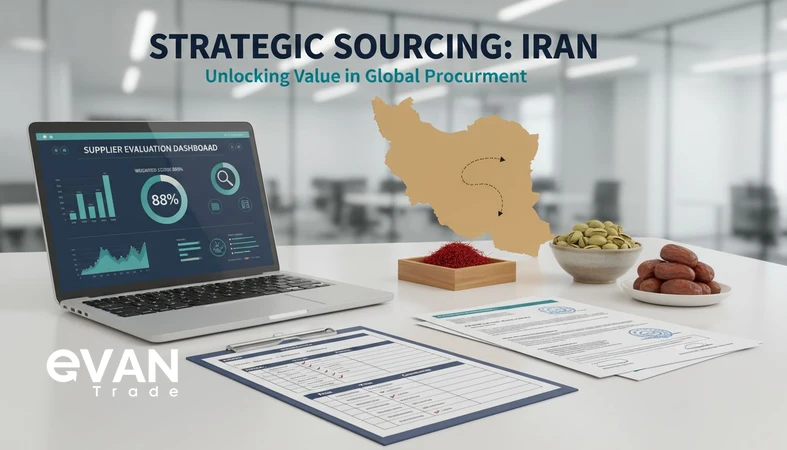
Supplier scorecard for Iran sourcing: why repeatable evaluation matters
Iran sourcing can be highly competitive on product quality and origin-specific advantages (for example, premium saffron, pistachios, dates, herbs, and processed foods). Yet for many international buyers, the real barrier is not product interest—it is uncertainty: inconsistent specs, uneven documentation discipline, customs-readiness gaps, packaging and shelf-life risks, or unclear dispute handling. A supplier scorecard for Iran sourcing turns these uncertainties into measurable checkpoints so your buying decisions are repeatable, auditable, and easier to defend internally.
A scorecard is not a one-time checklist. Done well, it is a living framework that distinguishes between supplier qualification (can this supplier meet requirements?) and performance monitoring (are they consistently meeting requirements over time?). This distinction is especially useful when you are building a supplier base in a market where capabilities vary by region, season, and processing infrastructure.
In practice, the scorecard should help you answer four buyer questions:
-
What evidence proves the supplier can deliver the product to spec (not just “similar quality”)?
-
What controls protect you from batch-to-batch variability and seasonal quality swings?
-
What documentation is required to stay customs-ready and reduce clearance delays?
-
What happens when something goes wrong—how fast do they respond, and how do they prevent recurrence?
This article provides a repeatable scorecard framework tailored to Iran sourcing, including category design, weighting logic, evidence requirements, red flags, and a quarterly review cycle. You can adapt it for food and agricultural products, ingredients, and many non-food categories that rely on disciplined documentation and traceability.
Qualification vs. performance monitoring (and why buyers often mix them)
Many sourcing programs fail because they use a single checklist for everything. Qualification and performance monitoring are related but different:
-
Qualification scorecard evaluates capability and readiness before you commit: certifications, traceability, documentation templates, packaging options, export experience, and compliance literacy.
-
Performance scorecard evaluates what actually happened: defect rates, COA accuracy, on-time dispatch, customs exceptions, complaint handling time, and corrective actions.
For Iran sourcing, this split matters because a supplier can look strong on paper but still struggle with recurring execution issues (for example, labeling errors, variable moisture levels, or late document submission). Conversely, a smaller supplier may lack polished marketing but perform reliably if their process controls and documentation discipline are strong.
How to apply the split in a practical buying process
-
Use qualification to shortlist and approve suppliers for a pilot shipment.
-
Use performance to decide whether to scale, renegotiate, or replace.
-
Keep both in the same file, but don’t let strong qualification scores mask weak performance trends.
Step 1–2: define product risk profile and select scorecard categories
Before scoring suppliers, define your product risk profile. The same supplier may be “acceptable” for one item and “too risky” for another. A grounded risk profile helps you pick categories that matter and avoid over-weighting irrelevant metrics.
Step 1: define the product risk profile (a simple buyer lens)
-
Intrinsic risk: is the product sensitive to moisture, oxidation, contamination, or temperature?
-
Regulatory exposure: are there destination-market limits (residues, allergens, additives, heavy metals)?
-
Traceability requirement: do you need farm/region, harvest window, lot-level traceability, or organic chain-of-custody?
-
Packaging & shelf-life sensitivity: does packaging materially affect stability, aroma, or microbial risk?
-
Commercial risk: price volatility, seasonality, and substitution risk.
Step 2: choose scorecard categories (a recommended baseline for Iran sourcing)
Most B2B buyers can start with 7 categories and adjust weights based on risk:
-
Quality system & consistency (spec control, sampling plans, CAPA)
-
Documentation & traceability (COA, MSDS where applicable, lot coding, labeling proofs)
-
Packaging & shelf-life controls (materials, barrier properties, storage conditions)
-
Compliance & customs-readiness (HS alignment, export docs completeness, inspection readiness)
-
Logistics reliability (lead times, dispatch discipline, Incoterms clarity)
-
Commercial terms & payment risk controls (terms, bank process readiness, fraud controls)
-
Communication SLA & dispute handling (response time, escalation, corrective actions)
Step 3–5: weighting logic, scoring rubric, and the evidence checklist
A scorecard becomes decision-grade when it is (1) weighted, (2) scored consistently, and (3) backed by evidence. Without these three, scorecards are easy to “talk around” in meetings.
Step 3: set weights using a risk-based logic
Instead of equal weights, use risk to drive priority. Example weighting logic:
-
High-risk food ingredients: heavier weight on quality consistency, traceability, and packaging/shelf-life.
-
Standardized industrial goods: heavier weight on compliance documentation, delivery reliability, and corrective action discipline.
-
New supplier / new route: heavier weight on customs-readiness and logistics reliability.
Step 4: define a scoring rubric that reduces subjectivity
Use a 1–5 scale with defined meanings. One workable rubric:
-
1 (High risk): no evidence / repeated failures / unclear ownership
-
2 (Weak): partial evidence / inconsistent application
-
3 (Acceptable): meets baseline requirements with minor gaps
-
4 (Strong): consistent performance, documented controls
-
5 (Best practice): proactive prevention, strong audit trail, continuous improvement
Step 5: build an evidence checklist (what “proof” looks like)
Evidence discipline reduces the “trust gap” that often appears in cross-border sourcing. Common evidence types include:
-
Recent COA per lot; third-party test reports where relevant
-
MSDS/SDS for chemical or regulated items (and any handling instructions)
-
Traceability: lot coding logic, harvest/production dates, supplier-of-supplier records
-
Label artwork approvals, photos of packed cartons, palletization plan
-
Export documentation set: invoice, packing list, certificate(s), inspection where applicable
If you want your scorecard to be enforceable, attach pass/fail gates for non-negotiables (for example, “lot-level COA required before shipment release”).
A practical supplier scorecard template (with thresholds, evidence, and red flags)
The table below is a template you can copy into Excel or your procurement system. It combines weighted scoring with evidence requirements and includes “stop/go” thresholds. Adjust weights by product risk profile.
|
Category |
Key metrics (examples) |
Scoring scale (1–5) |
Evidence required |
Weight (%) |
Pass/Fail gate & red flags |
|---|---|---|---|---|---|
|
Quality consistency |
Spec compliance rate, defect rate, sampling plan, CAPA closure time |
1=no controls; 3=baseline controls; 5=robust SPC/CAPA |
COA trend data, QC SOP, sample retention policy, CAPA records |
25 |
Fail if repeated out-of-spec without CAPA; red flag: refusal to share lot data |
|
Documentation & traceability |
Lot traceability, COA accuracy, labeling proof, record retention |
1=missing; 3=present but inconsistent; 5=auditable, disciplined |
Lot coding map, COA template, label artwork approval workflow |
15 |
Fail if no lot coding/COA; red flag: document changes after shipment |
|
Packaging & shelf-life controls |
Barrier properties, inner/outer pack, tamper evidence, storage conditions |
1=generic packing; 3=adequate; 5=validated shelf-life approach |
Packaging spec sheet, shelf-life statement, storage SOP, photos |
10 |
Fail if shelf-life not stated/traceable; red flag: unclear production date logic |
|
Compliance & customs-readiness |
Export docs completeness, HS clarity support, inspection readiness |
1=frequent gaps; 3=mostly correct; 5=low exception rate |
Document set samples, prior shipment references, compliance checklist |
15 |
Fail if recurring customs exceptions; red flag: unwilling to standardize documents |
|
Logistics reliability |
On-time dispatch, lead time variance, packaging for transit, Incoterms clarity |
1=unreliable; 3=acceptable; 5=predictable, proactive |
Lead-time history, dispatch logs, pallet plan, booking discipline |
15 |
Fail if repeated missed dispatch; red flag: last-minute changes without notice |
|
Commercial terms & payment risk |
Terms clarity, invoice accuracy, ability to support secure payment process |
1=opaque; 3=clear terms; 5=robust controls & documentation |
Proforma & invoice samples, bank details verification workflow |
10 |
Fail if bank details change without verification; red flag: pressure tactics on payment |
|
Communication SLA & dispute handling |
Response time, escalation path, complaint handling, CAPA quality |
1=slow/defensive; 3=responsive; 5=structured, preventive |
SLA agreement, complaint log, CAPA examples, meeting minutes |
10 |
Fail if no complaint process; red flag: denial without investigation |
Tip: Keep one overall threshold (for example, 75/100) and also enforce category-level minimums for the items that can block shipments (documentation, traceability, customs readiness).
Operational controls buyers should score: sampling, packaging, customs, and payment
Beyond “quality,” most shipment problems come from operational weak points. Your scorecard should explicitly capture these controls so you can detect risk early.
Quality consistency and sampling plans
-
Require a written specification with measurable limits (moisture, size/grade, color, microbiology where relevant).
-
Define a sampling plan for pre-shipment and arrival checks (AQL or fit-for-purpose sampling).
-
Score higher when the supplier can show historical COA trends per lot, not just one-off results.
Documentation discipline: COA, MSDS/SDS, traceability, labeling
Documentation should be treated as a production output, not an afterthought. The scorecard should verify that documents are consistent across: invoice, packing list, COA, labels, and any certificates. Mismatches are a common cause of clearance delays and buyer-side internal escalations. When relevant, require MSDS/SDS and handling instructions for warehouse safety and compliance.
Packaging and shelf-life risk controls
-
Match packaging to product sensitivity (barrier films for aroma-sensitive goods, moisture control for hygroscopic items).
-
Clarify production date and best-before logic; ensure lot codes tie back to records.
-
Ask for transit simulation reasoning: how the supplier reduces crushing, leakage, or odor loss.
Compliance, customs-readiness, and logistics reliability
Customs-readiness is rarely just “having documents.” It is having the right documents in the right format, on time, consistent with goods and labels. Score higher for suppliers who can produce document sets early for review, accommodate destination requirements, and operate with stable lead times. Logistics reliability can be supported by simple operational habits: dispatch calendars, advance notice, photo evidence of loading, and clear Incoterms alignment.
Step 6–7: onboarding, pilot shipment, and quarterly performance reviews
The scorecard is most valuable when it is embedded into your workflow, not used only at supplier selection.
Step 6: onboarding + pilot shipment (a disciplined sequence)
-
Pre-qualification call: confirm capability, export experience, product scope, and documentation readiness.
-
Document pack request: ask for sample COA, packing list, invoice, label draft, and traceability explanation.
-
Spec lock: agree on measurable specs and acceptable tolerances (including grade definitions).
-
Pilot shipment: smaller volume with enhanced inspection and tighter gates (no shipment release until documents are reviewed).
-
Post-arrival review: compare actual results vs. COA and packaging condition; log exceptions.
Step 7: quarterly performance review (turn outcomes into decisions)
Run a quarterly scorecard review to detect patterns. Track both leading and lagging indicators:
-
Leading indicators: document timeliness, response SLA, pre-shipment photo evidence, COA completeness.
-
Lagging indicators: defect rate, claim rate, customs exceptions, delivery variance, credit notes/returns.
Use the review to decide: maintain, improve (with CAPA), reduce volume, or re-qualify. The key is consistency—buyers reduce risk not by “finding the perfect supplier,” but by continuously narrowing variability and enforcing evidence-based gates.
Realistic scoring examples: saffron exporter vs. date supplier vs. pistachio processor
Below are simplified examples showing how the same framework can lead to different outcomes. These are illustrative, not guarantees.
Example 1: Saffron exporter (high value, high adulteration sensitivity)
-
What raises the score: lot-level traceability to harvest batch; clear grading and moisture limits; third-party authenticity-related testing where appropriate; tamper-evident packaging; photo evidence of labeling and sealing.
-
What lowers the score: inconsistent COA fields between lots; vague grade claims (“premium”) without measurable parameters; reluctance to share sampling and retention policy.
Weighting shift: heavier on traceability, documentation discipline, and packaging integrity than on pure delivery speed.
Example 2: Date supplier (shelf-life and infestation/microbial control matter)
-
What raises the score: clear storage conditions, pest control practices, moisture and microbial limits, packaging that reduces crushing and moisture pickup, consistent production date/best-before logic.
-
What lowers the score: unclear warehouse conditions; variable carton weights; inconsistent labeling languages or missing lot codes.
Weighting shift: packaging & shelf-life controls become more important, along with logistics handling discipline.
Example 3: Pistachio processor (food safety, sorting, and defect limits)
-
What raises the score: consistent sizing/grade definition, defect and foreign matter controls, documented sorting process, stable COA trends, clear CAPA after any deviation.
-
What lowers the score: wide variation across lots; COA not matching incoming inspection; slow or defensive complaint handling.
Weighting shift: quality consistency and complaint-to-CAPA discipline often dominate.
A practical rule: if a supplier’s score improves primarily through better “talk” rather than better “evidence,” treat it as a signal to tighten gates, not to increase volume.
FAQ: supplier scorecards and Iran sourcing
How many suppliers should we score before choosing one for Iran sourcing?
For many categories, scoring 3–6 suppliers is enough to see meaningful differences in documentation discipline, responsiveness, and consistency. The goal is not to score everyone—it is to create a comparable evidence set. If you only score one supplier, the scorecard becomes a formality. A small comparison set helps you calibrate what “good” looks like for your product and destination market.
What is a reasonable pass/fail threshold for a supplier scorecard?
A common approach is an overall threshold (for example, 75/100) plus non-negotiable gates in key categories like traceability and customs-readiness. In other words, a supplier should not “compensate” for missing lot coding by being fast on logistics. Your thresholds should reflect product risk and the cost of failure: high-value or highly regulated items typically require stricter gates and more evidence.
Which documents should be mandatory before shipment release?
At minimum, buyers often require a final commercial invoice, packing list, and a lot-specific COA that matches the agreed specification. Where applicable, request MSDS/SDS, labeling proofs (artwork and carton photos), and any certificates needed for your market. The operational point is timing: score suppliers higher when they can provide a complete, consistent document set early enough for review before dispatch.
How do we score communication and responsiveness without being subjective?
Define a simple communication SLA: response within X business hours, a named escalation contact, and a structured complaint workflow. Then score based on measured outcomes: median response time, completeness of answers, and whether corrective actions are documented and closed. Evidence can include email timestamps, meeting notes, CAPA documents, and a shared action tracker. This makes communication measurable rather than “feels good.”
How often should we run performance reviews once a supplier is approved?
Quarterly is a practical cadence for many buyers, with an exception-based review after any serious deviation (quality issue, customs exception, or repeated late dispatch). If your product is highly seasonal or your volumes are high, you may add monthly checks for leading indicators like document timeliness and pre-shipment inspection results. The goal is early detection of drift, not administrative burden.
What are common red flags in cross-border sourcing that a scorecard should capture?
Red flags include inconsistent bank details or sudden changes in payment instructions, reluctance to provide lot-level evidence, repeated document mismatches, pressure to skip inspection steps, and denial of issues without investigation. A good scorecard does not accuse—it simply logs evidence and outcomes. If a supplier cannot support basic verification steps, it is usually safer to slow down scaling until controls improve.
Conclusion: turn Iran sourcing into a controlled, auditable buying process
A supplier scorecard works when it converts uncertainty into measurable controls: clear specs, documented evidence, weighted risk logic, and a repeatable review cycle. For Iran sourcing, the most impactful gains often come from tightening documentation discipline (COA, traceability, labeling), enforcing packaging and shelf-life controls, and treating customs-readiness as a first-class requirement—not a last-minute task. Pair qualification scoring with performance monitoring so early optimism does not override real shipment outcomes.
Over time, your scorecard becomes a shared language across procurement, QA, logistics, and finance: everyone sees the same evidence, the same thresholds, and the same corrective action expectations. That is how you scale supplier relationships without scaling risk.
Evan Trade supports buyers who want a knowledge-led, transparency-first approach to Iran sourcing—emphasizing documentation discipline, practical risk controls, and clear guidance that helps purchasing teams make repeatable decisions.