

Container-ready setup for Iran exports: what it really means
In export logistics, many “quality” problems are actually packaging and unitization problems that surface late—at the port, during inland handling, or at the consignee’s dock. For Iran-origin shipments, buyers often face a familiar set of pain points: cartons crushed under stacking pressure, pallets leaning after a hard brake, mixed labels that trigger customs questions, wet packaging from condensation, and chargebacks for “non-compliant pallets” or “insufficient carton strength.” These issues are expensive because they create rejects, rework, claims, and avoidable disputes—often without a clear root-cause record.
A container-ready setup is a measurable, repeatable way of preparing goods so they can be loaded into a container (or truck) with predictable stability and traceability. It is not just “put it on a pallet.” It includes:
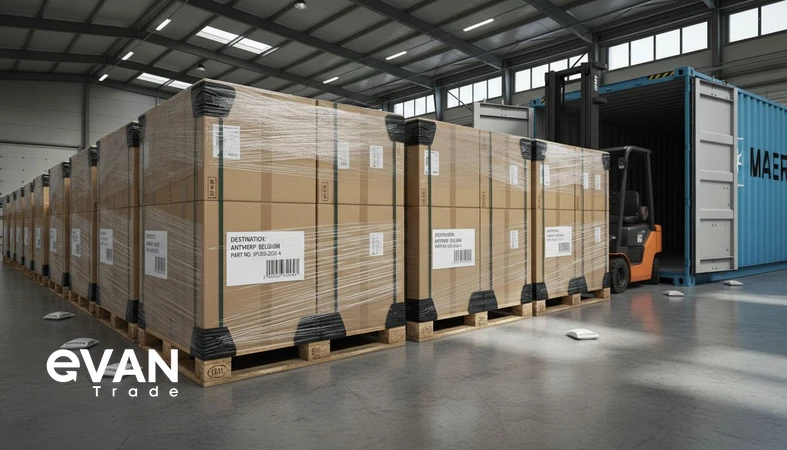
- Load stability: a pallet that can survive real handling and vibration without shifting or collapsing.
- Moisture/temperature risk control: materials and protection that anticipate humidity swings, condensation, and heat exposure.
- Labeling discipline: consistent, scannable marks on cartons and pallets (and correct placement) that match documents.
- Traceability: pallet IDs, lot/batch mapping, and shipment evidence (photos/videos) to prevent “he said, she said.”
- Documentation alignment: what customs and receivers see on the physical unit matches packing list, invoice, and any required marks.
This article breaks down palletizing and carton rules that matter in real shipments, plus container constraints and Incoterms boundaries—so buyers can specify requirements in the PO and reduce operational uncertainty when importing Iranian products.
Palletizing fundamentals: footprint, height, and stability rules that prevent damage
Pallet failures usually start with a mismatch between pallet footprint, carton dimensions, and the destination’s handling reality. Two principles matter most: (1) the pallet must be stable as a unit load, and (2) the unit load must fit the transport mode and warehouse equipment without improvisation.
Common pallet footprints (and why buyers should specify them)
- EUR/EPAL (1200×800 mm): widely accepted in many markets; good for standardized racking and pooling. Often preferred for EU-bound cargo.
- ISO/“UK” style (1200×1000 mm): common in many industrial supply chains; better surface area for some carton sizes.
- Custom/local pallets: can be adequate but frequently trigger receiving problems (fork entry, quality, phytosanitary expectations for wood, or “non-standard pallet” deductions).
If you are sourcing from Iran, do not assume the supplier’s default pallet will be accepted by your DC. Put the exact footprint, stringer/block type, and any material requirement (wood vs plastic) into the PO.
Height, weight distribution, and overhang
- No overhang as a default rule: cartons should not extend beyond pallet edges. Overhang greatly increases edge crush risk and snagging during handling.
- Even weight distribution: avoid “chimney stacks” or heavy items concentrated on corners. The center of gravity should remain low.
- Practical height limit: set a maximum pallet height based on product fragility, carton strength, and container door clearance. High stacks can look fine at origin and fail under vibration.
Stability tools: corner protection, anti-slip, wrap, and strapping
- Corner posts/edge protectors: distribute strap and wrap pressure and reduce carton corner collapse.
- Anti-slip sheets: increase friction between layers; useful for glossy cartons or shrink-wrapped inner packs.
- Stretch wrap vs shrink: stretch wrap is common for pallets; shrink can add rigidity but may trap heat/moisture depending on the product.
- Strapping (when/why): consider strapping for heavy loads, long transit vibration, or when pallet integrity is critical. But strapping can crush cartons without corner protection and correct tension.
- Top caps: protect the top layer and improve stacking behavior if double-stacking is expected (only when safe and permitted).
Where appropriate, a slip-sheet system (instead of pallets) can improve cube utilization, but it requires compatible push-pull equipment at both origin and destination—buyers should only approve it when the receiving operation can handle it.
Carton rules that matter: strength, sealing, and stacking logic
Carton performance in export is not about “thick cardboard” in a generic sense; it is about selecting a box specification that matches stacking loads, humidity, and handling. For many Iran exports, the biggest hidden risk is that cartons are designed for local trucking, not containerized export with long dwell time and re-handling.
ECT vs burst strength (simple decision guidance)
- ECT (Edge Crush Test): indicates how well a corrugated board resists being crushed from the sides—highly relevant for stacking and pallet loads.
- Burst strength (Mullen): indicates resistance to puncture/rupture—useful for rough handling and point impacts.
If your shipment is stack-heavy (warehouse stacking, long container vibration, risk of compression), prioritize adequate ECT and correct box design. If puncture risk is high (strapping contact, sharp edges nearby), burst strength and protective layers matter more. In many B2B scenarios, you want both to be appropriate—not “maximum,” but matched to reality.
Single-wall vs double-wall, inner packs, and dividers
- Single-wall: cost-effective for lighter items and controlled handling.
- Double-wall: better for heavier products, taller pallets, or uncertain handling; often worth it to prevent edge crush and panel bulging.
- Inner packs/dividers: reduce movement, improve presentation, and protect fragile units. They also help maintain carton shape under compression.
Ventilation holes: the trade-off buyers should understand
Vent holes can help airflow for certain products, but they also reduce stacking strength and can become tear points. If ventilation is needed, it should be engineered (hole size/placement) and compensated with stronger board or design. Random cut-outs are a frequent cause of collapse.
Tape specification and sealing pattern
- Use a defined tape type: width and adhesive quality should be specified; weak tape fails under humidity and dust.
- Sealing method: a consistent pattern (often “H-taping”) reduces openings and bulging at the flaps.
- Orientation: labels and handling marks should not be placed on seams that may be taped over or torn.
For a broader view of export packaging decision points (beyond cartons), align requirements with your internal quality standards and industry expectations; practical packaging discipline is often the difference between smooth receiving and costly exceptions.
Container constraints and loading logic: fit, airflow, and load-shift prevention
A container is not a simple “big box.” It has bottlenecks and physics that drive damage risk and utilization. Buyers should request a loading plan or at least a clear pallet count scenario, especially when mixed SKUs are involved.
Door bottlenecks: why some “fitting pallets” still fail
The container door opening is usually the tightest point for height and maneuvering. A pallet that fits inside the container may still be hard to load because of door height, pallet jack angle, or uneven floors. Set a maximum loaded pallet height that includes pallet thickness and any top cap, and confirm it against the planned container type.
Payload vs volume trade-offs
- Heavy products: you may hit payload limits before the container is full. Overpacking (too much board, unnecessary pallets) can reduce payload efficiency.
- Light products: you may cube out first; pallet patterns and carton dimensions become critical for utilization.
Condensation and moisture risk in containerized exports
Long transit and temperature swings can cause condensation (“container rain”). This risk increases with high moisture cargo, wet pallets, or loading during humid conditions. Practical mitigations include using dry pallets and cartons, avoiding direct contact with container walls where possible, and using appropriate moisture-control materials when justified (without assuming they eliminate risk entirely).
Preventing load shift: dunnage, airbags, and blocking/bracing
- Dunnage (void fill): reduces movement in gaps; can be paper, cardboard, or timber depending on rules and risk.
- Airbags: useful for stabilizing loads with voids; must be correctly sized and used for the application.
- Blocking/bracing: helps prevent forward/back movement. It must be done safely and in a way that does not damage product or violate destination requirements.
In procurement, specify acceptable stabilization methods and require photo evidence at key stages of loading. This is especially important when you buy under Incoterms where the seller controls loading.
Practical checklists: carton, pallet, and container-ready acceptance criteria
The fastest way to reduce disputes is to define acceptance criteria that are observable at origin. The goal is not perfection—it is a shared standard that can be inspected, documented, and repeated.
| Area | What to specify (measurable) | Why it matters | Evidence to request |
|---|---|---|---|
| Carton strength | Board grade (ECT and/or burst), single/double-wall, max gross weight per carton | Prevents crushing, bulging, burst during stacking and vibration | Supplier spec sheet; random carton photos; weight records |
| Sealing | Tape width/type, sealing pattern, no open flaps | Reduces openings, contamination, and pilferage allegations | Close-up photos of top/bottom seal on sampled cartons |
| Pallet footprint | Exact size (e.g., 1200×800), entry type (2-way/4-way), condition/quality | Avoids receiving refusals and handling problems | Pallet spec confirmation; photos showing fork entry |
| Overhang | No overhang; maximum allowable offset if any | Reduces edge crush and snagging during loading/unloading | Side-view photos of completed pallets |
| Unit load stability | Wrap type, number of wrap revolutions, corner/edge protection, strapping rules | Prevents leaning, layer slip, and collapse | Short video walkaround; photos of wrap/straps |
| Pallet ID & traceability | Pallet ID label format; lot/batch mapping per pallet | Enables targeted claims and avoids whole-shipment disputes | Pallet label photos; pallet list (ID ↔ SKU ↔ lot) |
| Container loading | Load plan; void fill method; max stack; wall clearance if needed | Improves utilization and reduces load shift | Door-to-door photo sequence; container seal photo |
Common failures vs fixes: a dispute-prevention perspective
Buyers often see the end result (damage, missing labels, unstable pallets) without a clear path to prevention. The table below links common failure modes to practical fixes that can be written into purchase orders and checked during loading.
| Failure mode | What typically causes it | Practical fix (PO-ready) |
|---|---|---|
| Crushed bottom cartons | Low ECT board, excessive pallet height, uneven weight distribution | Set max gross carton weight; specify minimum board grade; cap pallet height and layers |
| Pallet leaning / layer slip | No anti-slip, insufficient wrap, smooth carton coating, poor pattern | Require anti-slip sheets between layers; define wrap standard; use interlocked pattern where feasible |
| Carton corner collapse under straps | Strap tension + weak corners; no edge protectors | Mandate corner/edge protectors; define strapping material and tension limits |
| Customs/receiving label mismatch | Different item names/weights on cartons vs packing list; inconsistent marks | Single source of truth for product description; label template approval; pre-shipment photo set |
| Wet cartons / mold risk | Humid loading, condensation, wet pallets, wall contact | Load only dry packaging; keep clearance from walls where possible; use moisture-control materials when justified |
| Load shift inside container | Void spaces, insufficient bracing, abrupt handling | Require void-fill method; airbags/dunnage plan; loading photos before closing doors |
Incoterms and responsibility boundaries: why packaging must be specified anyway
Incoterms define who pays and who bears risk at certain points, but they do not automatically define your packaging standard. Many disputes happen because buyers assume “export packing included” while suppliers assume “standard domestic packing is fine.” The result is avoidable damage and arguments about responsibility.
How responsibilities shift across common Incoterms
- EXW: buyer carries most logistics responsibility. If you pick up at the supplier, you should still specify pallet/carton requirements because poor packing becomes your operational problem immediately.
- FCA: seller delivers to a named place/carrier. Packaging and unitization must be fit for handover; define what “fit” means.
- FOB: seller loads on vessel (context-dependent). Stable palletization and correct marks matter because disputes often arise after loading.
- CIF/CFR: seller arranges main carriage (and insurance under CIF), but packaging expectations still need to be explicit—insurance does not fix weak cartons.
- DAP/DDP: seller bears more risk and responsibility to destination, yet buyers should still define packaging to avoid receiving issues and downstream handling failures.
Best practice: include a packaging annex in the PO/contract. Use measurable parameters (pallet size, max height/weight, carton grade concept, labeling template, evidence protocol) rather than subjective language like “strong cartons” or “export-quality packing.”
Iran-specific export realities: documentation sensitivity and labeling consistency
Iran exports can be operationally smooth when documentation and physical presentation are aligned. Problems occur when cartons, pallets, and paperwork tell different stories. To keep this factual and practical: customs and intermediaries often focus on consistency—names, counts, net/gross weights, marks, and traceability identifiers.
What buyers should watch for (and specify)
- Label consistency: carton labels, pallet labels, and packing list should use the same product description and SKU logic.
- Count discipline: the number of cartons per pallet and pallets per container must reconcile with the packing list.
- Weight discipline: gross and net weight methods should be consistent; random “rounded” weights invite questions at receiving.
- Traceability: lot/batch and production dates (when applicable) should be readable and not smeared by wrap or tape.
If your organization relies on inspection and release processes, you can reduce ambiguity by requiring a standardized evidence pack at loading: photos of empty container condition, pallet staging, close-ups of labels, and final seal photo. This is also helpful for internal compliance and for resolving claims fairly.
FAQ: palletizing and carton rules for container-ready Iran exports
What does “container-ready setup” mean in a purchase order?
It means the goods are prepared as stable, traceable unit loads that can be loaded into the agreed container type without rework. In a PO, define pallet footprint, maximum pallet height and weight, overhang limits, wrapping/strapping requirements, labeling template, and a loading evidence protocol. Avoid vague wording; use measurable criteria and require pre-shipment photos/videos for verification.
Should I require EPAL/EUR pallets for Iran exports?
Only if your receiving operation or customer requires it, or if pallet pooling/standard racking compatibility is essential. EPAL/EUR can reduce receiving friction, but availability and cost vary. The key is to specify an accepted footprint and minimum pallet quality (fork entry, deck condition, and safe load capacity) rather than relying on whatever is cheapest locally.
How do I choose between single-wall and double-wall cartons?
Start from stacking risk and handling uncertainty. If cartons will be stacked high, exposed to vibration, or if product weight per carton is significant, double-wall often reduces compression failures. If the product is light and handling is controlled, single-wall may be sufficient. Ask for a board grade concept (ECT/burst) and cap carton gross weight to keep performance predictable.
Do ventilation holes help, or do they weaken cartons too much?
They can do both. Vent holes may help with airflow for certain goods, but they reduce panel strength and can become tear initiators. If ventilation is required, specify hole size and placement and compensate with appropriate board strength or design. Random holes cut during packing are a red flag because they are inconsistent and hard to validate against acceptance criteria.
What is the minimum evidence I should request to prevent packaging disputes?
A practical minimum is: (1) photos of empty container interior and floor, (2) photos of completed pallets from all sides, (3) close-ups of carton and pallet labels, (4) a short video walkaround of pallet stability, and (5) photos of the loaded container before closing plus seal photo. Tie pallet IDs to the packing list so claims can be targeted.
Do Incoterms decide who is responsible for palletizing quality?
Incoterms define cost and risk transfer points, but they do not automatically define your packaging standard. Even if the seller is responsible up to a certain point, you still bear the operational impact of poor unitization at receiving. Specify carton and pallet requirements in the PO and make them part of acceptance—regardless of whether you buy EXW, FCA, FOB, or CIF.
Conclusion: turn packaging into a measurable spec, not an assumption
For Iran exports, “container-ready” performance comes from disciplined, measurable choices: cartons designed for stacking and humidity realities, pallets built on a specified footprint with no overhang, stable patterns supported by anti-slip and edge protection, and a container loading approach that respects door bottlenecks, payload limits, and load-shift physics. Just as important, the physical presentation—labels, counts, and traceability—must match documentation to reduce customs questions and receiving friction. When buyers translate these requirements into PO-ready acceptance criteria and request a simple evidence protocol at loading, disputes become easier to prevent and easier to resolve.
For additional transparency-first guidance on Iran trade readiness, documentation discipline, and practical logistics decision-making, you can reference Evan Trade.