
You can share this page with your friends using the options below.

Iran-origin spices are traded in B2B supply chains primarily as whole, cut/flakes, and ground/powder formats, with buyer value determined by lot consistency, food safety controls, and packaging performance, not by marketing claims. For importers, the most practical way to buy is to define a lot-based specification (mesh size, moisture, purity, microbiology, residues scope), require a matching COA, and lock the packaging plan early so the shipment arrives clearance-ready and stable in transit.
On the supply side, buyers typically source either single spices (e.g., cumin, coriander, turmeric, paprika/chili) or program-based assortments where multiple SKUs ship under one logistics plan. Ground products often require tighter controls for adulteration, foreign matter, and microbial risk, while whole spices tend to travel better but still need defined cleaning, sorting, and packaging.
Indicative export-ready ranges (final depends on SKU and packaging): MOQ often starts from carton-level or 0.5–1 MT for bulk powders, while high-value items (e.g., saffron) can be handled in smaller lots. Lead times commonly range from 2–4 weeks for bulk items with standard packaging and routine tests, and longer when retail/private label or expanded lab scope is required.
If you want an importer-ready offer, send EvanTrade your destination market, Incoterm, target formats (whole/ground), and the COA scope you need. We will structure a comparable quote, confirm packaging configuration, and propose a lot-based sample plan.
In practice, the differentiator for “Iranian spices” in import trade is not a single universal attribute; it is the combination of product mix, format flexibility, and regional sourcing corridors that can support a multi-SKU program when the supplier manages quality and documentation properly. Many buyers come to Iran-origin sourcing because they need both commodity-volume items and specialty regional SKUs in a single supply channel, but this only works when each lot is specified, tested, and packed to the destination’s requirements.
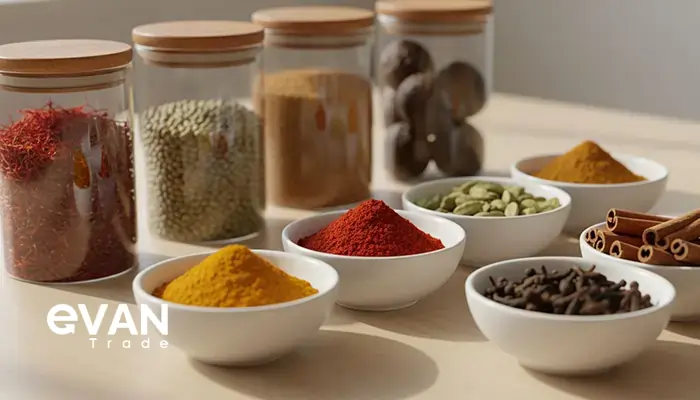
Iran-export programs commonly include both culinary staples (cumin, coriander, turmeric, paprika/chili, ginger, cinnamon, cardamom) and regionally popular ingredients (sumac, dried lime/limoo amani, black cumin/Nigella sativa) that serve ethnic retail, foodservice, and industrial blending. That breadth is useful for importers, because you can optimize freight, consolidate documentation, and standardize your QC playbook across multiple SKUs.
The compliance-first approach is simple: do not assume certifications or origin claims. If you need a specific certificate, standard, or claim, treat it as a capability that is available upon request if applicable, and verify it with documents tied to the shipment’s lot numbers. This keeps procurement aligned with what can be audited and cleared, not what sounds appealing.
A buyer-ready specification should translate your needs into measurable limits that can be tested on each lot. For spices, the most practical levers are form (whole/ground/cut), mesh size (for powders), moisture, purity/foreign matter, microbiology, and the right residues scope for your market. If you buy for private label or for industrial blending, you should also define how you will control adulteration risk (identity tests, microscopy where relevant, and supplier traceability).
| Spec element | What to define (examples) | Why it matters for importers |
| Product identity | Botanical name where relevant; declared ingredients for blends | Prevents substitution and supports labeling compliance |
| Form / cut | Whole, cracked, flakes, granules, ground | Drives stability, microbial risk, and buyer application |
| Mesh size (powders) | Target mesh + tolerance; method | Controls performance in blending and consistent dosing |
| Moisture | Target max %; method | Reduces caking, mold risk, and shelf-life variability |
| Purity / foreign matter | Max limits for extraneous material | Supports food safety and avoids claims disputes |
| Microbiology | Target limits; method; sampling plan | Key for ground spices and retail packs |
| Residues scope | Market-based pesticide list; method | Critical for EU/UK/US/GCC clearance planning |
| Heavy metals (if required) | Limits + method | May be required by buyer category or market |
| Packaging spec | Bag type, liner, net weight, carton config | Prevents transit damage and supports accurate landed cost |
| COA / lot coding | Lot-based COA aligned with spec | Enables acceptance decisions and traceability |
Use this table as your RFQ backbone: for each SKU, fill in only what you truly need, then require the supplier to confirm they can test and document it per lot. Over-specifying can inflate cost and lead time, while under-specifying increases rejection risk or customs delays.
Below are commonly traded SKUs and formats buyers typically request. Each item includes 1–2 buyer notes focusing on forms, grade drivers, risk controls, and packaging considerations. Any certification or special claim is available upon request if applicable.
Buyer Checklist (Pre-RFQ)
For importer planning, it is safest to think in terms of general sourcing corridors rather than making narrow geographic claims. Spices and spice-adjacent products may be supplied through multiple regions and trading hubs, and the exporter’s ability to aggregate, clean, process, and document lots often matters more than a specific farm location, unless your program explicitly requires origin traceability at that level.
Seasonality in spice sourcing is typically driven by harvest windows and post-harvest drying/processing cycles. In practical terms, buyers should expect that fresh-crop availability can improve consistency for certain items, while off-season supply may rely on stored inventory that needs stricter moisture and storage controls. If you run year-round retail or industrial supply, focus on suppliers who can maintain lot continuity and stable storage conditions, and who can present traceability records for each shipment.
The buying implication is straightforward: align your procurement calendar to your risk tolerance. If your market has strict residues enforcement or your product is sensitive to aroma and color drift, plan purchases with enough lead time to test candidate lots and lock packaging before peak logistics periods.
A compliance-first spice program is built on three pillars: controlled processing, verifiable lab testing, and traceability that links every carton to a lot and every lot to a COA. Processing should include cleaning (sieving, destoning where relevant), sorting, and metal detection as appropriate for the product and format. For ground products, the risk profile increases because grinding amplifies contamination exposure and makes foreign matter harder to detect visually.
QC checkpoints commonly include: incoming raw inspection, pre-processing cleaning verification, in-process checks (particle size, moisture trend), packaging integrity checks, and final lot release based on COA. Your RFQ should state which checkpoints you expect and which documents you want to receive (lot sheet, COA, packing list with lot mapping).
Lab tests should be chosen based on your destination and the SKU. For many programs, the base set includes moisture, microbiology, foreign matter/purity, and residues (market-specific scope). Heavy metals and additional authenticity/identity tests may be buyer-required depending on category and risk profile; if so, request them explicitly as “available upon request if applicable.”
A practical buyer acceptance logic is to tie approval to a decision rule: samples must match your spec and the COA must reflect the same lot(s) that will ship. If you approve a sample from Lot A, your contract should state that shipment must be Lot A (or clearly defined equivalent lots) with documented traceability and identical packaging configuration.
Spices require packaging that protects against moisture uptake, aroma loss, and contamination during handling. Bulk packaging typically uses multiwall paper bags, PP woven bags, or kraft bags with food-grade inner liners; the exact configuration should match product sensitivity and transit route. Retail and private label packaging shifts the priority to barrier properties, seal integrity, and label compliance, often requiring laminated pouches, jars, tins, or sachets with tamper-evident features.
Packaging decisions should be made early because they affect MOQ, lead time, testing logistics, and even COA sampling (e.g., if the product is packed into retail units before release). If you want private label, treat packaging as part of the compliance scope, not a last-minute add-on.
| Program type | Common formats | Materials | Typical net weights | Carton notes |
| Bulk (industrial/wholesale) | Bags, inner liners | Kraft/PP with food-grade liner | 10–25 kg (varies) | Define palletization, stretch wrap, lot coding |
| Bulk premium / aroma-sensitive | Double-liner bags | Higher barrier liners | 10–20 kg | Reduces aroma loss and moisture pickup |
| Retail (standard) | Pouches/jars | Laminates / PET / glass | 50 g–1 kg | Requires label artwork + barcode plan |
| Private label | Custom packs | As specified | As specified | Confirm carton counts, case marking, QA seal checks |
| Portion packs | Sachets | Laminates | Single-serve | Higher packaging lead time, strict weight control |
Use this table to force clarity in quotes: ask suppliers to state the exact bag/pouch structure, liner type, and carton configuration, then compare offers on “like-for-like” packaging. This also prevents hidden changes (e.g., swapping liner grade) that can affect shelf stability and customs presentation.
Spices are shelf-stable when moisture, oxygen exposure, and contamination are controlled, but real-world shelf life depends on volatile oil retention, color stability, and microbial control, especially for powders. Your storage plan should keep product in a cool, dry environment, away from direct sunlight and strong odors, with good pallet hygiene and pest controls.
Whole spices generally hold quality longer than ground equivalents because less surface area is exposed to oxygen and humidity. Powders and blends require stricter packaging and storage discipline to avoid caking, aroma loss, and quality drift. For buyer programs, the key is not to rely on a generic shelf-life statement; instead, define storage conditions and require manufacturing/packing dates and lot coding.
| Driver | Risk if unmanaged | Buyer control lever |
| Moisture uptake | Caking, mold risk, off-odor | Moisture spec + barrier packaging + dry storage |
| Oxygen/light exposure | Aroma loss, color fade | Opaque/high-barrier packs; carton storage |
| Microbial load (powders) | Compliance risk | Micro spec + validated cleaning + COA scope |
| Odor transfer | Cross-contamination | Sealed inner packs; segregated storage |
Use this table when selecting formats: if your route has long transit times or high humidity, favor packaging upgrades for powders and aroma-sensitive items, and tighten moisture and integrity checks.
Market access depends on aligning your product specification, COA scope, and labeling to the destination’s expectations. In the EU/UK context, importers often focus on residues compliance, traceability, and labeling accuracy; in the US, buyers commonly emphasize preventive controls, supplier verification, and consistent documentation; in GCC and parts of Asia, requirements can vary by channel, but importers still benefit from lot-based COA and clear labeling in the required language(s). If your program needs specific certifications or attestations, treat them as available upon request if applicable and verify them for the shipping lots.
This checklist is your “label gate”: approve artwork only after your compliance team confirms mandatory statements for the destination and after you confirm how the lot code will be printed and mapped to COA and cartons.
Spices ship well by sea when protected from humidity and temperature swings, but powders and aroma-sensitive items can degrade if packaging is weak or if containers experience condensation. Air freight is typically used for urgent replenishment, smaller high-value lots, or when you need to minimize transit exposure, but it increases landed cost and requires tight packaging for pressure and handling changes.
Incoterms should be chosen based on who controls risk at each step. If you want maximum control over freight and arrival handling, you may prefer terms where you manage the main carriage; if you want simpler landed planning, negotiate a term where the seller arranges more of the movement but still provides complete documentation. In all cases, define arrival-condition controls: require moisture protection measures, specify palletization, and set expectations for carton condition and lot legibility on arrival.
Your best protection is procedural: lock packaging specs, require photo evidence of packing and marking where feasible, and keep documentation aligned so customs does not question product identity or labeling.
A clearance-ready shipment is a documentation project as much as a logistics project. Importers reduce delays by ensuring documents are consistent in SKU names, weights, pack counts, and lot references, and by keeping the COA tied to the exact lots shipped.
Export-side core documents
Buyer/market-driven documents (as required)
Use this checklist as a “document reconciliation” step: before shipment dispatch, cross-check invoice, packing list, and COA so every lot code appears consistently and every SKU’s pack configuration matches the contract.
Demand for spices is typically stable year-round, but it spikes around retail and foodservice peaks such as religious holidays, national festival seasons, and promotional periods. Ethnic retail and diaspora markets often drive steady pull for SKUs like sumac, dried lime, and black cumin, while industrial demand is anchored in blending programs where mesh consistency and COA stability matter more than brand storytelling.
Top markets vary by buyer channel and SKU mix, but importers generally find consistent demand across the EU/UK, North America, GCC, and parts of Asia for staple spices and for specialty regional ingredients. Seasonality also affects logistics: peak shipping periods can tighten container availability and increase lead times, so buyers should plan earlier for private label or multi-SKU consolidations.
Price drivers (without quoting numbers) typically include crop availability, cleaning/processing intensity, lab scope (especially residues panels), packaging complexity, and freight conditions. For procurement, the most controllable drivers are your spec discipline and your packaging plan, clarity reduces surprises.
A strong RFQ prevents misunderstandings by forcing offers to be comparable and by aligning the COA and packaging plan from day one. Your RFQ should be SKU-by-SKU, but governed by one consistent acceptance logic: lot-based specs, COA scope, packaging configuration, and a documented sample approval rule.
Decision rule (recommended): “A shipment is accepted only if the shipped lot numbers match the approved sample lots and the final lot-based COA meets the RFQ limits, with packaging and labeling exactly as approved.”
This decision rule keeps procurement, QC, and logistics aligned: you avoid last-minute substitutions, and you reduce the risk of customs holds due to mismatched documents or unclear labeling.
Whole spices generally travel better and reduce adulteration risk, while ground spices offer convenience but require tighter mesh, micro, and foreign matter controls.
Mesh size standardizes powder particle size, impacting blending behavior and dosing consistency; it should be specified with tolerance and method.
Microbiology, moisture, purity/foreign matter, and a destination-appropriate residues scope are common priorities; add tests only when your program requires them.
Prefer whole formats where feasible, require identity controls for powders (method-defined), and enforce lot-based traceability from sample to shipment.
Usually yes if the supplier can meet packaging, labeling, and documentation requirements; treat it as “available upon request if applicable” and validate capability per SKU.
Use moisture-barrier inner liners and sealed cartons; for powders, upgrade barrier properties and control moisture tightly to prevent caking.
Lot substitution, different grind/mesh, changed packaging materials, or moisture exposure during storage/packing; prevent this with lot-locked approvals.
Buying spices from Iran becomes predictable when the process is built around measurable specifications, not assumptions. Once you define the commercial format (whole/ground), mesh targets, moisture limits, and the required COA scope per lot, you can compare offers fairly, control food-safety risks (residues, microbes, foreign matter), and keep traceability intact from samples to shipment.
The same discipline applies to packaging and logistics: barrier materials, carton configuration, and clear lot coding protect quality in transit and prevent disputes at destination. When labeling and documentation are aligned before dispatch, customs clearance becomes a procedure not a surprise, because invoice, packing list, COO, and COA all point to the same lots and the same declared product identity.
As a professional exporter of Iranian agri-food products, EvanTrade supports importers by turning these controls into a repeatable program: lot-based sourcing, auditable QC, packaging that matches route risk, and clearance-ready documentation. If you want consistent quality across multiple SKUs, treat every purchase as a documented workflow, and let EvanTrade structure the quote, samples, and shipment plan accordingly.