

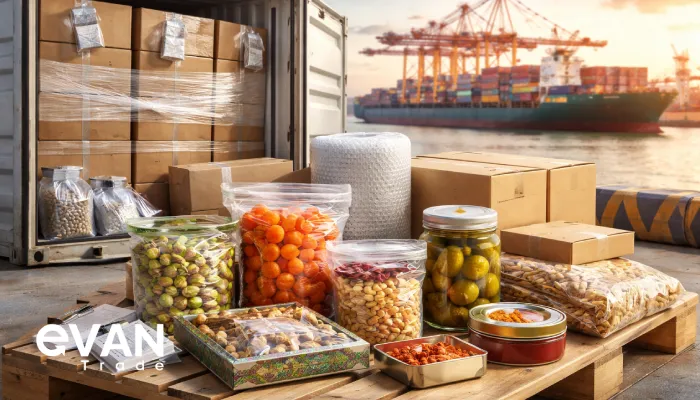
Why packaging—not the product—often decides whether a shipment “arrives sellable”
Sea freight is brutally honest. It doesn’t care how premium your pistachios are, how aromatic your saffron is, or how carefully you produced your pickles. It cares about time, humidity, temperature swings, compression, vibration, and handling. For many food exporters, the first painful lesson is that product quality can be destroyed quietly—not by spoilage in a dramatic way, but by stale flavor, soft texture, oil oxidation, broken seals, label failure, carton collapse, mold spots, and “container smell” absorption.
This is why export packaging should be treated as a market-access and shelf-life system, not just a box. If your goal is repeat orders and fewer claims, you need packaging that is engineered for three realities:
- Sea freight risk profile (long transit + container environment)
- Storage and distribution reality at destination (warehouse + retail handling)
- Protection needs of the product (oxygen, moisture, light, crushing, migration, taint)
Done right, export packaging reduces risk, stabilizes shelf life, and makes quality predictable—especially when combined with a clear spec sheet and a disciplined QC routine (see anchor text: export quality control checklist).
Sea freight realities that packaging must survive
1) “Container climate” is not controlled—even when weather feels mild
Even in standard dry containers, temperatures can swing widely between day and night, and humidity can condense into water droplets (“container sweat”). This is one of the most common causes of:
- mold growth on cartons or product surfaces
- softening of crispy foods (moisture gain)
- label peeling / ink bleeding
- carton compression failure after moisture weakens corrugate
2) Salt air, odors, and volatile compounds can taint foods
Some foods absorb odors easily—think nuts, dried fruits, spices, and confectionery. Packaging must create a taint barrier, and container loading must avoid incompatible goods. (Anchor text: sea freight container loading best practices)
3) Handling shocks are predictable—and preventable
Port handling, inland trucking, warehouse pallets, and retail distribution introduce repeated shock and vibration. Protection comes from:
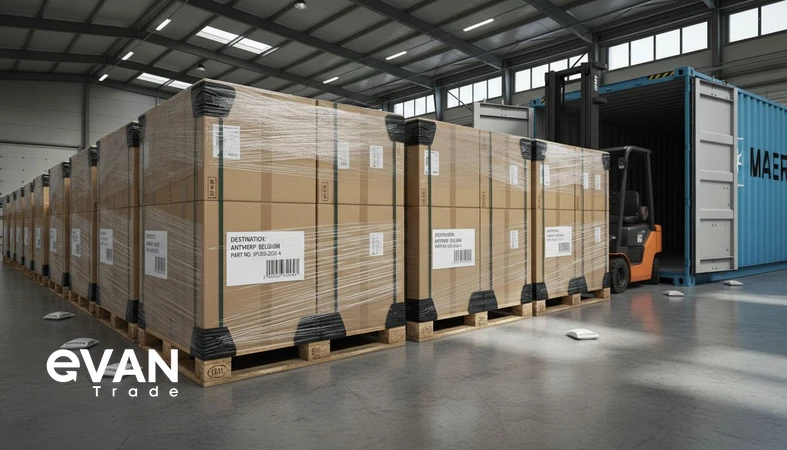
- correct unitization (pallet pattern + stretch wrapping)
- correct case strength and headspace control
- correct primary pack selection (film, pouch, jar, can)
Packaging goals for Iranian foods (what “good” looks like)
A packaging system for export should do four things consistently:
1) Preserve sensory quality (flavor, aroma, crunch, color)
- control oxygen exposure to slow oxidation (rancidity in nuts, color loss in spices)
- control moisture to prevent sogginess or caking
- block light when pigments and oils are sensitive
2) Maintain safety and stability (microbial and chemical)
- prevent moisture-driven microbial activity
- avoid migration risks with compliant food-contact materials
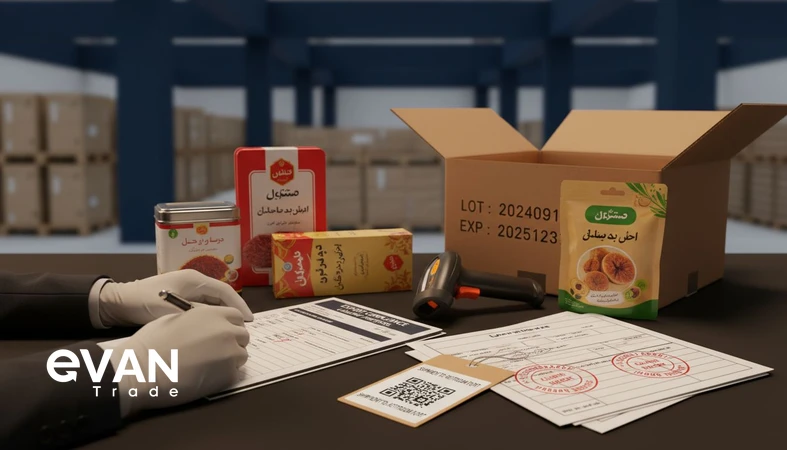
- enable traceability with clear coding (Anchor text: traceability and lot coding for food exports)
3) Survive logistics with minimal damage
- resist compression and vibration
- protect from puncture and edge crushing
- maintain seals and closures
4) Communicate quality at destination
- labels that remain readable and durable
- packaging that “sells” reliability without making claims
- consistent appearance across batches
Product-by-product packaging strategy for common Iranian exports
Nuts (pistachios, almonds, mixed nuts)
Core risks: oxidation (rancidity), moisture gain/loss, odor absorption, insect risk, crushing
Better approach for sea freight:
- High-barrier laminated pouches (low OTR + low WVTR) with robust heat seals
- optional nitrogen flush where appropriate for premium segments
- secondary packaging with strong corrugate + internal dividers if needed
Operational note: Don’t guess shelf life—validate with storage trials and basic packaging performance data (OTR/WVTR, seal checks). (Anchor text: shelf-life validation for export foods)
Dried fruits (dates, raisins, dried apricots, figs)
Core risks: moisture migration (sticky surfaces), fermentation off-notes, mold, crushing
Better approach:
- barrier pouches or lidded trays + overwrap with moisture control
- carton and pallet design that prevents compression damage
- for dates: manage oiling/stickiness via film selection and temperature handling
Saffron, spices, and herbal products
Core risks: aroma loss, oxidation, light sensitivity, taint absorption
Better approach:
- light-blocking primary packaging (opaque containers or foil-laminate sachets)
- strong seal integrity; avoid materials that pass odor easily
- minimize headspace to reduce aroma loss
- include clear tamper evidence where required by buyers
Confectionery (gaz, sohan, cookies, chocolate-based items)
Core risks: fat bloom (chocolate), deformation, moisture pickup, breakage
Better approach:
- avoid “pretty but fragile” packs for sea freight; prioritize structure
- internal trays, corner protection, and anti-crush case design
- for heat-sensitive items: consider seasonal routing or reefer solutions depending on destination climate and transit time (Anchor text: cold chain shipping basics for food)
Pickles, sauces, syrups (glass jars / bottles)
Core risks: breakage, cap loosening, leakage, label failure
Better approach:
- torque-controlled closures + tamper-evident bands
- dividers/partitions, edge protection, and strong corrugate
- moisture-resistant labels + adhesives suitable for humidity
- consider shrink sleeves or protected label zones
Canned foods (tomato paste, canned beans, tuna)
Core risks: can corrosion, denting, pallet instability, label scuffing
Better approach:
- ensure external coatings and storage dryness; protect from condensation
- trays/shrink wrap for stability; corner posts for pallet stacking
- avoid metal-on-metal abrasion during handling
The export packaging stack: primary, secondary, tertiary
Primary packaging (touches the food)
This is where barrier performance lives. For sea freight, primary packaging should be selected based on:
- oxygen barrier (OTR) needs
- moisture barrier (WVTR) needs
- seal integrity under vibration and temperature swings
- resistance to taint/odor transfer
Rule of thumb: if aroma matters, barrier matters—especially for spices, nuts, and confectionery.
Secondary packaging (cases/cartons)
Your case must survive humidity and stacking loads. Focus on:
- proper corrugate grade and edge crush strength
- moisture resistance (coatings or better materials)
- internal fit that prevents movement and abrasion
Tertiary packaging (pallet + stretch wrap)
This is where many claims are prevented:
- use a stable pallet pattern (interlock where possible)
- correct stretch-wrap tension; add top sheets if needed
- corner boards for stacked loads
- avoid overhang (it causes edge crush and tears)
Sea freight protection: the five most common failure modes (and how to prevent them)
1) Moisture and “container sweat”
Prevent with:
- moisture-tolerant cases
- desiccants or container liners when appropriate
- avoiding warm loading into cold environments (condensation risk)
- proper ventilation strategy for specific products
2) Oxygen-driven quality loss (rancidity, color fade)
Prevent with:
- high barrier films/pouches
- reduced headspace
- optional inert gas flush for sensitive categories
- supplier control for film consistency
3) Compression and carton collapse
Prevent with:
- correct case strength + stacking limits
- strong pallet design
- avoid double-stacking beyond tested stability
- humidity-resistant corrugate solutions for long voyages
4) Leakage (especially jars, syrups, sauces)
Prevent with:
- closure torque specs + sampling checks
- liners compatible with product
- internal dividers + shock protection
- drop-test and vibration simulation for final pack
5) Taint and odor absorption
Prevent with:
- barrier packaging that resists volatile compounds
- container loading rules (segregate odorous goods)
- avoiding contaminated pallets, inks, or adhesives
- basic “pack odor” QC before shipping
Storage and warehouse: packaging must match the destination reality
Exporters often optimize for production, then lose control at destination. Your packaging spec should assume:
- longer-than-expected warehouse dwell time
- re-palletizing and mixed loads
- exposure to forklifts and handling damage
- potential non-ideal humidity conditions
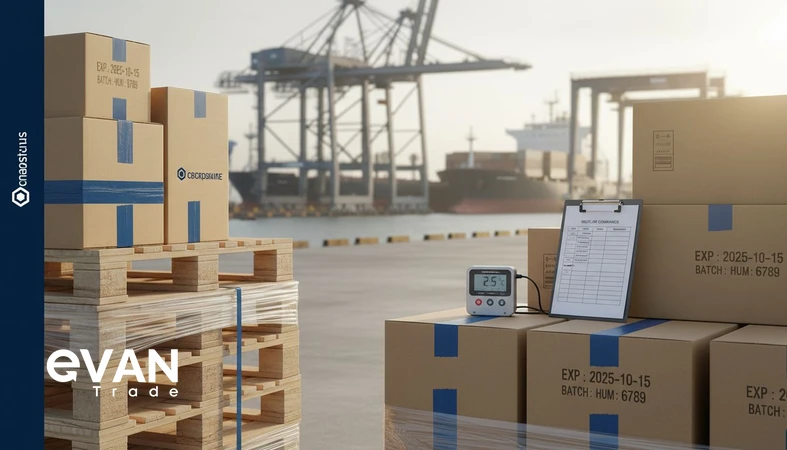
Practical move: define acceptable storage conditions in the product spec sheet (temperature and RH ranges) and align packaging accordingly—especially for hygroscopic foods like dried fruits and nuts. (Anchor text: export product specification sheet template)
Testing and verification: how to make packaging “defensible”
You don’t need a research lab to reduce failures; you need a repeatable verification routine.
Recommended checks (practical and scalable)
- Seal integrity checks for pouches (visual + burst/leak tests where available)
- Drop tests for shipper cases (handling realism)
- Compression checks for stacking stability
- Torque checks for jar closures
- Label adhesion spot checks after humidity exposure
If you want a recognized framework, many exporters use standard transit simulation concepts (often aligned with ISTA-style thinking) to validate packaging under realistic handling.
Cost control without weakening protection
Packaging cost is real—but claims, rework, and lost shelf life cost more.
Smart cost levers that don’t reduce safety
- optimize case dimensions to reduce void space
- standardize a small number of packaging SKUs across product lines
- reduce damage by improving pallet design (often cheaper than upgrading films)
- invest in spec discipline: fewer “surprises” = fewer expedited fixes
Table: Packaging options for Iranian foods in sea freight
| Product Type | Key Sea-Freight Risks | Recommended Primary Pack | Secondary Pack | Extra Protection |
| Pistachios & nuts | Oxidation, moisture gain, odor absorption | High-barrier laminated pouch; optional nitrogen flush | Strong corrugate case | Desiccant/liner if high humidity; stable pallet wrap |
| Dates & dried fruits | Stickiness, moisture migration, mold | Barrier pouch or tray + overwrap | Reinforced case | Moisture control; avoid excessive stacking |
| Saffron & spices | Aroma loss, light damage, taint | Opaque container or foil-laminate sachet | Compact cases | Light protection; headspace control |
| Confectionery (gaz/sohan/cookies) | Breakage, deformation, moisture | Structured trays + protective wrap | Anti-crush case | Corner protection; vibration-resistant pack |
| Glass jars (pickles/syrups) | Breakage, cap loosening, leakage | Glass + torque-controlled closures | Divided cases | Drop/vibration validation; humidity-resistant labels |
| Canned foods | Dents, corrosion, scuffing | Can with protective coating | Trays + shrink / strong cases | Dry storage; top sheets; edge/corner boards |
FAQs
1) Do we always need high-barrier packaging for sea freight?
Not always. Use high-barrier packaging when oxygen or moisture changes affect quality (nuts, spices, many dried foods). For stable canned goods, structural protection may matter more than barrier performance.
2) What’s the biggest packaging mistake in sea freight exports?
Treating the shipment like domestic distribution: light cases, weak palletizing, and “pretty” packs that can’t handle vibration, compression, and humidity.
3) Are desiccants necessary in every container?
No. They are most useful when the product or packaging is sensitive to condensation and humidity, or when routes and seasons increase “container sweat” risk. The decision should be route- and product-specific.
4) How do we prevent jars from leaking or caps loosening?
Control closure torque, use compatible liners, add dividers and shock protection, and validate with drop/vibration checks. Leakage is usually a system failure, not one component.
5) What matters more: carton strength or pallet wrapping?
Both matters, but poor pallet design can destroy strong cartons. A stable pallet pattern, correct wrap tension, and corner protection often reduce damage dramatically.
6) How should we set shelf life for export markets?
Shelf life should reflect product stability + packaging barrier + logistics time. For sea freight, include buffer for delays and destination storage. Validate with real storage trials, not assumptions.
7) Can we keep packaging “premium” without making it fragile?
Yes—premium can be achieved through consistent design and quality cues, while structural protection is handled through trays, cases, and pallet engineering.
Conclusion: packaging is a risk-management system, not a box
Export packaging for Iranian foods succeeds when it is engineered for the real world: sea freight humidity and temperature swings, handling shocks, long storage cycles, and protection needs specific to each product. The most reliable exporters build a packaging system that is:
- barrier-appropriate (oxygen/moisture/light/taint)
- structurally resilient (case + pallet + handling reality)
- testable and repeatable (basic validation and QC)
- documented (clear specs, coding, and traceability discipline)
When packaging is treated this way, quality becomes predictable—and predictable quality is what buyers remember, reorder, and trust.
Evan Trade supports Iranian food exporters by focusing on the operational side of market readiness—helping align packaging specifications with sea-freight realities, storage conditions, and protection requirements, so shipments arrive with consistent quality and fewer avoidable claims.