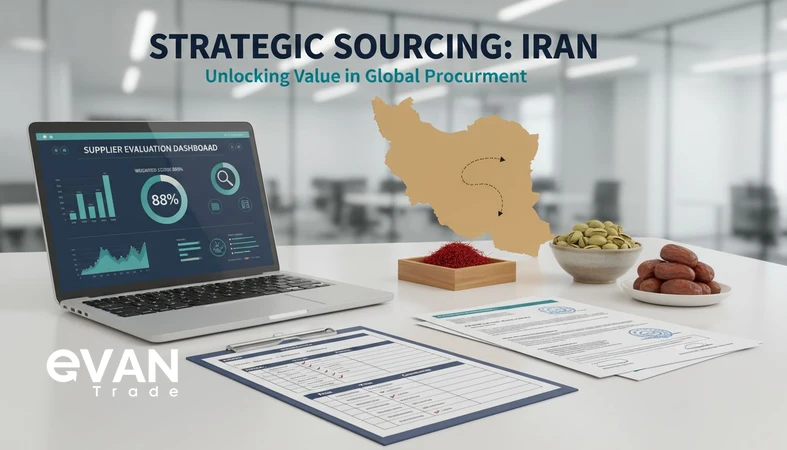

Importing from Iran can be commercially attractive—strong agricultural capacity, competitive pricing in several food categories, and deep expertise in certain value chains. But the upside comes with a reality every importer has to manage: supplier risk is rarely visible on the surface. A polished catalog, confident sales calls, or even a neat set of certificates can hide gaps in traceability, inconsistent production control, or documentation that won’t survive scrutiny at customs.
The goal of due diligence is not to “catch” suppliers. It’s to reduce uncertainty so you can make a decision that holds up operationally: product quality remains stable over time, shipments clear smoothly, and the commercial relationship stays predictable even when something changes (raw material variation, seasonal constraints, logistics disruptions, or documentation requests from your market).
This guide gives you a practical, risk-based checklist to vet Iranian suppliers—especially for food and FMCG categories—so your first order is not your first surprise.
Why Iranian supplier vetting feels different for importers
Supplier qualification always matters, but Iran adds a few friction points that can amplify risk if you don’t plan for them:
- Documentation complexity: translations, naming variations, and inconsistent formatting across documents can make verification harder than it looks.
- Banking and payment constraints: even when trade is permitted, payment routes can be limited depending on jurisdiction and counterparties.
- Compliance sensitivity: screening and “who you’re really buying from” matters—ownership and counterparties can affect whether you can legally trade in your market.
- Operational variability: some suppliers operate with excellent systems; others rely heavily on manual controls and inconsistent subcontracting.
A strong due diligence process turns these variables into a clear go/no-go decision.
Build a risk-based approach before you ask for documents
Before requesting anything, define the risk level of the product and route. This prevents “document overload” and keeps supplier cooperation high.
Key risk factors to score (simple 1–5 scale)
- Product risk: allergen presence, microbiological risk, shelf stability, contamination history.
- Market risk: strict labeling rules, mandatory certifications, border sampling frequency.
- Supply chain risk: number of intermediaries, subcontracted production, seasonal raw materials.
- Compliance risk: high sensitivity jurisdictions, payment complexity, ownership opacity.
- Brand risk: are you private labeling? is your brand reputation tightly tied to consistency?
Once you score risk, match it to effort: low-risk products may only require documentary checks + third-party inspection; high-risk products require deeper validation, testing, and tighter contracts.
(If you maintain a knowledge base for procurement teams, it helps to keep a reusable risk scoring template—a format many importers store inside an internal “Quality in Practice” playbook.)
Step 1: Identity and legitimacy checks (the “is this a real supplier?” layer)
This stage is non-negotiable. It’s fast, low-cost, and it filters out the most preventable problems.
What to request
- Company legal name (English + Persian), registration number, tax ID
- Official address, phone, website domain, and corporate email
- Authorized signatory details (name, role, signature specimen)
- Bank account details (to be verified later, not accepted at face value)
What to verify
- Consistency across documents: legal name and address must match on certificates, invoices, contracts, and packaging approvals.
- Physical footprint: verify the facility exists (map data + photos + third-party confirmation).
- Business model clarity: manufacturer vs trader vs broker. Ask directly: “Are you the producer? If not, who produces and who holds the export responsibility?”
Practical tip: Ask for one “master file” early—an organized supplier dossier. The quality of their response often predicts future execution quality.
Step 2: Ownership, counterparties, and compliance screening (keep it general, but do it)
For many importers, the highest-impact failure is not quality—it’s trading with a restricted or high-risk counterparty by mistake. This section is not legal advice, but it reflects standard importer practice.
What to request
- Beneficial ownership statement (who ultimately owns/controls the company)
- List of related companies involved in production/export
- Names of logistics partners (forwarder) and banks used for settlement (if relevant)
What to do
- Run sanctions/restricted-party screening on the supplier, owners, and key counterparties using your compliance provider.
- Confirm the planned trade lane is permissible for your jurisdiction and product category.
- Document your checks (date, tool/provider, results).
Step 3: Quality system verification (certificates are evidence—not proof)
Many suppliers will provide ISO certificates quickly. Treat them as signals, not conclusions.
Minimum set to ask for (food categories)
- HACCP plan overview and last internal audit summary
- ISO 22000 / FSSC 22000 certificates (if applicable)
- Allergen management policy (where relevant)
- Traceability procedure (one-step-forward, one-step-back)
- Last 12 months of nonconformance/corrective actions summary (even anonymized)
What to look for
- Scope and site: certificates must cover the specific site and product scope you are buying.
- Issuing body credibility: verify the certification body’s legitimacy and accreditation.
- Process discipline: ask how they control critical points (not just that they “have HACCP”).
A strong question: “Show me one real example of a corrective action you implemented in the last 6 months and how you verified effectiveness.”
Step 4: Product-level evidence (specs, COA logic, and realistic tolerances)
This is where deals often break later—when the importer expects “perfect uniformity” and the supplier works with agricultural variability. Your job is to convert expectations into measurable specifications.
What to request
- Product specification sheet (phys-chem + sensory where relevant)
- Shelf-life and storage conditions
- Standard packaging specs and palletization details
- Example COAs from multiple batches (not just one “best” sample)
- Country-of-origin statements if needed by your market
What to verify
- COA plausibility: do results vary realistically from batch to batch?
- Methods and labs: who tested? which methods? are they aligned with your market expectations?
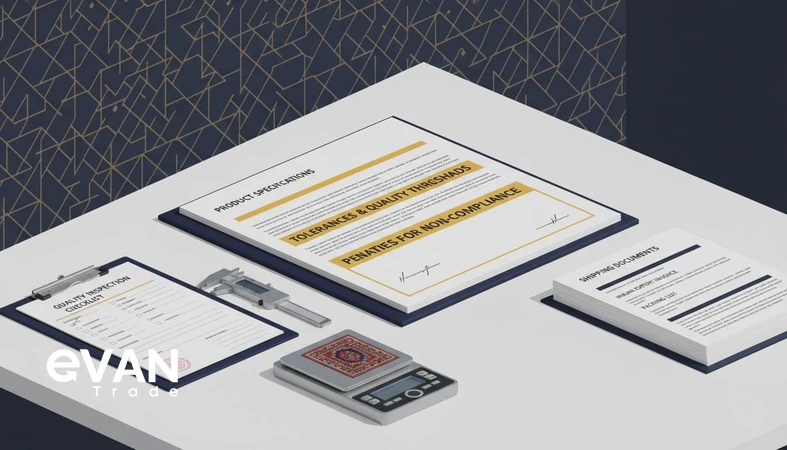
- Tolerance bands: define acceptable ranges (not just single-point targets).
Step 5: Traceability and fraud resilience (especially for high-value categories)
If you import higher-value foods (e.g., saffron, pistachio, dried fruits, specialty concentrates), traceability and fraud controls deserve extra rigor.
Ask for
- Batch coding system explanation (how to read it)
- Raw material sourcing region(s) and seasonality constraints
- Adulteration prevention measures (where applicable)
- Retention sample policy (how long they keep “golden samples”)
Verify via a simple exercise
Ask the supplier to do a mock traceability drill:
- pick one batch number from a past shipment (or their internal log)
- show upstream raw material record + processing date + QC checks + packaging record
If they can’t do this cleanly, traceability risk is high regardless of certificates.
Step 6: Packaging, labeling, and documentation readiness (clearance risk reducer)
Even excellent product quality can be stalled at customs by labeling or document mismatch.
What to validate early
- Label artwork workflow (who approves final text?)
- Mandatory label fields for your market (ingredients, allergens, nutrition, origin, importer details)
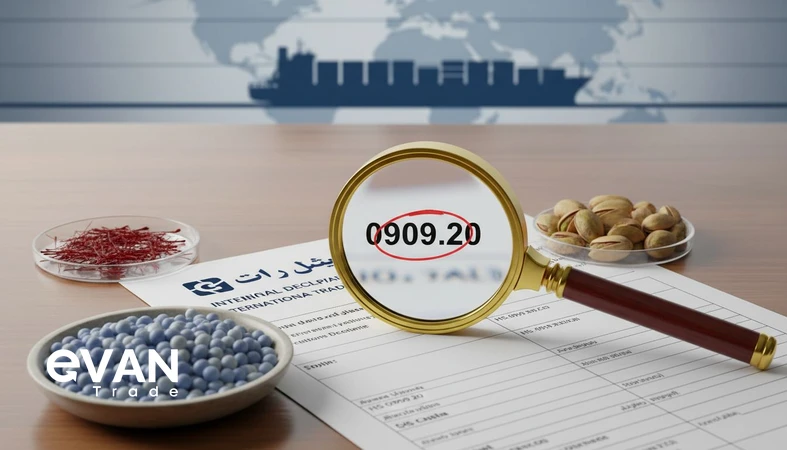
- Export documentation set: invoice, packing list, COO, health certificate (as applicable), phytosanitary documents (where applicable)
Common failure patterns
- Product name differs across invoice vs label vs COO
- HS code assumptions without confirmation
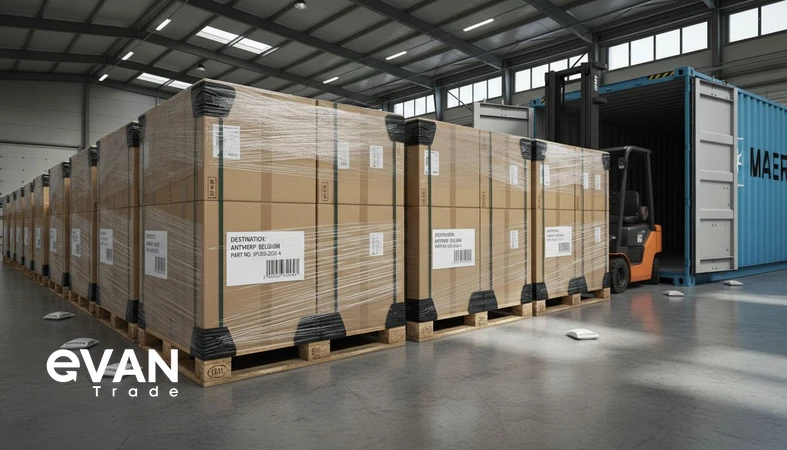
- Incomplete pallet or carton markings
Step 7: Operational capability (capacity, lead times, and change control)
A supplier may be legitimate and certified, but still fail under volume pressure.
Questions that reveal reality
- What is your monthly capacity for this exact SKU and packaging format?
- What are your peak-season constraints?
- Which steps are outsourced (packing, labeling, transport, cold storage)?
- What triggers a spec change—and how do you notify buyers?
Evidence to request
- Production plan snapshot (even simplified)
- List of critical equipment and maintenance approach
- Change control policy (for ingredients, packaging, process)
If they cannot explain how they manage change, you should expect surprises.
Step 8: Commercial and payment risk controls (make predictability the target)
Avoid treating payment terms as a negotiation-only topic. Treat them as a risk-control mechanism.
What to define
- Incoterms and responsibility boundaries
- Inspection point and acceptance criteria
- Claims process: timelines, evidence, resolution method
- Currency, payment route, and documentation required by banks (if applicable)
Keep it practical: Align quality acceptance to measurable conditions (COA ranges, sampling plan, packaging integrity) and define what happens when results fall in the “gray zone.”
Due diligence checklist table (printable / team-ready)
| Stage | What you request | What you verify | Go/No-Go signals |
| Pre-screen | Company dossier, product list, export markets | Basic legitimacy, responsiveness | Evasive answers, inconsistent company identity |
| Documentary due diligence | Registration details, ownership statement, certificates | Scope/site match, credibility of issuers | Certificates don’t cover site/product; name mismatch |
| Quality system review | HACCP overview, traceability SOP, CAPA summary | Process maturity, corrective action discipline | “We have certificate” but no real system evidence |
| Product validation | Specs, multiple-batch COAs, shelf-life data | Variability realism, lab/method credibility | COAs look identical or implausible; no method clarity |
| Packaging & labeling | Packaging specs, label workflow, doc set | Clearance readiness, field completeness | Inconsistent names/weights/HS assumptions |
| Operational capability | Capacity, lead times, outsourcing map | Ability to deliver consistently | Subcontracting undisclosed; vague capacity answers |
| Pilot shipment | Pre-shipment inspection plan, sampling plan | Spec adherence in real conditions | Refuses inspection; weak traceability drill |
| Ongoing monitoring | KPI cadence, complaint handling, change control | Stability over time | No monitoring structure; reactive culture only |
How to run a low-risk pilot order (the most underestimated step)
A pilot is not “order small and hope.” It’s a controlled test of the full system.
Design your pilot to test
- Batch consistency: two batches if feasible
- Packaging integrity: real route stress (temperature, handling)
- Documentation accuracy: every paper must match
- Responsiveness: how fast do they resolve minor issues?
Add one safeguard
Use a third-party inspection (pre-shipment) for the first order, with a clear checklist: packaging, labeling, carton marking, quantity count, and random sampling.
Red flags importers should not rationalize away
- “We can’t share ownership details” (without a reasonable alternative)
- Certificates with unclear scope or unverifiable issuers
- Sudden price drops when you ask hard questions
- Resistance to sampling/testing or third-party inspection
- Invoices/COAs that repeatedly change format and identifiers
- Unwillingness to commit to tolerance ranges and claim handling
If you see multiple red flags, the lowest-cost decision is usually to pause.
FAQ
1) Are ISO/HACCP certificates enough to trust a supplier?
No. Certificates help, but they don’t prove day-to-day process control. Ask for batch-to-batch COAs, corrective action examples, traceability drills, and (for first orders) third-party inspection.
2) What’s the fastest way to detect a trader posing as a manufacturer?
Ask for facility evidence tied to the product (production line photos/videos with date markers), certificate scope showing the production site, and a clear answer to: “Who controls production and who is the exporter of record?”
3) How many COAs should I review before placing an order?
At least 3–5 COAs from different batches for the same product/spec. One COA can be curated; multiple batches reveal normal variability.
4) Should I always do third-party inspection for the first shipment?
For most importers, yes—especially for new suppliers, private label, or higher-risk categories. It’s a small cost compared with clearance delays or quality claims.
5) How do I reduce customs and labeling surprises?
Validate document consistency early (name, net/gross weight, batch codes, HS code assumptions) and run a labeling pre-check against your market’s mandatory fields before printing.
6) What if my compliance team flags “Iran risk” broadly—does that mean I can’t import?
Not necessarily. Rules vary by jurisdiction, product, counterparties, and payment route. Treat compliance as a structured review: screen counterparties, confirm permissibility, document checks, and consult qualified counsel when needed.
7) How long should supplier due diligence take?
A focused process can be done in 1–3 weeks for lower-risk categories and 3–6 weeks for higher-risk products (especially if you add testing and an audit/inspection). Time usually depends on document quality and responsiveness.
Conclusion: make supplier vetting a system, not a one-time event
Vetting Iranian suppliers isn’t about suspicion—it’s about discipline. When you replace assumptions with evidence, you lower the two costs that hurt importers most: inconsistent quality and operational surprises. A good due diligence checklist converts complexity into steps your team can repeat, improve, and audit over time.
If you want a more structured path, Evan Trade shares importer-oriented resources and practical “Quality in Practice” checklists shaped by hands-on export execution—covering documentation readiness, supplier qualification, and quality controls that reduce friction from first inquiry to repeat shipment—without turning procurement into guesswork.