

Canada Market for Iranian Foods
Canada becomes a straightforward import market when the importer locks classification, product specification, bilingual label scope, and lot-tied compliance evidence before booking freight. It becomes difficult when any “data mismatch” appears across HS codes, invoice weights, packing lists, COAs, pallet labels, or label versions, because those mismatches slow broker processing and can escalate admissibility questions at the border.
For Iranian agri-food, clearance friction in Canada typically concentrates in four areas: (1) CFIA-regulated commodity routing and submission readiness where applicable (IID/Single Window), (2) importer accountability under the Safe Food for Canadians Regulations (SFCR) preventive-controls mindset, (3) bilingual labeling and Nutrition Facts Table workflow for retail packs, and (4) traceability/lot discipline across documents and physical markings. CFIA’s Integrated Import Declaration (IID) is designed as the single portal used by commercial importers/brokers to submit required import information for CFIA-regulated commodities, category-dependent.
EvanTrade structures Canada-ready offers so your quote, label plan, COA scope, and shipping file are aligned from day one: HS locked, specs locked, packing configuration locked, lot definition locked, and label version control enforced.
What Sells in Canada (demand map + buyer use cases by channel)
Canada’s demand for Iran-origin agri-food tends to be strongest where the product can be standardized, traced, and presented with repeatable quality evidence. The best performers are typically “spec-stable” categories (nuts, dried fruits, saffron threads, whole/cut spices) where buyers can set measurable tolerances and keep documentation consistent shipment-to-shipment.
Retail (consumer packs): Buyers prioritize bilingual labels (English/French), Nutrition Facts Table readiness, allergen controls, and consistent pack weights. Best-fit use cases include private label pistachios, dates, raisins, and selected spices, when label governance and pack configuration are stable across lots.
HoReCa (restaurants, catering, foodservice): Buyers value reliable availability, bulk formats, and practical quality specs (size/count, moisture range, color, defect tolerances). Iran-origin dates, raisins/dried fruits, pistachio kernels, and spices/herbs are common fits where case-level traceability is clean.
Industrial (ingredient users): Ingredient buyers focus on analytical evidence, contaminant risk control (category-dependent), and lot-to-lot consistency. Pistachio kernels and raisins/dried fruits can fit well with a defined COA scope; powders and blends require tighter authenticity and contamination controls.
Ethnic (specialty distribution): Demand can be strong for traditional varieties and culturally specific use cases. These channels still benefit from compliance discipline because a single label or COA issue can disrupt repeat orders across multiple retailers.
Seasonality & Demand Triggers in Canada (operational calendar)
Demand in Canada is often driven by retail reset cycles, holiday-driven buying, and foodservice planning windows. Instead of chasing “spot” shipments, Canadian buyers typically prefer forward planning that aligns production lead times, label approvals, and import submissions where applicable.
Common operational triggers include:
- Retail promotion windows: buyers seek stable SKU configuration (net weight, bilingual label layout, case pack) far ahead of promotions to avoid relabeling or artwork changes close to ship date.
- Holiday and gifting season: premium nuts and saffron often see planning and tendering earlier than the selling season, with higher scrutiny on packaging presentation and claims evidence.
- Ramadan/Eid demand: dates and some dried fruits can see uplift in relevant communities; planning improves availability and reduces last-minute substitution risk.
- Industrial production runs: ingredient buyers schedule around manufacturing slots; late COA or lot ambiguity can cause line delays.
Operational takeaway: align label version freeze, COA scope, lot definition, and packing configuration early, then book freight only after the shipment file is internally consistent.
Best-Fit Iran-Origin Products for Canada
Best-fit Iran-origin products for Canada (quote-to-clearance aligned)
Product category | Best-fit Iranian varieties/grades/forms | Demand channels | Winning pack formats + typical net weights (ranges only) | Key compliance/QC risks + Canada controls (category-dependent) | Where buyers get stuck + EvanTrade prevention |
pistachio in-shell | Export grade, calibrated sizing, roasted/salted or raw (as specified) | Retail, HoReCa, Ethnic | Retail pouches/jars; bulk cartons; mixed pallet programs (weight ranges) | Aflatoxin risk management; moisture/defect tolerances; allergen cross-contact controls; lot-tied COA where required | Weight/grade mismatch vs invoice; inconsistent size spec; missing lot IDs → lock size spec + tolerances, define lot code format, reconcile net/gross by case |
pistachio kernels | Whole kernels, pieces (declared), roasting state as specified | Industrial, HoReCa, Retail | Vacuum/liner cartons; retail packs; consistent case pack (ranges) | Aflatoxin and residues (category-dependent); foreign matter control; kernel breakage spec | COA not tied to shipped lot; pallet labels don’t match docs → lot map + pallet map + COA-to-lot mapping |
saffron threads | Threads (not powder), defined cut/grade, moisture/spec scope | Retail, Industrial, Ethnic | Small retail tins/jars; foodservice packs; sealed inner units (ranges) | Adulteration/authenticity risk; origin/spec evidence; label claim evidence | “Premium” claims without evidence; inconsistent grade terms → define commercial grade language + test scope + claim constraints |
dates | Named varieties (as agreed), pitted/whole, texture class, size/count range | Retail, HoReCa, Ethnic | Retail trays/pouches; bulk cartons with liners (ranges) | Moisture/texture variation; sugar bloom perception; insect/foreign matter controls; shelf-life/handling controls | Retail label vs actual pack mismatch; inconsistent case counts → lock pack configuration + artwork sign-off + case/pallet map |
raisins/dried fruits | Raisins and selected dried fruits with defined moisture and sorting grade | Retail, Industrial, HoReCa, Ethnic | Retail pouches; bulk cartons; controlled liner specs (ranges) | Residues risk (category-dependent); moisture and clumping; foreign matter | Missing sorting/QC evidence; inconsistent defect tolerances → QC gate checklist + agreed defect/micro scope where applicable |
spices/herbs (whole/cut) | Whole seeds, cut herbs, crushed forms with defined mesh/cut spec | Retail, HoReCa, Industrial, Ethnic | Retail shakers/pouches; foodservice packs; bulk cartons (ranges) | Foreign matter; microbial load (category-dependent); allergen cross-contact; claim governance | “Clean label” claims unsupported; inconsistent cut size → spec table + COA scope + cleaning and screening evidence |
spice powders (higher risk) | Single-ingredient powders; blends only with full formulation disclosure | Industrial, Retail (careful), HoReCa | Sealed inner liners; controlled batch sizes; minimal SKU variation (ranges) | Higher authenticity/fraud risk; contaminant and microbial controls; formulation traceability | Lack of batch-level traceability; changing formulations → batch/lot discipline + change control + enhanced testing plan |
Market Access & Import Rules
Canada’s entry process is typically a coordinated interface between CFIA (food import controls and admissibility decisions), Health Canada (compositional/health requirements where applicable), and CBSA (border release, enforcement, and customs accounting). When a commodity is CFIA-regulated, import information and documents may need to be submitted through the Integrated Import Declaration (IID) via the CBSA Single Window pathway, depending on the product and regulatory route.
Importer-of-record (buyer-controlled) accountability in Canada is anchored in SFCR’s preventive-controls mindset and traceability expectations. SFCR includes preventive controls and traceability provisions and is supported by CFIA guidance and tools used by industry to understand obligations.
Jurisdiction split (Not applicable, but operationally relevant): Canada is federal-first for import admissibility and core labeling rules, while provincial overlays can affect language and certain market practices (especially for distribution and retail execution). Treat provincial overlays as a commercial requirement to confirm during channel onboarding, not as an afterthought.
HS Classification & Tariff Readiness
Canadian import success starts with HS discipline. Lock HS classification before you finalize a quotation, because HS codes drive customs treatment, broker routing, and downstream data consistency across the commercial invoice, packing list, and any import submission records.
Use the Canadian Customs Tariff (CBSA) as the primary reference point for classification structure, and the Canada Tariff Finder as a practical lookup aid where applicable (without relying on it as a legal determination). EvanTrade supports buyers by preparing an HS evidence pack: product description aligned to commercial reality, processing method summary, ingredient/form declaration for spices/blends, and packaging description that matches how the item is sold.
Food Safety & Compliance Expectations
Canada import compliance is strongest when the buyer treats each shipment as an auditable file: defined lot structure, defined COA scope, defined pass/fail rules, and defined corrective actions when results fall outside spec. SFCR’s framework includes traceability and preventive control plan concepts, and CFIA guidance emphasizes understanding how requirements apply to different businesses and activities.
“Requirements are shipment- and category-specific; confirm the applicable route with your customs broker and competent authority guidance in Canada.”
Define “lot” (non-negotiable)
A lot is the traceability unit that must reconcile across:
- COA identifiers (sampled lot/batch)
- Commercial invoice line mapping
- Packing list carton counts and net/gross weights
- Pallet labels (pallet ID → carton range → lot)
- Any IID or customs submission data fields (where applicable)
If the COA is not lot-tied to what physically ships, it is not defensible when questions arise.
Buyer Checklist— Pre-Quote Lock Checklist (Canada)
- HS code locked (with rationale notes)
- Product spec locked (grade/form, tolerances, defect limits)
- Packing configuration locked (case pack, net/gross ranges, palletization approach)
- Label scope locked (retail vs foodservice vs bulk; bilingual plan if retail)
- COA scope locked (category-dependent: authenticity/contaminants/micro as agreed)
- Incoterm locked + delivery point clarity
- Timeline locked (production, lab lead time, label approvals, booking window)
- Sanctions/trade-restriction screening completed for parties and payment route (operational gate; confirm compliance with your advisors)
Buyer Checklist— Pre-Shipment Release Gate (Canada)
- COA received and matches shipped lot IDs; pass/fail rule applied
- Label version sign-off complete (English/French where applicable)
- Packing reconciliation done (carton count, net/gross totals, pallet map)
- Document match confirmed (HS, description, weights, lot IDs, dates consistent)
- IID/DCG readiness confirmed with broker/importer setup (as applicable)
Minimum QC gates checklist (Canada)
- Incoming raw material screening evidence (supplier-controlled, reported to buyer)
- In-process sorting/cleaning controls (foreign matter plan)
- Finished-pack verification (net weight range checks, seal integrity, coding/lot marking)
- Retained samples and lot file retention (buyer-defined retention policy)
- Corrective action triggers defined (what happens if COA fails or label mismatch is found)
Labeling & Claims
For consumer retail in Canada, bilingual labeling is a core expectation: mandatory information on consumer prepackaged food generally must appear in both official languages (English and French), with defined exceptions that should be confirmed category-by-category.
Health and compositional requirements may apply depending on the product and claims. Treat claims as “evidence-required”: any claim that implies health, origin, purity, or superiority should be supported by documentation and should be reviewed against competent authority guidance and buyer legal review where needed.
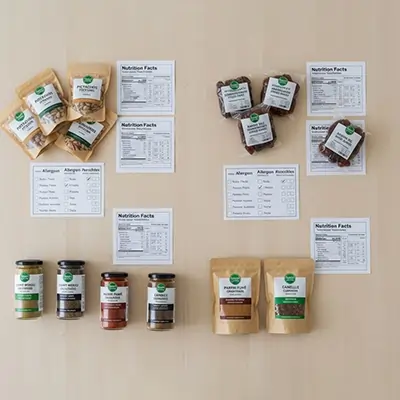
Nutrition Facts Table (NFT) expectations (workflow-first)
Do not treat NFT as a design task. Treat it as a regulated output that must be traceable to inputs:
- final formulation / ingredient declaration (especially for blends)
- serving basis and pack size logic
- analytical evidence or validated calculation approach (as applicable)
- versioning and approval record
CFIA provides industry tools/checklists for core labeling requirements; use them as part of your artwork QA, then maintain a version-controlled approval record.
7-step artwork approval workflow (Canada-ready)
- Confirm selling unit (retail vs foodservice vs bulk) and mandatory label scope
- Lock product identity language (common name) and ingredient/allergen declaration inputs
- Build bilingual copy (English/French) and define exceptions only with documented rationale
- Generate NFT based on evidence (not guesswork) and record the method used
- Run CFIA core label checklist review + buyer compliance review
- Freeze label version (v1.0) linked to SKU + pack configuration + lot coding plan
- Pre-shipment verification: printed label matches approved version; photo evidence captured
Packaging Standards for Canada
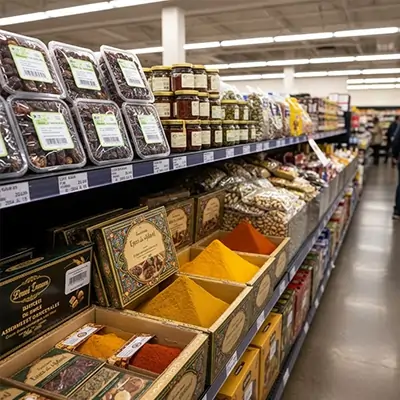
Packaging should be designed to protect product integrity across long transit lanes and varied climate conditions, while supporting traceability (lot coding) and retail readiness (bilingual label execution). Canada buyers often reject “one-off” packaging because it causes warehouse handling issues, relabeling cost, and label nonconformance risk.
Packaging standards (practical expectations)
Use case | Typical packaging goal | Key controls |
Retail (consumer packs) | Shelf-ready appearance + compliant bilingual label | Label version control, NFT evidence, barcode/SKU governance, tamper integrity |
Bulk (ingredient/foodservice) | Minimize damage + preserve quality | Inner liner specs, moisture barriers (category-dependent), pallet stability, clear lot coding |
Private label | Repeatability across reorder cycles | Change control for pack/label/spec; master artwork file governance; sample-to-production match |
Logistics & Delivery Planning to Canada (air vs sea; humidity/temp risk; Incoterms guidance; claims evidence pack)
Air can reduce time-in-transit and exposure but increases cost and can compress time available for COA completion and label approvals. Sea can be efficient for bulk programs but increases humidity/temperature exposure risk and raises the importance of moisture barriers, liner specs, desiccant strategy (where appropriate), and robust palletization.
For nuts, dried fruits, and spices, the biggest operational risks are often moisture pickup, odor contamination, and packaging failure under load. Build a claims-evidence pack that makes disputes resolvable:
- container stuffing photos (including pallet condition and lot labels)
- seal number recording and seal photo
- pallet map and carton range mapping to lot IDs
- damage notes and handling notes at origin
- temperature/humidity notes where available (operational, not a guarantee)
Incoterms guidance: use Incoterms to clarify who controls export clearance, main carriage, insurance, and risk transfer. Align Incoterms with evidence responsibilities (who captures stuffing photos, who holds the original docs, who manages claims with the carrier).
Documentation & Customs Checklist
Canada documentation & process checklist
Requirement/document | When needed | Who issues | What process it supports | Typical lead-time risk + mitigation |
Importer business identifier / importer account setup (Canada concept) | Before first import and broker onboarding | Buyer/importer (with broker support) | Enables customs and regulatory filings, payment/accountability setup | Setup delays → start onboarding early; confirm broker delegation requirements |
Customs declaration/accounting in CBSA CARM (DCG/broker filing, as applicable) | Each shipment (process-dependent) | Broker or importer | Accounting, duties/taxes handling, post-release adjustments | Registration/delegation issues → confirm CARM access and authority delegation early |
HS evidence (classification rationale, rulings if available) | Pre-quote and pre-shipment | Buyer/broker with supplier inputs | Prevents reclassification disputes and data mismatch | Late HS disputes → lock HS before PI; keep rationale notes and product specs aligned |
Commercial invoice | Each shipment | Supplier/exporter | Customs value/description/terms record | Description/weights mismatch → template invoice fields; reconcile totals to packing list |
Packing list | Each shipment | Supplier/exporter | Carton/pallet counts, net/gross reconciliation | Carton count errors → pallet map + double-count sign-off |
COA (category-dependent; lot-tied) | Before booking / before release gate | Lab/supplier (as agreed) | Quality evidence; buyer onboarding; risk control | Lab lead time → plan testing window; define lot sampling method and COA identifiers |
Health/official certificates (if required; category-dependent) | When product route requires it | Competent authority / authorized issuer | Admissibility evidence | Late issuance → confirm requirement early; avoid assumptions |
Pre-notification / regulated submission in IID (category-dependent) | When commodity and route require it | Broker/importer | CFIA-regulated import submission through single portal | Submission readiness → confirm IID applicability and data fields early |
Phytosanitary (if required; category-dependent) | Certain plant products/routes | Authorized issuer | Plant health admissibility evidence | Missed trigger → confirm with CFIA guidance/broker early |
Label artwork approval record (English/French where applicable) | Retail SKUs and private label | Buyer (approval) + supplier (execution) | Defensible label governance | Version drift → label version freeze + pre-ship photo proof |
Lot list / packing configuration (carton count, net/gross, pallet map) | Each shipment | Supplier, validated by buyer | Traceability and reconciliation | Lot ambiguity → standardized lot code; pallet labels must match documents |
Non-negotiable document quality rules
- One master product description per SKU, reused consistently across PI, invoice, packing list, and import submissions.
- HS, weights, and unit measures must reconcile (no “rounding drift” that changes totals meaningfully).
- Lot IDs must appear on COA and must be traceable to pallet/carton mapping.
- Label version and pack configuration must match what ships; changes require written change control.
Pricing, Payments & Contract Terms (dispute prevention; staged payments; change control)
Canada-facing pricing should be built around quote-to-clearance discipline, not just product cost. The main dispute drivers are spec drift, pack drift, and documentation drift. Prevent disputes by defining what is included in the quote: COA scope, packaging materials, labeling scope (bilingual where applicable), inspection points, and document set.
Use staged payments that align to risk reduction milestones (example logic, not legal advice): initial deposit to start production, second stage after label approval and COA plan is confirmed, final stage after pre-shipment release gate passes and shipping file is complete. Add a change-control clause: if the buyer changes pack size, label text, formulation, or COA scope after approval, timeline and cost are re-baselined and a new label version is issued.
RFQ Template + Sample Workflow for Canada
A Canada RFQ should be clearance-ready, not marketing-driven. It should allow your broker and QA team to validate feasibility before you commit.
RFQ template (Canada-ready fields)
- Product category + form (in-shell/kernels; threads; whole/cut; powder/blend)
- Intended channel (Retail / HoReCa / Industrial / Ethnic)
- Target spec + tolerances (grade, size/count, moisture range concept, defect definitions)
- Packaging plan (retail or bulk; case pack; palletization preference)
- Label scope (bilingual retail? private label? claim restrictions?)
- COA scope request (category-dependent; authenticity/contaminants/micro as needed)
- Lot definition request (how lots will be assigned and printed)
- Destination (city/port/airport) + Incoterm preference
- Timeline (target ship window; lead time constraints)
- Compliance gates (what must be approved before booking freight)
Sample workflow (Canada)
Samples should be lot-tied and pack-representative whenever possible. If retail packs are planned, sample labels must reflect the intended bilingual layout and claims constraints, even if marked as “draft.” Approval should be recorded as a versioned decision (sample lot + label version + spec version), so production cannot silently drift.
Common Failure Points
- HS uncertainty after pricing → lock HS before PI; document rationale.
- COA not tied to shipped lot → enforce lot IDs on COA and pallet map.
- Invoice/packing weight mismatch → reconcile totals; sign-off before dispatch.
- Label version drift (bilingual retail) → version freeze + pre-ship photo proof.
- NFT treated as design, not evidence → build NFT from documented inputs; record method.
- Powders/blends sold without authenticity controls → higher-risk testing plan + formulation traceability.
- Missing foreign matter controls for spices/herbs → cleaning/sieving plan + inspection gates.
- Lot IDs absent on cartons/pallets → mandatory lot coding + pallet labels aligned to docs.
- Late IID readiness discovery → confirm IID applicability and data fields early with broker.
- CARM/broker delegation not ready → confirm importer setup and broker authority before first shipment.
- Unscreened payment route / restricted party risk → sanctions/trade-restriction screening as a booking gate.
- Spec language too vague (“premium”, “best”) → replace with measurable specs and tolerances.
FAQs
1.Do Iranian agri-food shipments always require CFIA IID submissions?
Answer: No, IID applicability is category- and route-dependent; confirm with your broker and CFIA guidance for the specific commodity.
2.Is bilingual (English/French) labeling mandatory for retail food in Canada?
Answer: For consumer prepackaged foods, mandatory information generally must appear in both official languages; confirm any category-specific exceptions before printing.
3.Who is responsible for SFCR compliance, the supplier or the Canadian importer?
Answer: Operationally, the importer controls Canada-facing compliance outcomes (market access, submissions, label acceptance), while the supplier must deliver consistent specs, traceability, and compliance evidence aligned to the importer’s file.
4.What is the most common cause of border delays for dried fruits and nuts?
Answer: Document and label data mismatches, HS codes, weights, lot IDs, and COA identifiers not reconciling across invoice, packing list, pallet labels, and certificates.
5.What is the fastest way to reduce rework on first shipments?
Answer: Use a Pre-Quote Lock Checklist (HS + specs + pack + COA scope + label version) and a Pre-Shipment Release Gate so nothing ships until the entire file is internally consistent.
Understand global markets, choose the right Iranian agri-food products, and learn step-by-step how to source reliably from Iran.
Canada-Ready Quote & Samples (EvanTrade)
If you import Iranian agri-food into Canada, the fastest path to a smooth first shipment is to eliminate “file inconsistency” before anything is booked: lock the HS classification, freeze the commercial specification, confirm packaging and case configuration, define a lot system that ties COA to carton/pallet labeling, and control label versions (especially for retail bilingual requirements). Most border delays and post-arrival rework are triggered not by the product itself, but by mismatches across invoice lines, packing totals, lot IDs, COA identifiers, and label artwork references. EvanTrade structures Canada-bound offers so your broker and warehouse receive a single, auditable pack where documents, labels, and test evidence reconcile cleanly.
Request a Canada-Ready Quote: Send your target products, channel (Retail/HoReCa/Industrial/Ethnic), destination gateway, Incoterm preference, packaging plan, bilingual label scope (if retail), and your required COA scope with pass/fail rules. EvanTrade will build the offer around locked HS + locked specs + locked packing configuration + lot-based COA scope + label version control, so clearance and buyer onboarding are aligned from the first file.
Request Samples: Ask EvanTrade for sealed, lot-tied samples delivered with the proposed spec sheet, draft bilingual label layout (if retail), and the intended COA scope, so your approval is matched to what will actually ship, not a one-off sample that cannot be replicated in production.
- Related content
- Article category