


Most cross-border quality disputes do not start with bad faith. They start with ambiguity. A buyer expects a certain “grade,” “look,” or “performance,” while a supplier believes they delivered what was agreed. When the product is sourced internationally—especially from complex supply markets where multiple farms, workshops, or processors feed one shipment—small variations are normal. The problem is that contracts often describe quality in words that sound clear but cannot be measured consistently: “export grade,” “premium,” “clean,” “good color,” “no defects,” or “as per sample.”
For English-speaking B2B buyers sourcing Iranian products, quality ambiguity can become expensive quickly: rework, disposal, customer claims, delayed cash cycles, or a relationship that collapses after a single shipment. The most practical way to reduce this risk is to make quality measurable and fair by writing tolerances into the contract—so both parties know what variation is acceptable, how it will be checked, and what happens if results fall outside agreed limits.
This article explains how to define “tolerance” in commercial quality terms, translate subjective disputes into pass/fail acceptance criteria, set fit-for-purpose sampling and testing, and build a dispute workflow that keeps decisions evidence-based rather than emotional. The goal is not to eliminate variation; it is to manage it transparently.
What “tolerance” means in commercial quality (not just manufacturing)
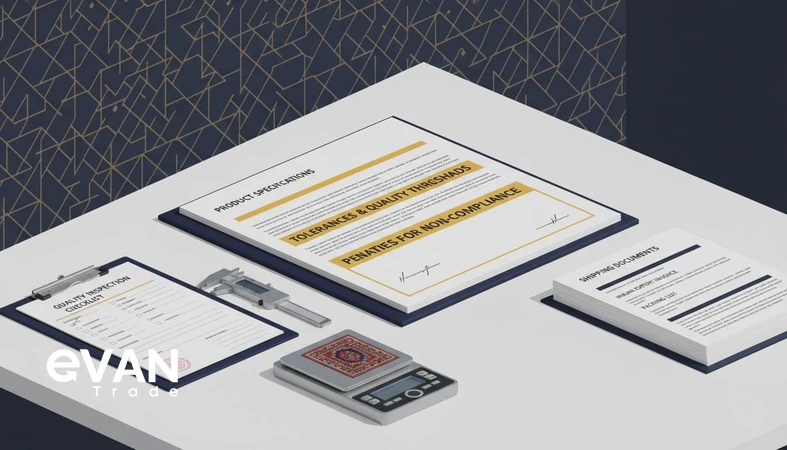
In contract quality language, a tolerance is the agreed allowable range around a target requirement. It turns “should be” into “must be within X to Y.” In commercial practice, tolerances apply to far more than dimensions. They cover chemical composition, moisture, defect rate, net weight, packaging integrity, labeling, and even documentary completeness.
A workable tolerance framework usually includes four parts:
- Target: the intended value (e.g., moisture 8.0%).
- Allowable range: the acceptable variation (e.g., moisture 7.0%–9.0%).
- Defect classification: what is critical vs major vs minor (e.g., foreign matter is critical; slight color variation is minor).
- Acceptance rule: how pass/fail is decided (e.g., “accept the lot if composite test result is within range and critical defects = 0”).
This is where disputes become measurable. If the contract defines tolerances, the discussion shifts from “your product looks worse than last time” to “the shipment measured 10.2% moisture against an agreed maximum of 9.0% using the specified method.”
Tolerances also make contracts fairer. Buyers avoid paying for non-conforming goods, while suppliers avoid being rejected for normal, predictable variation that was never explicitly excluded. If you already use quality documentation internally, tolerances help ensure the same discipline exists between the parties.
Turn subjective disputes into measurable acceptance criteria
To convert subjective quality language into objective contract terms, focus on three elements: measurable parameters, test methods/standards, and clear pass/fail wording. This approach works across many Iranian export categories (food ingredients, minerals, industrial inputs, textiles, and more).
1) Choose measurable parameters that match the buyer’s actual risk
Start from the buyer’s downstream failure modes. Ask: “What makes this product unusable, non-compliant, or commercially unfit?” Parameters should reflect that reality, not generic certificates.
- Functional performance: viscosity, particle size distribution, tensile strength, soluble solids, melting point.
- Safety/compliance: heavy metals, microbiological limits, prohibited dyes, allergens where relevant.
- Commercial usability: moisture (for shelf stability), net content, breakage rate, appearance thresholds.
- Logistics sensitivity: packaging seal integrity, palletization, humidity protection (linked to sea vs air freight risks).
2) Specify test methods and which standard prevails
A parameter without a method invites disagreement. Contracts should define the method (or reference a recognized standard where applicable) and clarify precedence when multiple methods exist. For example: “Moisture shall be tested by Method X; if results conflict, the referee method is Method Y.”
Avoid over-claiming. Instead of stating “ISO-certified” broadly, specify what you actually need: “Testing aligned to internationally recognized methods where applicable” and name the method or lab accreditation expectations in a reasonable way.
3) Write acceptance rules in pass/fail language
Good acceptance clauses remove negotiation after the fact. Use language like:
- “The lot is accepted if…”
- “The lot is rejected if any critical defect is found…”
- “If results fall between X and Y, the parties will…” (e.g., price adjustment, sorting, rework)
These rules should be compatible with your inspection strategy and pre-shipment checks so you do not discover issues only after arrival.
A decision table: common dispute points translated into tolerances
The table below shows how to translate frequent buyer-supplier conflict areas into measurable tolerances, test methods, and acceptance rules. Use it as a template and adapt it to your product category and risk profile.
| Dispute point (typical wording) | Measurable tolerance (example) | Test/inspection method | Acceptance rule (contract language) |
|---|---|---|---|
| “Too much moisture / not stable” | Moisture max 9.0% (or 7.0%–9.0% target range) | Composite sample lab test; method specified; report uncertainty if applicable | Accept if result ≤ 9.0%; if 9.0%–9.5% then price adjustment; reject if > 9.5% |
| “Foreign matter / contamination” | Critical defects: 0 for glass/metal; total foreign matter ≤ 0.10% w/w | Visual sorting on defined sample size; magnet test where relevant | Reject lot if any critical defect found; otherwise accept if total foreign matter within limit |
| “Wrong size / particle distribution” | e.g., 90% between 1–3 mm; fines (<1 mm) max 5% | Sieve analysis with defined mesh set and procedure | Accept if distribution meets limits; if fines 5%–8% then partial credit; reject if fines > 8% |
| “Color not as expected / inconsistent” | Color range defined by reference standard or instrument values (e.g., L*a*b* range) | Colorimeter reading under specified lighting; or approved master sample with retention | Accept if readings within range; if using sample reference, sample must be sealed and identified as “master” |
| “Underweight cartons / short shipment” | Net weight per unit: target 25.0 kg; tolerance −0.2% to +0.5%; count variance max 0 | Calibrated scale checks per sampling plan; count verification | Accept if average and minimum meet tolerance; shortage credited or replaced per contract |
| “Packaging damaged / seals leaking” | Seal integrity: 0 leaks in sample; carton burst strength minimum specified | Drop test / vacuum leak test; visual checks at loading | Reject affected units; if damage rate exceeds X% of sample, hold for joint inspection and corrective action |
Notice the pattern: define the number, define how it is measured, and define what happens at the boundary. This prevents “moving goalposts” after shipment.
Sampling and representativeness: make the lot, sample plan, and evidence defensible
Even perfect tolerances fail if sampling is weak. Sampling is where many disputes become personal: each side tests “their” sample and gets different results. A defensible system makes the sample representative and traceable.
Define the lot (and avoid mixing lots)
A lot should be defined as a specific production run or a defined quantity with consistent traceability (date range, batch numbers, or container). If a shipment combines multiple origins or dates, the contract should require lot segregation and labeling. Otherwise, one bad batch can contaminate the acceptance decision for the whole container.
Use a simple sampling plan (AQL concept at a high level)
You do not need to turn your contract into a statistics textbook. But you should agree on a basic sampling approach consistent with the risk and value of the goods. Many buyers use an AQL-style approach (Acceptable Quality Limit) to determine sample size and acceptable defect counts. At a high level, it means:
- Higher risk (food safety, critical performance) → larger samples, stricter acceptance.
- Lower risk (minor cosmetic issues) → smaller samples, more tolerance for minor defects.
Pair this with documented inspection planning so the supplier knows what will be checked, when, and by whom.
Retain samples, counter-samples, and chain-of-custody
A practical dispute-prevention clause is to create retain samples at the time of inspection/loading:
- One sealed retain sample held by supplier.
- One sealed counter-sample held by buyer (or independent party).
- Optional referee sample held by a third party.
Each sample should be sealed, labeled (lot, date, container, sampler), and documented with photos and signatures. Chain-of-custody matters—especially for parameters that change with time (moisture pickup, oxidation) or with poor handling. This is also where shelf-life validation and storage conditions become contractually relevant rather than “nice to have.”
Testing and documentation: COA vs third-party lab vs in-house QC
Testing is not only about quality; it is about proving quality in a way the other party accepts. Your contract should define what documentation is required and what evidence is decisive when there is disagreement.
COA (Certificate of Analysis): useful, but define its role
A supplier COA can be appropriate for routine parameters if the supplier has consistent controls. But COAs often become a dispute flashpoint when buyers treat them as guarantees and suppliers treat them as internal snapshots. If you require a COA, specify:
- Which parameters must appear (not a generic COA).
- Lot/batch traceability and test date.
- Method reference and units.
- Who signs and what “released” means.
This is where clear COA requirements reduce “paper compliance” and align documentation to contract tolerances.
Third-party lab: when independence matters
Third-party testing is most valuable when:
- Regulatory or customer audits require independent evidence.
- The parameter is high-risk or expensive to get wrong (e.g., contaminants, microbiology, purity).
- The relationship is new and trust is still being built.
The contract should specify acceptable labs (or minimum capability) and who pays for initial tests and for referee tests in case of dispute. Be realistic: independence improves trust, but it adds cost and time.
In-house QC: fast feedback, but define calibration and uncertainty
In-house QC can support rapid release decisions. To avoid arguments, specify calibration expectations and measurement uncertainty for key instruments. If a tolerance is tight, uncertainty can change decisions at the boundary. A fair clause is to define a “guard band” or how uncertainty is handled in pass/fail decisions.
Dispute workflow: timelines, evidence, re-test rules, and cost allocation
A dispute clause should not be written only for worst-case scenarios; it should function as a routine process. When parties know the steps, they are less likely to escalate prematurely.
1) Notification windows and quarantine
Define a reasonable time window for the buyer to notify non-conformity after arrival (e.g., X days after unloading for visible issues, Y days for lab results). Require the buyer to quarantine suspected goods and avoid commingling with other lots. This protects evidence and reduces “it happened in our warehouse” arguments.
2) Evidence package (make it standard)
Define an evidence checklist:
- Photos/videos with timestamps (packaging, labels, damage, defects).
- Sampling records and chain-of-custody.
- Test reports with methods and lab details.
- Container condition notes (humidity indicators if used).
- Copy of agreed specs and inspection reports.
Well-structured evidence aligns with disciplined export documentation practices and reduces time lost in back-and-forth.
3) Independent re-test and referee rules
Specify when a re-test is allowed, which sample is used (retain vs counter-sample), and which lab is the referee. Also define how to reconcile conflicting results (e.g., referee lab result prevails). This is crucial for parameters sensitive to time and transport.
4) Cost allocation and resolution ladder
A fair cost allocation approach:
- If goods conform → buyer pays dispute testing costs.
- If goods do not conform → supplier pays testing costs and agreed remedies.
- If results are inconclusive → costs split or handled per a pre-agreed rule.
Include a resolution ladder (commercial discussion → management escalation → mediation/arbitration) with timelines, so disputes do not linger and harm operations. Align this with your approach to payment terms risk so commercial leverage does not replace technical truth.
Practical contract drafting elements buyers often miss
Quality clauses fail most often in the details. The following elements make tolerances enforceable and reduce “interpretation gaps.”
Attach a specification sheet (and make it the controlling document)
Put all parameters, tolerances, methods, and defect classifications into a spec sheet attached to the contract or purchase order. Define that the spec sheet prevails over marketing descriptions, emails, or proforma invoices.
Define test method precedence and measurement uncertainty
If more than one method is used in the industry, state which method controls. Add a short clause on uncertainty where appropriate (especially for lab tests). This is a common source of “but our lab says…” disputes.
Account for packaging and handling effects
Some non-conformities are created by transport, not production. Contracts should define packaging specs, pallet patterns, desiccant use where needed, and container loading practices. If using mixed logistics modes, clarify responsibilities tied to packaging integrity and known humidity/temperature exposure risks.
Watch for tolerance stacking
Stacking happens when multiple allowed variations compound into a larger commercial problem (e.g., each carton can be slightly underweight, and the total shortfall becomes meaningful). Prevent this by setting both unit-level tolerances and shipment-level rules (e.g., minimum total net weight, or average net weight requirement plus minimum per unit).
A good tolerance is not “tight.” It is “fit for purpose”—tight where failure is costly, flexible where variation is normal and harmless.
Mini-cases: how tolerances prevent (or resolve) real disputes
Case 1: Moisture disagreement becomes a clear decision
A buyer imports a natural ingredient used in a dry blend. The contract says “low moisture,” but no number. On arrival, the buyer measures 10.0% moisture and claims the goods will clump in production. The supplier argues their internal COA shows 8.4% at dispatch.
With tolerances, the dispute becomes manageable: the contract would specify (a) moisture max 9.0%, (b) method and sampling approach, (c) sealed retain/counter-samples taken at loading, and (d) referee lab rules. If the referee result is 9.8% on the counter-sample, the parties can apply the pre-agreed remedy (price adjustment or rejection threshold) without debating intentions.
Case 2: “As per sample” works only when the sample is controlled
A buyer approves a sample for an industrial input, but the contract only says “as per approved sample.” After delivery, the buyer says color and particle size “look different.” The supplier says raw material variability is normal and the product is within their standard.
A better approach is to define the sample as a “master reference” with seal number and retention period, and convert the key attributes into measurable specs: sieve distribution and instrument color range. Then “as per sample” becomes a controlled reference instead of a memory. This also supports consistent lot traceability when multiple batches are shipped.
FAQ: quality tolerances, sampling, COAs, inspection, and disputes
1) How do we choose tolerances without over-specifying and raising costs?
Start from your downstream risk: what causes regulatory non-compliance, production failure, or customer rejection? Tighten tolerances only on those critical parameters. For non-critical attributes, allow wider ranges or define “minor defect” limits. Ask suppliers for process capability feedback and align tolerances to what is realistically controllable, then verify via pre-shipment inspection and periodic third-party tests.
2) Should the contract rely on the supplier’s COA?
A COA is helpful when it is traceable, method-defined, and tied to a specific lot. It is less reliable as the sole acceptance basis for high-risk parameters or new suppliers. Many buyers use a layered approach: supplier COA for routine release, plus independent testing for critical parameters at an agreed frequency. Clear COA requirements reduce confusion about what the certificate actually represents.
3) What sampling plan is “good enough” for B2B shipments?
“Good enough” depends on risk. For critical defects, use stricter acceptance (often zero tolerance) and larger or more targeted samples. For minor issues, an AQL-style plan can balance cost and confidence. The key is representativeness: define the lot, sample from different parts of the shipment, document the process, and keep sealed retain/counter-samples with chain-of-custody.
4) How do we handle measurement uncertainty near the tolerance limit?
If limits are tight, uncertainty can flip pass/fail decisions. Address this in the contract: specify the test method, lab requirements, and how uncertainty is treated (for example, applying a guard band or using a referee method for borderline results). This avoids “our lab says pass, yours says fail” situations, especially for chemical assays and moisture testing.
5) When should we do pre-shipment inspection versus arrival inspection?
Pre-shipment checks reduce the chance of shipping known problems and help verify packaging, labeling, and visible defects before the container is sealed. Arrival inspection remains important for transit-related issues (damage, moisture pickup) and for independent verification. The contract should define which checks are performed at each stage and how results affect release, payment, and claims.
6) What is a fair dispute process if the buyer claims non-conformity?
A fair process includes: prompt notification windows, quarantine of goods, a standard evidence package, and a clear re-test/referee mechanism using sealed retain/counter-samples. Cost allocation should depend on the outcome (conforming vs non-conforming). A resolution ladder with timelines prevents disputes from lingering and encourages technical decisions supported by documentation rather than negotiation pressure.
7) How do we prevent disputes caused by packaging and logistics rather than production?
Define packaging specifications (materials, seal type, palletization, desiccants if needed), container loading requirements, and handling conditions. Clarify responsibility boundaries: what the supplier controls at dispatch and what risks transfer during transport. This is especially important when choosing routes and modes because sea vs air freight risks differ in humidity exposure and time in transit.
Conclusion: measurable tolerances turn quality from opinion into a process
Quality disputes are rarely solved by stronger language like “best quality” or “no defects.” They are solved by measurable tolerances, aligned test methods, and a sampling and documentation system that both parties accept. The practical steps are consistent across products: define targets and allowable ranges, separate critical from minor defects, agree on sampling representativeness, keep retain/counter-samples with chain-of-custody, and write pass/fail acceptance rules that connect directly to inspection and testing. Add a dispute workflow with notification timelines, evidence standards, independent re-test rules, and fair cost allocation, and the contract becomes a technical tool—not a negotiation battlefield.
For buyers sourcing from Iran, these disciplines help translate market opportunity into repeatable procurement outcomes: fewer surprises, faster resolution when issues occur, and clearer expectations for suppliers. If you want a knowledge-driven partner to support risk-aware sourcing—especially around documentation discipline, inspection planning, and contract-ready quality structures—Evan Trade shares practical guidance and helps buyers navigate the operational realities of importing Iranian products.