

Export labeling is rarely the reason a buyer wants to change suppliers, but it is often the reason a shipment gets delayed, reworked, or disputed. For Iranian-origin products, the risk is amplified by multi-country routing, consolidated cargo, and strict market surveillance in many destinations. A missing allergen declaration, an unreadable date code, or a mismatch between carton marks and documents can turn a routine import into a customs hold, a relabeling bill, or a chargeback from a retail customer.
This article treats labeling as a market-access system, not a graphic design task. You’ll find a buyer-oriented export labeling checklist, a verification table, and practical examples to help you assess whether an Iranian product is truly “market-ready” before it ships—reducing avoidable friction across customs, warehousing, and shelf-life management.
Why export labeling drives market access (and where buyers get exposed)
Export labeling sits at the intersection of three controls: (1) destination regulatory requirements, (2) logistics traceability, and (3) commercial/retail specifications. When any one of these is weak, the buyer typically carries the cost—even if the supplier “made a small mistake.” In practice, labeling failures show up as:
- Customs holds: missing importer details, required language, origin statements, or product category claims that need substantiation.
- Relabeling and rework: stickers applied in-bond or at a 3PL, often under time pressure and with higher error risk.
- Chargebacks: retail non-compliance (e.g., barcode placement, carton marking, case pack errors, font size rules) and non-conforming pallet labels.
- Shelf-life disputes: unclear date coding, storage conditions not shown, or manufacturing/batch information not aligned with CoA/lot paperwork.
For Iranian products specifically, one recurring buyer challenge is inconsistency across layers: the consumer unit label may be acceptable, while the master carton lacks clear batch/lot marks or the pallet label does not match the packing list. Treat “labeling” as a complete set of identifiers across unit, carton, and pallet. If you already run structured checks on export packaging requirements, labeling should be the next control gate—because labeling errors are often visible only after arrival.
Labeling as a system: unit label, shipper carton, and pallet marks
Buyers often focus on the retail-facing label and under-specify logistics labels. For smoother receiving and fewer disputes, define requirements for all three levels:
1) Consumer unit label (what the market regulator and consumer sees)
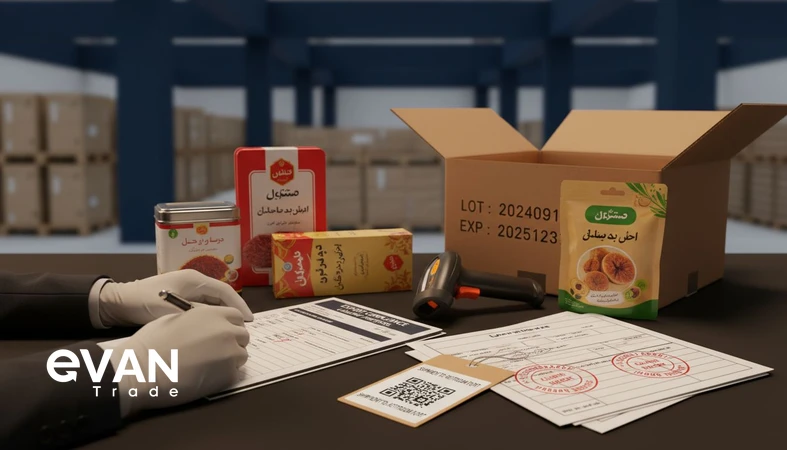
- Product name (as marketed), net quantity, ingredient list, allergens, nutrition panel (if required), origin statement, manufacturer/packer details, importer details (if required), storage instructions, and date coding.
- Mandatory statements for the category (for example, “keep refrigerated” where applicable) and any warnings.
- Language rules and legibility (font size, contrast, permanence).
2) Master carton / shipper carton (what customs and warehouses rely on)
- SKU/Item code, product description, quantity per case, gross/net weight, dimensions if required, country of origin, handling marks (fragile, keep dry), and batch/lot coding.
- Carton barcode or SSCC label if your customer uses structured receiving.
3) Pallet label (what drives fast receiving and traceability)
- Pallet ID, case count, SKU, lot/batch, production and/or expiration date references where required, and destination/warehouse identifiers.
- Consistency with packing list and shipping marks.
In many B2B disputes, the unit label is fine—but the warehouse cannot reconcile cartons to documents, leading to delays and claims. A robust approach is to align labeling with your pre-shipment inspection checklist so that what is printed is verified against what is shipped.
Export labeling checklist: what must be correct before shipping
Use this checklist as a practical “go/no-go” gate. It’s intentionally buyer-centric: each item is something you can request, check, and document.
- Market and channel identified: destination country, retailer vs. foodservice vs. industrial channel, and any private label rules confirmed.
- Correct product identity: product name and description match purchase contract, invoice wording, and HS/category conventions used in that market.
- Country of origin statement: consistent across unit/carton documents; avoid ambiguous phrasing.
- Net content and pack format: units (g/ml/oz) per destination requirement; case pack and net weight match packing list.
- Ingredients and allergens: declared per destination definitions; cross-contamination statements used only when substantiated.
- Nutrition and claims control: any “free-from,” “organic,” “natural,” or health claims supported by evidence and allowed in the target market.
- Dates and codes: manufacturing date, best-before/expiry format (DD/MM/YYYY vs. MM/DD/YYYY risk), and lot/batch code present and legible.
- Storage conditions: temperature range, keep away from light/moisture, and post-opening instructions where relevant.
- Traceability fields: manufacturer/packer address, plant identification if used, and importer information if required.
- Language compliance: required language(s) present; translations validated (not machine-only) for regulated terms.
- Barcode readiness: correct symbology and scannability; barcode matches GTIN assigned to that exact pack format.
- Carton/pallet marks aligned: shipping marks, batch, and quantities match packing list and bill of lading references.
- Label material and adhesion: ink permanence, smear resistance, and label adhesion tested for cold chain or humid conditions.
- Document alignment: label statements consistent with COA and lab test documentation, specifications, and certificates required for import.
- Change control: version control on artwork and label templates; old stock labels blocked from production.
Practical buyer rule: if a claim or statement appears on the label, it should be traceable to a document, test result, or written specification you can file. If it cannot be filed, it can become a dispute.
Verification table: label elements, why they matter, common mistakes, and how to verify
The table below is designed to help importers audit labels quickly and consistently across suppliers.
| Label element | Why it matters | Common export mistakes | How a buyer can verify |
|---|---|---|---|
| Product name & description | Aligns customs classification and commercial invoice wording | Using marketing names that don’t match documents; vague descriptions | Compare artwork text vs. proforma invoice and packing list; confirm category naming conventions for the market |
| Country of origin statement | Market access, tariff rules, and origin marking compliance | Inconsistent origin between unit and carton; unclear phrasing | Request label photos of unit and carton; cross-check with COO/producer declaration if used |
| Net quantity & units | Consumer protection; retail compliance; pricing integrity | Wrong unit system; mismatch between unit and case totals | Recalculate case net from unit net × pack count; check against spec sheet |
| Ingredients & allergens | Safety and legal compliance; recall risk control | Allergens missing or not highlighted as required; inconsistent ingredient order | Compare recipe/spec to label; confirm allergen handling policy and cross-contact statement logic |
| Dates (MFG/BBE/EXP) & lot/batch code | Shelf-life disputes, FEFO warehousing, traceability in recalls | Ambiguous date format; ink that rubs off; lot code absent on carton | Ask for production photos showing code legibility; define date format in contract; reconcile lot with CoA |
| Storage conditions | Protects quality; sets objective handling expectations | Missing “keep refrigerated/keep frozen” where relevant; vague ranges | Confirm against stability data and shipment method; align with shelf life and storage conditions guidance |
| Importer/manufacturer details | Regulatory accountability; complaint handling | Incomplete addresses; wrong company role; missing importer when required | Validate entity names and addresses against contract and destination requirements; keep an approval record |
| Barcode/GTIN | Retail scanning, inventory accuracy, chargeback avoidance | Wrong GTIN for size/variant; poor print quality; barcode placed on curves | Scan test on samples; confirm GTIN assignment per SKU and pack format |
| Carton/pallet shipping marks | Receiving speed; reconciliation with documents | Case count missing; weights wrong; pallet label doesn’t match packing list | Require carton/pallet label proofs; match to packing list line-by-line before shipment |
High-risk areas for Iranian exports: translation, origin, dates, and claims
Most labeling issues are not “big” errors; they are small mismatches that trigger rigid systems at ports and in retail supply chains. For Iranian products, buyers commonly see heightened sensitivity in four areas:
Translation and regulated wording
Destination regulators may require specific terms (for allergens, additives, or storage conditions). A literal translation can be technically incorrect. Buyers should request: (1) the source-language ingredient specification, (2) the translated label text, and (3) a sign-off workflow. If you are already tightening export compliance documentation, add label text validation as part of the same discipline.
Origin marking consistency across touchpoints
Origin is not just a flag; it is a statement that must stay consistent across unit labels, carton marks, invoices, and (where applicable) certificates. Avoid scenarios where the unit says one origin phrasing and the carton says another, or where documents describe the producer differently than the label.
Date format ambiguity and shelf-life math
DD/MM vs. MM/DD confusion is a real operational risk. Define the format in your purchase terms and require the same format on labels and cartons. Also confirm that “best before” is used where appropriate and that any “expiry” claim is consistent with product category expectations and stability evidence.
Claims (quality, health, and “free-from”)
Claims increase scrutiny. Even if a claim is legal, it can require substantiation. From a risk-reduction perspective, keep labels conservative unless the supplier can back claims with controlled specifications, test results, and traceability. Where a claim touches quality metrics, align it with quality control and acceptance criteria used for receiving.
Align labeling with packaging, shelf life, and cold-chain reality
Labeling is often treated as “paper compliance,” but it must match physical reality—especially for food, cosmetics, and temperature-sensitive goods. The failure mode is predictable: labels indicate a storage condition, but the packaging and logistics cannot support it, leading to quality complaints and shelf-life disputes.
- Packaging–label fit: If a product requires light protection, the label should not imply stability that the container cannot maintain. Likewise, “keep refrigerated” only works if the ship method and distribution plan can enforce temperature control.
- Code durability: Date codes must survive condensation, abrasion, and handling. Thermal ink that smears under humidity becomes a receiving problem, not just a QA issue.
- Secondary packaging accuracy: Cartons must carry the same lot/batch reference as the unit, or traceability breaks at the warehouse level.
- FEFO readiness: If your warehouse operates First-Expiry-First-Out, pallet and carton labels should make expiry/best-before and lot visible without opening cases.
For buyers evaluating Iranian supply, consider packaging and label verification as a combined gate. If you maintain category playbooks for export packaging and shelf life planning, add a section for code placement, label materials, and carton marks to prevent downstream rework.
Implementation workflow: how buyers can approve labels and reduce rework
Even a strong checklist fails without a clear workflow. Below is a practical buyer-side process that reduces last-minute fixes and ensures traceable approvals.
Step 1: Collect baseline inputs
- Destination country/channel requirements (regulatory + retailer/3PL specs if applicable).
- Product specification and ingredient statement (source language and English).
- Proposed artwork (unit, carton, pallet label templates).
Step 2: Run a “document-to-label” consistency audit
- Match label identity to invoice description and packing list naming.
- Match lot/batch format to CoA and internal QA records.
- Confirm net weights and pack counts are consistent across all layers.
Step 3: Sample-based verification
- Request photos of printed labels on real packaging under normal lighting.
- Perform a barcode scan test on physical samples (or high-quality print proofs where samples are not feasible).
- Test code legibility after light abrasion and moisture exposure (simple handling simulation).
Step 4: Approve with version control
- Assign label version numbers and lock approved files.
- Define a change-control rule: any ingredient, supplier, or process change triggers label review.
This workflow complements pre-export checks for export documentation and shipping readiness and helps prevent the most expensive scenario: discovering label issues after goods arrive.
FAQ: practical export labeling questions buyers ask
1) What’s the minimum labeling evidence I should request before placing an order?
Ask for (a) the current label artwork files for unit and carton, (b) a filled product specification (including ingredients/allergens), and (c) one recent production photo showing date/lot coding on both unit and carton. If claims are present, request the supporting basis (spec limits, test results, or certificates) so you can file it alongside your import documentation.
2) Should the lot/batch code be on the unit, carton, and pallet?
For most controlled supply chains, yes. Having the code only on the unit slows receiving and complicates traceability if cartons are separated from consumer units. At minimum, buyers should require lot/batch on the master carton and a pallet identifier that links to the same lot. This is especially important when goods are consolidated or split across warehouses.
3) How do I avoid disputes caused by date format differences?
Write the required date format into the purchase contract and label approval record (e.g., DD/MM/YYYY). Then enforce it consistently on unit and carton. Consider adding month names (where allowed) or using an unambiguous format such as YYYY-MM-DD if acceptable in the destination market. Also ensure “best before” vs. “expiry” language matches category norms and evidence.
4) Are English-only labels acceptable for all markets?
No. Many markets require local language for mandatory statements, and some require bilingual presentation. Even where English is accepted, regulators may specify exact terms for allergens, additives, and storage conditions. Buyers should confirm language requirements at the destination and validate translations for regulated wording, not just general meaning.
5) What labeling issues most commonly trigger relabeling at destination?
Common triggers include missing importer details (where required), incorrect or missing allergens, non-compliant net quantity units, unclear origin marking, and illegible or missing date/lot codes. Retail channels add risks like barcode failures and carton mark mismatches. A document-to-label audit before shipment is the most cost-effective way to prevent these issues.
Conclusion: turning export labeling into a repeatable market-readiness control
Export labeling is a practical test of whether a product is ready for cross-border distribution, not just whether it looks professional. For buyers importing Iranian goods, the safest approach is to treat labeling as a structured system across unit, carton, and pallet—then verify consistency with documents, traceability codes, and shelf-life realities. A disciplined checklist, a clear approval workflow, and sample-based verification can materially reduce avoidable customs holds, relabeling costs, and disputes over dates, storage, and claims.
In this transparency-first context, Evan Trade operates as a documentation- and verification-oriented resource—focusing on clear specifications, traceable records, and practical readiness checks that help buyers evaluate export labeling and related compliance details with fewer assumptions.