

Iranian export dates for importers: why buyers still face avoidable risk
For many procurement teams, dates look like a “simple” commodity until the first container arrives with inconsistent moisture, sticky fruit, hidden infestation, or packaging that fails during transit. These issues rarely come from bad intent; they usually come from unclear specifications, variety-grade mismatch, and gaps in quality assurance between the packhouse and the importer’s receiving process. If you are importing for retail, food service, or industrial ingredients, the cost of a quality incident is not limited to the invoice—it can include relabeling, slow sell-through, complaints, and customs delays.
Iranian export dates are a strategic category for importers because Iran is a major producer with multiple commercially distinct varieties, a wide range of grades, and pricing that often sits in an attractive “value-to-quality” position. But to buy well, you need to treat dates like any other controlled food ingredient: define measurable specs, align packaging with shelf-life targets, verify documentation early, and build an incoming inspection routine that catches problems before product moves into your network.
This guide is designed for English-speaking importers and B2B buyers. It focuses on practical decision points: which Iranian varieties fit your use-case, how grades are commonly described, what to check before shipment, and how to reduce customs and quality risk without overcomplicating the purchase.
Why Iranian dates are a strategic import category
Seasonality and supply planning
Date harvest windows vary by region and variety, but as a category, Iranian dates can support year-round programs because exporters typically operate with cold storage and controlled packing. For importers, the strategic advantage is not “always in-season” fruit; it is the ability to plan procurement cycles (contracting, packaging production, shipping schedules) around consistent availability from stored lots—if the supplier has robust stock management and lot coding.
Price/quality positioning
In many markets, Iranian dates compete strongly when buyers need a balanced combination of:
- Eating quality for retail and gifting (aroma, softness, appearance)
- Industrial reliability for pastes, bakery, confectionery, or sweetening applications
- Commercial flexibility across bulk cartons, consumer packs, and private label formats
The key is to match variety and grade to your cost-to-performance target. Paying for premium appearance when you are buying for processing is an avoidable cost; buying a value grade for high-visibility retail is an avoidable risk.
Use-case diversity across varieties
Iran offers multiple export varieties with distinct textures and moisture behaviors. This diversity helps importers build segmented assortments (premium, mainstream, value) or cover multiple channels (retail clamshells, bulk for food service, industrial inputs) from a single origin—provided you define specs clearly and test samples against your process.
Key Iranian export date varieties and buyer-fit
Below are some of the best-known Iranian export varieties used in international trade. Names can have spelling variations (e.g., Sayer/Estamaran). Always confirm the variety on the packing list and carton markings to prevent substitution risk.
| Variety | Typical profile | Common use-cases | Buyer-fit notes |
|---|---|---|---|
| Mazafati | Soft, dark, moist; rich flavor; usually needs cold chain | Retail premium, gifting, chilled ranges | Great eating quality but sensitive to temperature abuse; define moisture range and storage requirements |
| Zahedi | Semi-dry to dry; amber/golden; firmer bite | Value retail, food service, ingredient use | Often easier in ambient distribution; focus on size/count and defect tolerances |
| Piarom | Premium semi-dry; elongated; dark brown; “nutty/caramel” notes | High-end retail, gifting, specialty | Appearance and uniformity matter; tighten specs for skin separation, color, and sizing |
| Kabkab | Soft to semi-soft; sweet; medium size; can be sticky | Retail mainstream, paste/purée, bakery | Manage stickiness via moisture control and packaging; check for syruping and surface defects |
| Sayer (Estamaran) | Semi-dry; versatile; good processing performance | Industrial ingredient, bulk supply, value retail | Strong choice for stable supply programs; define moisture, foreign matter limits, and pit condition |
How to choose the right variety
- Retail (visible fruit): prioritize uniform color, intact skin, low defect tolerance, and consistent sizing. Piarom and Mazafati are often positioned for higher-end shelves depending on your market.
- Ingredients (chopped, paste, bakery): prioritize consistent sugar profile, manageable moisture, and low contamination risk over perfect appearance. Sayer and Zahedi are commonly considered for industrial needs, but always validate against your process.
- Ambient vs chilled distribution: semi-dry varieties typically tolerate ambient handling better than very moist soft dates. If your downstream chain is not refrigerated, specify varieties and packaging that match your reality.
Grades and commercial specifications importers should define
Date “grades” are not always standardized across exporters and markets. Terms like Grade A/AA/Superior can be used differently. The safest approach is to define measurable specifications in the PO/contract, supported by reference samples and a pre-shipment inspection plan.
Core specifications to include in your purchase order
- Variety and crop year (and whether old crop is acceptable)
- Size or count range (count per kilogram or per 500 g, depending on your market)
- Moisture range (critical for shelf life, stickiness, and mold risk)
- Texture (soft / semi-soft / semi-dry / dry) aligned to the variety
- Color uniformity (tolerance for light/dark variation and sunburn)
- Defects tolerance (skin separation, broken fruit, cap stem presence, crystallized sugar, scarring)
- Pit condition (pitted vs unpitted; for unpitted, tolerance for broken pits; for pitted, check pitting quality and residual pit fragments)
- Foreign matter limits (stones, plant material, insects, plastic; define “zero tolerance” where appropriate and clarify sampling method)
Brix/sugar profile: when it matters
Many date transactions do not specify Brix explicitly, but it can matter for industrial buyers using dates as a sweetening ingredient or in fermentation-sensitive recipes. If your process is sensitive, request a typical profile (Brix or sugars) and validate via lab testing on arrival. For most retail programs, sensory performance and moisture control are usually more operationally important than a numeric Brix target.
Defects that commonly cause disputes
Disputes often arise because the buyer expects “retail-ready” fruit while the supplier packs to a broader tolerance. Clarify these points before you sign:
- Mold vs sugar crystallization: sugar bloom can be mistaken for mold; define how it will be assessed and when lab confirmation is required.
- Infestation and eggs: define detection method and tolerance. If your market has strict rules, require treatment or specific controls.
- Stickiness/syruping: tie to moisture range and packaging method; it is a predictable outcome if moisture is high and temperature fluctuates.
Export packaging formats and how they affect shelf life
Packaging is not only a marketing choice; it is a technical control that affects moisture migration, oxidation, physical damage, and the likelihood of infestation or contamination during distribution.
Common export formats
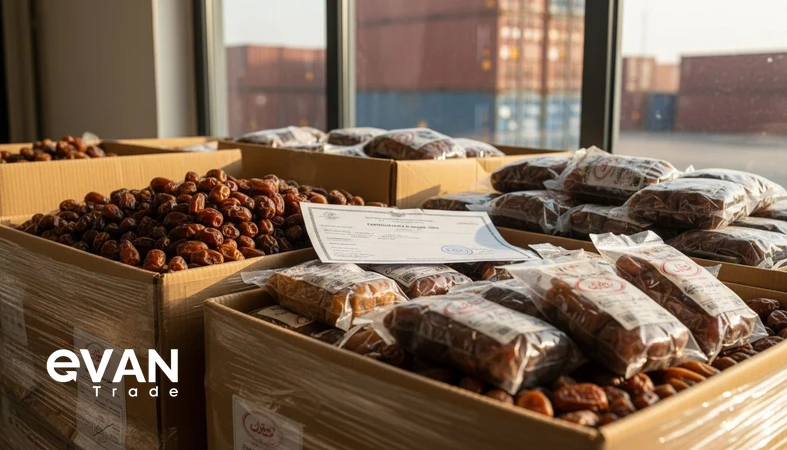
- Bulk cartons (e.g., 5 kg or 10 kg): typical for food service and industrial buyers; economical and efficient, but requires clean liners and strong carton integrity for stacking.
- Consumer packs (e.g., 200–500 g): for retail; can be flow-wrap, trays, or tubs; requires clear labeling and consistent net weight control.
- Vacuum packs: can reduce oxygen exposure and slow quality changes, often used for some varieties and markets; may alter fruit appearance (compression) and requires strong seal quality control.
- MAP (modified atmosphere packaging): used in some retail programs to extend shelf life; requires technical capability and stable cold chain expectations.
Practical packaging checks for buyers
- Inner liner specification: thickness and food-grade compliance; check for odor transfer and seal integrity.
- Carton stacking strength: confirm pallet pattern and maximum stacking height for your warehouses.
- Lot coding and traceability: outer carton and inner pack should carry consistent lot identifiers.
- Claims vs reality: avoid relying on “long shelf life” statements unless linked to storage conditions and validated packaging performance.
Buyer tip: If you plan to distribute ambient, avoid packaging that “assumes” refrigeration unless you can guarantee temperature control from port to shelf.
Quality assurance and incoming inspection checklist
A strong QA routine reduces both commercial disputes and food safety risk. The goal is not to over-test every shipment, but to apply consistent controls that match your product risk level and market requirements.
Sampling and inspection approach
Agree in advance how samples will be taken for pre-shipment checks and how you will inspect on arrival. Your inspection plan should reflect container size, packaging format, and risk profile (soft/high-moisture dates generally require tighter controls).
Incoming inspection checklist (practical)
- Documentation match: verify lot codes, variety, net weight, packaging format, and origin details against packing list and labels.
- Visual checks: color uniformity, skin separation, excessive stickiness, presence of cap stems, crushed fruit, leakage/syruping.
- Odor check: sour/fermented notes can indicate temperature abuse or microbial activity.
- Moisture control: confirm product condition aligns with the specified moisture range; if you cannot measure in-house, use a lab or a qualified third party.
- Infestation risk: inspect for live insects, webbing, or eggs; quarantine suspect pallets to prevent spread.
- Mold risk: investigate suspicious white growth; differentiate from sugar crystallization via careful examination and lab testing when uncertain.
- Foreign matter: check carton cleanliness, liner integrity, and random pack opening for contamination.
When to request lab tests
Consider lab tests when: (1) product is for sensitive consumer segments, (2) your market requires certificates, (3) you observe anomalies (odor, discoloration, visible growth), or (4) you are onboarding a new supplier/packhouse. Typical tests may include microbiology parameters and, where relevant to regulations, pesticide residues or contaminants. Align test scope with your destination-country requirements.
Documentation buyers should request and verify
Document readiness is a frequent cause of customs holds. Dates are an agricultural food product; requirements depend on destination rules, but importers can reduce risk by requesting a consistent document set early and checking it for internal consistency.
Core trade documents
- Commercial invoice: consistent product description (variety, grade/spec), HS code (as used by your broker), unit price, Incoterms, payment terms.
- Packing list: carton count, net/gross weight, pallet count, pack format, lot codes, production/packing date where applicable.
- Certificate of origin: confirm issuer and format accepted by your customs authority.
- Phytosanitary certificate (as applicable): some destinations require it for plant products; confirm before shipping.
- Health certificate (if relevant): requirements vary; clarify with your importer-of-record and broker.
- COA (Certificate of Analysis) when used: ensure it references the correct lot codes and test methods; do not accept generic COAs without traceability.
Traceability and lot coding
Ask for a lot coding scheme that ties cartons to production day/line and raw material lots. In a quality event, traceability reduces the scope of a hold or recall and prevents blanket rejection of all inventory.
Buying tips, contracting, and logistics: reducing disputes and delays
Define specs in measurable terms
Replace broad grade labels with a specification sheet attached to your PO/contract. Include acceptance criteria and how non-conformities will be handled (credit note, replacement, partial discount, or return). If you use reference samples, keep sealed “golden samples” on both sides.
Incoterms and control points
- EXW/FOB: gives you more control over freight and sometimes packaging handling, but increases your coordination responsibility.
- CFR/CIF: simpler logistics on paper, but you still need clarity on temperature requirements, container type, and documentation responsibilities.
Whichever term you use, define who is responsible for: pre-shipment inspection access, container loading photos, temperature set points (if refrigerated), and document corrections.
Payment risk basics
Use payment methods and milestones that match counterparty risk and order size. Common tools include staged payments, documentary collections, or other bank-mediated structures depending on what is feasible for both sides. Regardless of method, align payment triggers with objective evidence (inspection report, loading confirmation, document set readiness).
Preventing customs holds (practical)
- Align product naming across invoice, packing list, and certificates (same variety spelling and pack format).
- Ensure net weight and carton counts reconcile exactly.
- Confirm labeling language, allergens (if any), and date format rules for your market before packing.
- Request pre-alert document scans early enough to fix errors without delaying the vessel release.
Storage and handling fundamentals for importers
Many “quality problems” are actually handling problems after arrival. Dates are hygroscopic: they absorb and release moisture depending on humidity and temperature. That means warehouse conditions and container history matter.
Recommended handling practices
- Temperature and humidity control: set internal standards appropriate to the variety and packaging. Soft, high-moisture dates are more sensitive to heat spikes that can accelerate spoilage and syruping.
- Container condition checks: on arrival, check for odors, signs of water ingress, and pallet shifting. Document with photos before unloading completes.
- FIFO/FEFO discipline: use First-In-First-Out, and when you have best-before dates, use First-Expire-First-Out to protect shelf life.
- Avoid mixed loads with odor-active goods: dates can pick up odors through packaging, especially if liners are thin or seals are imperfect.
- Quarantine procedure: if infestation or mold is suspected, isolate the lot to prevent cross-contamination in your warehouse.
Common mistakes to avoid
- Assuming all varieties behave the same in ambient storage.
- Buying vacuum/MAP packs without verifying seal integrity and distribution realities.
- Skipping incoming inspection because the supplier is “known.” Crop conditions and packing performance can change.
- Not documenting temperature/condition evidence, making disputes hard to resolve fairly.
FAQ: importing Iranian dates
Which Iranian date variety is best for retail shelves?
It depends on your positioning and distribution. Piarom is often selected for premium presentation due to its elongated shape and semi-dry texture, while Mazafati is valued for a soft, rich eating experience but typically needs stronger temperature control. For mainstream retail with simpler handling, semi-dry options like Sayer or Zahedi may fit better. Always test with your packaging and shelf-life targets.
How should I write date specifications to avoid “grade” disputes?
Use measurable specs rather than only Grade A/AA language. Define variety, size or count range, moisture range, acceptable defect tolerances (skin separation, broken fruit, cap stems), pit condition, and foreign matter limits. Add an agreed sampling method and a dispute mechanism (inspection, re-check, and credit rules). Reference samples can help, but written limits are essential for consistent decisions.
Do I need refrigerated containers for dates?
Not always. Many semi-dry varieties can move in ambient conditions if packaging and transit times are appropriate. However, soft/high-moisture dates are more vulnerable to heat spikes that increase syruping and microbial risk. Decide based on variety, moisture target, season of shipment, route duration, and your destination warehousing. If temperature control is required, specify set points and monitoring expectations in writing.
What are the most important documents to check before shipment?
At minimum, review the commercial invoice, packing list, and certificate of origin for consistency in product description, lot coding, weights, and Incoterms. Depending on your destination, you may also need phytosanitary and/or health certificates. If a COA is provided, ensure it is lot-specific. Request document scans early to correct errors before the cargo reaches port.
How can I reduce infestation and mold risk in imported dates?
Start with supplier controls (hygiene, storage, sorting) and back them up with a clear inspection plan. Specify moisture targets, require clean liners and intact packaging, and ask for lot traceability. On arrival, perform visual checks and quarantine any suspicious pallets. When signs are unclear (e.g., white residue), use lab confirmation to distinguish sugar crystallization from mold before making commercial decisions.
What packaging format is safest for long-distance shipping?
“Safest” depends on your channel. Bulk cartons with robust liners and strong cartons are efficient for B2B distribution, while sealed consumer packs reduce handling and contamination risk for retail. Vacuum or MAP can extend stability in some programs but requires strong seal quality and realistic distribution temperatures. Choose packaging as a technical control: match it to variety moisture, transit time, and your storage environment.
Conclusion: buying Iranian export dates with fewer surprises
Iranian export dates can be a high-performing import category when buyers treat them as a specification-driven food product rather than a generic commodity. The most consistent outcomes come from aligning the variety with the use-case, translating “grade” into measurable limits (moisture, size/count, defects, and foreign matter), selecting packaging that matches your real distribution conditions, and implementing a disciplined incoming inspection routine. Documentation accuracy and traceable lot coding reduce customs friction and make quality events easier to resolve fairly. With these controls in place, importers can build stable supply programs and reduce the costly variability that often shows up only after the container is opened.
For readers building sourcing knowledge across Iranian products and export workflows, Evan Trade publishes practical market and trade guidance aimed at helping procurement teams specify, verify, and move products with fewer operational surprises.