


In international food trade, a Certificate of Analysis (COA) is often the single most decisive technical document between “commercially acceptable” and “operationally risky.” For buyers evaluating Iranian food exports, COA review is not a paperwork formality; it is a pre-contract control that affects food safety, regulatory compliance, customs clearance, insurance exposure, and even brand reputation. Many procurement teams focus heavily on price, lead time, and packaging, but the COA is where the measurable truth of the product is documented—what was tested, by whom, using which methods, for which batch, and against what limits.
Because food regulations differ across markets (and sometimes across product categories within the same market), a “good-looking COA” can still be insufficient if it lacks critical parameters, uses non-recognized methods, or fails to prove traceability to the shipment batch. This is especially important before signing a contract, when buyers still have negotiation leverage to define specifications, testing scope, sampling rules, acceptance criteria, and remedies. This article breaks down what a COA for Iranian food exports should contain, what buyers must verify, and how to spot red flags early—so you can manage food import risk with technical clarity instead of assumptions.
What a COA is—and how it differs from other export documents
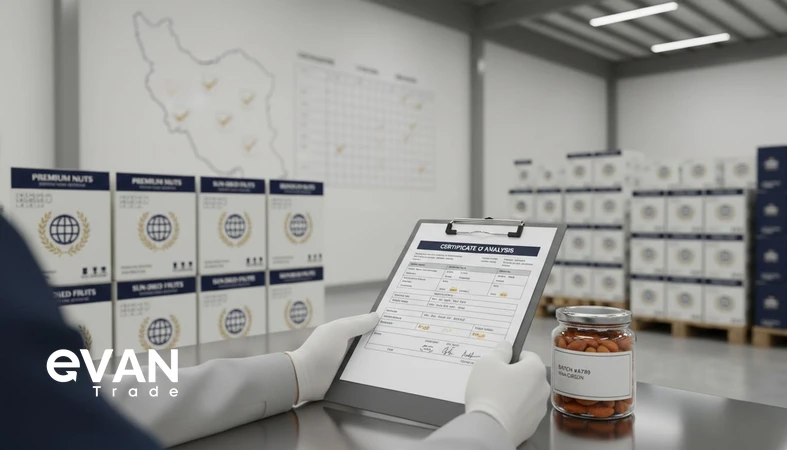
A COA (Certificate of Analysis) is a laboratory-issued report that lists analytical test results for a specific product batch (or lot) against defined parameters. It is not a general quality promise; it is evidence of test outcomes at a point in time under specific conditions. In compliance and market access terms, the COA is part of your supplier verification and food import risk management toolkit because it converts “quality” into measurable indicators.
Buyers sometimes confuse a COA with other export documents. Understanding the distinction helps prevent gaps in contractual expectations:
- Commercial Invoice / Packing List: Commercial and logistics data (price, HS codes, weights, packaging, quantities). No analytical results.
- Certificate of Origin (CO): Confirms origin, typically for customs/tariff purposes. Not a lab test document.
- Health Certificate / Phytosanitary Certificate (when applicable): Issued by competent authorities for certain categories; may reference compliance but does not replace detailed lab values.
- Specification Sheet (Product Spec): Target ranges and quality attributes (what should be). A COA shows what was measured (what is).
- MSDS/SDS (for some ingredients): Safety handling info, not food quality compliance.
Before contract signing, the COA should be aligned with the product specification sheet and the buyer’s market requirements. If these documents contradict each other (for example, a spec says “moisture max 10%” but COA reports 12%), treat it as a serious pre-contract issue, not a post-shipment inconvenience.
COA for Iranian food exports: core elements buyers should expect
A COA becomes contract-useful when it is traceable, method-specific, and clearly tied to the shipment batch. The following elements should be visible and internally consistent:
- Product identification: Product name, grade (if any), form (whole/ground/concentrate), and any critical descriptors (e.g., “sun-dried,” “steam sterilized,” “roasted”).
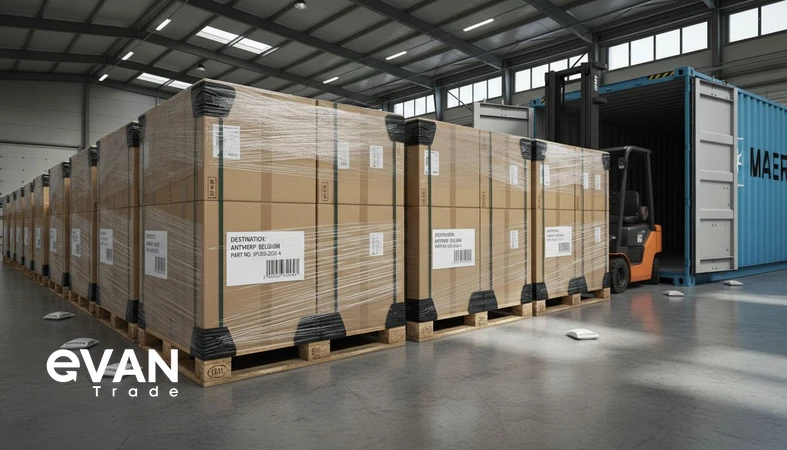
- Batch/lot number: Must match packaging markings and shipping documents where applicable.
- Manufacturing and test dates: “Date of analysis” should be recent enough to reflect the shipped lot.
- Sampling statement: Who sampled, from where, how many units, and whether the sample is representative.
- Test methods and standards: ISO, AOAC, EN, USP, or other recognized methods. “In-house method” may be acceptable only if validated and disclosed appropriately.
- Units and limits: mg/kg, CFU/g, ppm, %—and the acceptance criteria (spec limit) alongside results.
- Laboratory identification: Lab name, address, signature/approval, and accreditation scope where relevant.
- Result interpretation: “Pass/Fail” can help, but never replaces numeric values and limits.
From a procurement perspective, these elements support two critical controls: (1) technical acceptance before shipment and (2) defensibility in disputes. If a COA lacks batch linkage or uses unclear methods, it weakens both.
COA elements vs buyer verification focus (comparison table)
The table below summarizes common COA sections and what buyers should actively verify before contracting and before shipment approval.
| COA element | What buyers should verify | Why it matters before contract |
|---|---|---|
| Product name, grade, form | Matches purchase spec, labels, and intended application (retail, ingredient, industrial) | Prevents mismatch disputes and downstream reformulation risk |
| Batch/lot number | Clear, unique, and consistent across COA, packaging marks, and shipping docs | Enables traceability and recall readiness |
| Sampling method | Representative sampling plan; who sampled; sample size; sealing/chain-of-custody | Reduces “sample not representative” arguments |
| Microbiological results | Organisms tested, limits, units (CFU/g), method references | Core food safety control and import clearance sensitivity |
| Chemical contaminants | Heavy metals, pesticide residues, mycotoxins if relevant; aligned to destination limits | High enforcement area; prevents rejection and brand risk |
| Physical parameters | Moisture, purity, foreign matter, ash, particle size (if relevant) | Affects shelf life, yield, and customer acceptance |
| Test methods/standards | ISO/AOAC/EN references; detection limits/LOQ where relevant | Ensures results are interpretable by regulators and auditors |
| Lab accreditation | Accreditation number and scope (e.g., ISO/IEC 17025) for the specific tests | Strengthens reliability and reduces retesting disputes |
Mandatory technical parameters to verify (what “good” looks like)
“Mandatory” depends on product category and destination market, but in practice, buyers should define a baseline COA scope in the contract. For Iranian food exports, the baseline often includes microbiology, chemical contaminants, and key physical parameters. The goal is to make the COA actionable: results must be comparable to your acceptance criteria and regulatory limits.
Microbiological limits (typical buyer focus)
Microbiological testing is frequently the first line of import controls and customer audits. Typical organisms/indicators include (depending on category and processing):
- Total plate count (TPC)
- Yeast and mold
- Coliforms / E. coli
- Salmonella (often “Not detected in X g”)
- Staphylococcus aureus (where relevant)
Buyer verification tips: ensure the COA states units (CFU/g), sample size, and “not detected” thresholds (e.g., in 25 g). Also check whether the product is raw, heat-treated, or sterilized—micro specs vary significantly by processing level.
Chemical contaminants: heavy metals, pesticide residues, and mycotoxins
Chemical safety is a major risk area in spices, herbs, dried fruits, nuts, grains, and some concentrates. A COA should not merely say “complies”; it should list numeric results (with detection limits where important) for contaminants relevant to the product:
- Heavy metals: Lead, cadmium, arsenic, mercury (commonly reported as mg/kg).
- Pesticide residues: Often requires multi-residue screening aligned to the destination market’s MRL framework.
- Mycotoxins (when relevant): Aflatoxins (B1, total), ochratoxin A, etc., depending on commodity risk.
Buyers should confirm whether results are reported against specific limits (buyer spec or regulatory maximum levels). If the COA only lists a small pesticide panel for a high-risk commodity, treat it as incomplete and renegotiate the testing scope before contract finalization.
Physical and compositional parameters that affect usability and shelf life
Even when a product is safe, it can fail commercially if key physical parameters are out of range. Common parameters include:
- Moisture / water activity (if used): Predicts mold risk and shelf life stability.
- Purity / foreign matter: Stones, stems, extraneous matter; critical in herbs/spices and agricultural commodities.
- Ash, insoluble ash (spices): Indicates contamination with soil/sand or adulteration risk.
- Particle size distribution (powders): Important for industrial mixing and customer consistency.
- Salt, acidity, Brix (processed foods): Impacts label claims and sensory profile.
Contracting insight: specify both target ranges and maximum limits, and require the COA to report numeric values, not only “conforms.” This reduces arguments over borderline quality and rework costs.
Accreditation, standards, sampling, and traceability: how to evaluate reliability
A COA is only as credible as the laboratory competence and the sampling integrity behind it. Before signing a contract, buyers should confirm that the COA’s results are defensible in audits, disputes, or border inspections.
Laboratory accreditation and scope
Ask whether the lab operates under ISO/IEC 17025 (or equivalent) and whether the accreditation scope covers the specific tests listed. A lab can be accredited for some analyses but not others. A reliable COA typically includes the lab’s identification details and may reference accreditation information. If accreditation is not available, buyers may require third-party testing at an agreed lab as part of the compliance documentation package.
Testing methods and standards
Methods should be cited clearly (e.g., ISO, AOAC, EN). For contaminants, detection limits and LOQ/LOD (where relevant) determine whether “ND” is meaningful. If a COA states “ND” without a threshold, it becomes hard to map results to regulatory limits.
Sampling method, sealing, and chain-of-custody
Sampling is a frequent weak point. Buyers should clarify:
- Who collected the sample (supplier, independent inspector, lab courier)
- Sampling plan (number of units, randomization, composite samples)
- Sealing and labeling of samples
- Whether the sample is from the final packed goods or from bulk
For higher-risk categories or sensitive markets, define sampling rules in the contract and consider pre-shipment inspection or independent sampling. This is a practical step in supplier risk management and helps reduce dispute scenarios.
Batch traceability and documentation consistency
Traceability is not just a food safety concept—it is a contractual control. The batch number on the COA should match production records and, where applicable, the batch/lot markings on the packaging. If the shipment blends multiple lots, buyers should request a COA per lot or a clear composite testing rationale agreed in advance.
Common COA risks and red flags before contract signing
Poorly prepared COAs are not always fraudulent—often they reflect misunderstandings about destination requirements or weak documentation culture. However, buyers should treat these issues as operational red flags because they tend to correlate with nonconformities later (label issues, border holds, retesting, or customer complaints).
Red flags that justify escalation
- No batch/lot number or batch number does not match other documents.
- Missing test methods or vague phrases like “standard method” without references.
- Pass/Fail only with no numeric results or no stated limits.
- Outdated test date that does not align with production/shipment timing.
- Unrealistic uniformity across multiple COAs (identical values repeated across different batches).
- Incorrect units (e.g., ppm vs mg/kg confusion) or inconsistent formatting.
- Incomplete contaminant scope for known risk commodities (e.g., no mycotoxin data where it is typically expected).
Challenges and practical fixes (pre-contract)
- Challenge: COA does not reflect destination market requirements.
Fix: Attach a buyer-approved COA template and minimum parameter list to the contract. - Challenge: Disputes over sampling representativeness.
Fix: Define sampling plan, independent sampling option, and retesting rules (including which lab is authoritative). - Challenge: Lack of clarity on detection limits for contaminants.
Fix: Require LOD/LOQ reporting for key contaminants and specify method sensitivity expectations.
In practice, the best time to correct COA weaknesses is before the first shipment. Once goods are in transit, leverage drops and costs rise—especially if re-testing at destination is required.
Market-specific compliance considerations (EU, GCC, Asia): how to stay realistic
COA expectations are not identical worldwide. Buyers should avoid assuming that a COA suitable for one market will satisfy another. The correct approach is to map the COA to your destination’s enforcement patterns and your customer’s internal standards.
European Union (EU)
EU buyers commonly scrutinize pesticide residues, mycotoxins (for relevant commodities), heavy metals, and microbiological criteria depending on the food category. The practical takeaway is not that every shipment needs “all tests,” but that the COA should align with commodity risk and buyer spec. If you operate under retailer standards or GFSI-aligned supplier programs, you may need additional parameters beyond basic regulatory compliance.
GCC markets
In GCC, documentation alignment and labeling compliance are often operationally important, and certain categories may attract additional scrutiny based on risk profiling. Buyers should ensure the COA is consistent with product labeling (ingredients, shelf life, storage conditions) and that it supports the product’s declared characteristics (for example, moisture levels for dried goods that influence shelf life claims).
Asia (varies widely by country and channel)
Across Asian markets, requirements can vary significantly by country, port, and whether goods are imported for retail or further processing. The COA should be flexible enough to support customs and customer review: clear methods, clear limits, and batch traceability. For buyers supplying industrial customers, consistent physical parameters (moisture, particle size, purity) can be as important as contaminant testing.
Compliance is rarely just “having a COA.” It is having a COA that is interpretable against the buyer’s limits, traceable to the shipped lot, and produced by a competent testing process.
How COA review improves risk management, customs clearance, and supplier evaluation
A rigorous COA review process is not bureaucracy—it is a cost control mechanism. When done consistently, it reduces avoidable friction at three levels: border clearance, internal quality assurance, and long-term supplier management.
Customs clearance and border holds
When a shipment is questioned, authorities or border inspection partners may request evidence of compliance. A COA that clearly states parameters, methods, and batch linkage can reduce delays. Conversely, unclear COAs can trigger retesting, extended holds, demurrage, or even rejection—costs that are often far higher than pre-shipment testing.
Operational risk management and claims defensibility
If a customer reports an issue (off-odor, mold, contamination concern), your first step is traceability: which lot, which test results, which sampling plan. A well-prepared COA supports structured investigation and can limit the blast radius of a recall or complaint. For procurement teams, this is part of quality control documentation and supplier accountability.
Supplier performance benchmarking over time
COAs are data. Over multiple shipments, they reveal whether a supplier is stable, improving, or drifting. Buyers can use COA trends to:
- Monitor variability in moisture, purity, and microbiological counts
- Identify seasonal risk patterns
- Decide when to increase sampling frequency or shift to independent testing
- Support renegotiation of specs and tolerances based on real capability
This is where COA review becomes a strategic lever: it turns supplier evaluation from subjective impressions into measurable performance.
FAQ: COA review before signing an import contract
1) Can a COA replace a health certificate or phytosanitary certificate?
No. A COA is a lab report showing analytical results for a batch, while health or phytosanitary certificates are typically issued by competent authorities for specific categories and purposes. Depending on your destination and product type, you may need both. Contractually, treat them as complementary parts of an export documentation set rather than substitutes.
2) How recent should the COA be relative to shipment?
There is no single universal rule, but the COA should reasonably represent the shipped batch and its condition at dispatch. Buyers often require that testing occurs after production (and ideally after final packing for many products) and within an agreed time window before loading. Define the acceptable timeline in the contract to avoid last-minute debates.
3) What if the supplier provides only “Pass” results without numeric values?
That is usually insufficient for professional import control. Numeric values and stated limits are essential for mapping to regulations, internal specs, and customer audits. If a supplier cannot provide numeric results, request an updated COA format or arrange third-party lab testing under agreed methods and parameters before the contract is finalized.
4) Do I always need pesticide residue testing on the COA?
Not always, but many buyers treat pesticide residues as a priority for higher-risk agricultural commodities. The correct scope depends on product category, origin practices, and destination enforcement. A practical approach is to define a baseline multi-residue panel for relevant commodities and then adjust frequency based on supplier history and risk profiling.
5) Should the COA be issued by the producer’s lab or an independent lab?
Both models exist. Producer-lab COAs can be acceptable if competence, methods, and integrity are strong. However, independent lab testing often increases trust—especially for new suppliers, higher-risk products, or sensitive markets. Many buyers use a hybrid approach: routine supplier COAs plus periodic independent verification and clear retesting rules.
Conclusion: using COA clarity to build safer, more predictable trade
A COA is not just a technical attachment—it is a decision tool that helps importers evaluate safety, compliance readiness, and supplier reliability before commercial commitments become costly. For Iranian food exports, the highest value COAs are the ones that are batch-traceable, method-transparent, and aligned with the buyer’s destination-market limits and product specifications. By defining COA scope in contracts, tightening sampling and traceability rules, and treating COA results as trend data (not one-off paperwork), buyers can reduce border delays, minimize retesting costs, and create more stable supplier relationships over time.
For teams coordinating multiple documents and stakeholders across origins and destination requirements, platforms such as Evan Trade are typically involved in export coordination and documentation support—helping standardize document quality, align shipment records, and reduce avoidable friction in cross-border execution.