

Iranian Food Exports to the United States
The United States is a high-volume, compliance-driven food import market where clearance is typically smooth when filings, labels, and lot documentation match perfectly. It becomes slow and expensive when data diverges across systems (HS code, product identity, net weights, lot IDs, label versions, dates) or when category-dependent FDA/USDA expectations are not aligned up front.
For Iran-origin agri-food, the operational reality is “auditability first”: buyers win when they treat each shipment as a reconciled package, specs, COA scope, labeling, packing configuration, and entry data all tied to the same lot definition and the same approved artwork.
Where clearance friction happens most often: prior notice/entry data mismatch, label version errors, incomplete lot traceability, and COA scope not matching buyer spec (especially for higher-risk categories like powders and blends). FDA requires prior notice for imported food and links this to import targeting and admissibility processes.
What Sells in the U.S. (demand map + buyer use cases by channel)
Retail
Retail demand tends to reward consistent grading, stable packaging, and “repeatable label compliance.” Pistachios (in-shell and kernels), dates, and selected dried fruits can perform well in mainstream and specialty retail when pack formats and label claims are controlled, and when the supply program can maintain lot-to-lot consistency.
HoReCa
Foodservice buyers prioritize pack efficiency and spec stability: consistent kernel size/cut, predictable moisture targets, and packaging that survives back-of-house handling. Spices and dried herbs (whole/cut) are often bought in larger foodservice packs, with a strong emphasis on identity and contamination controls.
Industrial / ingredient buyers
Ingredient buyers (bakeries, confectionery, snack manufacturers, beverage/extract users) purchase on commercial specs + COA scope. They typically require tighter documentation discipline: lot definition, traceability, and a documented change-control process for any adjustment to cut size, roasting, additives, or label declarations.
Ethnic
Ethnic channels can move saffron threads, dates, and specific pistachio styles when authenticity controls and label accuracy are strong. Buyers still get stuck on the same points as mainstream channels label version control, lot documentation, and COA scope alignment so “ethnic” does not mean “less compliance.”

Seasonality & Demand Triggers in the U.S. (operational calendar)
Retail seasonality is driven by promotional planning and gifting cycles; operationally, that means POs and label approvals often start months earlier than the shelf date. For pistachios and dates, demand commonly lifts around holiday and gifting periods, while raisins/dried fruits and spice lines follow bakery and seasonal menu planning.
Foodservice cycles are often tied to menu resets and distributor catalog windows. Industrial demand is tied to production schedules and reformulation cycles, buyers care less about “season” and more about supplier reliability, predictable lead times, and repeatable COA outcomes.
Religious/cultural demand triggers can be relevant (category-dependent) for dates and certain specialty items. The practical implication is not marketing, it’s capacity planning: reserve lots early, freeze label versions early, and avoid last-minute packing changes.
Best-Fit Iran-Origin Products for the U.S. Market
These are Iran-origin categories that typically align well with U.S. importer demand when HS, specs, pack configuration, and lot-based COA scope are locked before quoting. The table below maps each product to best-fit forms, channels, pack ranges, and the category-dependent QC/compliance controls that prevent clearance and onboarding friction.
Product category | Best-fit Iranian varieties/grades/forms | Demand channels | Winning pack formats + typical net weights (ranges only) | Key compliance/QC risks + U.S. controls (category-dependent) | Where buyers get stuck + EvanTrade prevention |
Pistachio (in-shell) | Commercial graded in-shell; roasted/salted if specified | Retail, HoReCa, Ethnic | Retail bags/pouches and bulk cartons; mixed net weight ranges | Aflatoxin/residue risk (category-dependent), foreign matter, moisture; COA scope + lot traceability | HS/spec/label mismatch; we lock HS assumption + defect tolerances + label version before quoting |
Pistachio kernels | Whole/halves/pieces; calibrated kernel sizes | Industrial, Retail, HoReCa | Bulk cartons/liners; retail packs for private label | Aflatoxin/residue (category-dependent), shell fragments, oxidation/rancidity; COA + QC gates | “Kernel size vs label vs invoice” mismatch; we reconcile spec sheet to invoice + packing list + COA |
Saffron (threads) | Threads (filament), commercial grades aligned to buyer spec | Retail, Ethnic, HoReCa | Small retail units and bulk tins; ranges by program | Authenticity/adulteration risk; require lot-tied COA and buyer-defined authenticity approach | “Grade naming” confusion; we map commercial type to measurable COA fields and sample tie-back |
Dates | Commercial varieties/forms (pitted/unpitted, whole) | Retail, HoReCa, Ethnic | Retail consumer packs, foodservice bulk; ranges | Condition/moisture, infestation controls (category-dependent), labeling accuracy | Lot/date code errors; we enforce lot list + date-code reconciliation |
Raisins/dried fruits | Standard dried fruits; calibrated grades | Retail, Industrial, HoReCa | Bulk cartons/bags and retail packs; ranges | Moisture, foreign matter, residues (category-dependent); COA scope aligned to use case | “COA doesn’t match spec”; we set pass/fail rules and re-test triggers |
Spices/dried herbs (whole/cut) | Whole/cut formats preferred for authenticity | HoReCa, Industrial, Retail | Bulk bags/cartons, some retail; ranges | Micro/foreign matter (category-dependent), identity; controlled cleaning and traceability | Cut size drift; we lock cut spec + change-control |
Spice powders (higher risk) | Powders/blends only with stronger controls | Industrial, some Retail | Sealed bulk packs and controlled retail; ranges | Higher adulteration/micro risk; tighter COA scope + authenticity controls (category-dependent) | “Powder trust gap”; we require chain-of-custody + lot-tied samples + expanded testing plan |
Market Access & Import Rules
Competent authorities
For most packaged foods, the core federal touchpoints are:
- FDA for food import oversight, including facility registration and prior notice (category-dependent).
- CBP for customs entry processing through the U.S. single window environment (ACE).
- USDA/APHIS where plant/plant-product rules, permits, or phytosanitary considerations apply (category-dependent).
Jurisdiction split
Not applicable (federal-first; state overlays may apply).
In practice, buyers should still plan for state-level overlays in distribution (e.g., retail labeling expectations, marketplace requirements), but your baseline import admissibility is federal-led.
Importer-of-record responsibilities vs supplier responsibilities
Importer-controlled (U.S. buyer / broker side): entry filing strategy, final HS classification decision, prior notice/partner agency filings, customs bond and importer setup, and broker coordination through ACE.
Supplier-controlled (EvanTrade / origin side): lot definition, packing configuration, label artwork control, COA scope execution, document quality (invoice/packing list/lot list), and evidence pack consistency.
Boundary sentence (mandatory):
“Requirements are shipment- and category-specific; confirm the applicable route with your customs broker and competent authority guidance in COUNTRY.”
Pre-Quote Lock Checklist (United States)
- HS assumption (and what evidence supports it)
- Product spec + defect tolerances (category-dependent)
- Pack format + net weight ranges + case count
- Label scope: PDP/back panel, allergens (if applicable), country-of-origin marking, claim list
- COA scope: which tests, which methods (where relevant), and lot definition
- Incoterm + delivery point + insurance responsibility
- Target timeline: sampling → artwork approval → production → shipment window
HS Classification & Tariff Readiness
In the U.S., HS/HTS classification should be treated as a “pre-quote lock.” If the HS assumption changes after labeling and documents are built, you risk rework across invoices, entry lines, and product descriptions. Use the Harmonized Tariff Schedule (HTS) Search maintained by the U.S. International Trade Commission as your tariff reference source (“TARIFF DATABASE NAME”).
For classification support, buyers and brokers often reference CBP CROSS (Customs Rulings Online Search System) and, where needed, pursue binding guidance through CBP programs (broker-led, category-dependent).
Classification evidence pack (what to keep on file)
Keep a simple, auditable “HS evidence pack” per SKU: product description, ingredient breakdown (if applicable), processing description (raw/roasted/salted; whole/cut/powder), photos, packing configuration, and any CBP ruling references used by your broker.
Preventing HS/label/spec mismatches
Lock three fields as identical across systems: (1) commercial product name, (2) physical form, (3) pack description. If your label says “kernel halves,” your invoice cannot drift to “pieces,” and your packing list cannot drift to mixed forms in the same lot.
Food Safety & Compliance Expectations
Define the lot
A U.S.-ready program defines a lot in a way that is consistent across production, lab testing, packaging, and documents. Practically, the lot should be the smallest unit you can (a) test, (b) segregate, and (c) trace through packing and shipping, then reflect that lot ID on cartons/pallet labels, COA, packing list, and invoice line mapping.
Minimum QC gates checklist
- Incoming raw material intake check (identity, condition, foreign matter)
- In-process sorting/cleaning controls (category-dependent)
- Finished product inspection against spec + defect tolerances
- Lot-tied sampling plan with COA scope agreed in writing (category-dependent)
- Packaging integrity and label version verification at pack-out
- Final document reconciliation: weights, case counts, lot list, dates, label version
FDA’s import framework also expects core “system readiness” items like facility registration where applicable (category-dependent) and prior notice for imported food shipments.
Pre-Shipment Release Gate (United States)
- COA results meet the agreed pass/fail rule (by lot)
- Label version sign-off complete (no unapproved edits)
- Packing reconciliation: lot list ↔ cartons ↔ pallets ↔ container load plan
- Documents match exactly: shipper/consignee, product form, net weights, lot IDs, dates
- Prior notice/entry data pack prepared for broker handoff (category-dependent)
Labeling & Claims
Label essentials
For the U.S., label work should be run like controlled documentation: one approved artwork per SKU per revision, and every shipment references the revision used. The “must-haves” are category-dependent, but the process is universal: define required elements, control claims, and prevent version drift between what’s printed and what’s filed.
Claims:
Any claim (quality, purity, “free-from,” origin statements beyond required marking) should be treated as evidence-backed. If the buyer cannot document the claim basis, remove it, because label disputes often become entry disputes when a shipment is inspected.
7-step artwork approval workflow (version control)
- Buyer sends label requirements + claim list (approved/forbidden)
- EvanTrade issues label data sheet (ingredients/form, net weight range, lot/date coding method)
- Artwork drafted (buyer side or EvanTrade-supported) with version number
- Compliance review: claim evidence check + mandatory fields check (category-dependent)
- Buyer sign-off in writing (final PDF + checksum/version ID)
- Pack-out control: line clearance + first-carton photo + pallet label photo
- Shipment file: store final artwork + approval record + photos tied to lot IDs
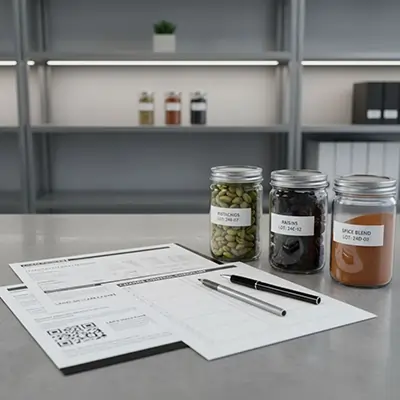
Packaging Standards for the U.S.
Packaging should be selected based on channel and risk: moisture/oxygen sensitivity, odor migration, and damage resistance during long ocean legs. For private label, packaging is not “just marketing”, it is part of your compliance and traceability system (lot coding, label permanence, carton marking, pallet labels).
packaging by channel
Channel | Typical packaging intent | Packaging notes (category-dependent) |
Retail | Shelf-ready + brand consistency | Strong label control; tamper evidence where applicable; stable case packs |
HoReCa | Operational efficiency | Larger net ranges; robust outer cartons; clear lot coding |
Industrial | Spec + traceability | Batch/lot discipline; liners/barriers; easy reconciliation by lot |
Ethnic | Authenticity + repeat orders | Avoid claim creep; keep lot/label discipline equal to mainstream |
Logistics & Delivery Planning to the U.S.
Mode selection by product risk
Air freight can protect high-value, low-weight products (e.g., saffron threads) and reduce dwell time risk, while sea freight often fits bulk pistachios, dates, and dried fruits when packaging and moisture protection are engineered correctly. The key operational control is not the mode, it’s evidence and condition control (liner choice, desiccants where appropriate, pallet labeling, and consistent load photos).
Incoterms guidance (buyer-controlled vs supplier-controlled)
Treat Incoterms as a responsibility map, not a pricing tactic. Buyers should decide whether they want control of the main carriage and insurance; suppliers should ensure the handoff point is documented with seal numbers, packing reconciliation, and photos.
Claims evidence pack (arrival-ready)
Build a repeatable “claims evidence pack” per container/air shipment: stuffing photos, seal number photos, pallet labels, carton lot coding photos, and a packing configuration summary that matches the packing list. This does not replace insurance, it prevents disputes when damage or shortages are alleged.
Documentation & Customs Checklist
CBP processes trade through ACE (Automated Commercial Environment), and food shipments may require FDA prior notice via FDA/CBP electronic routes (category-dependent).
documents, timing, issuers, process value, lead-time risks
Requirement/document | When needed | Who issues | What process it supports | Typical lead-time risk + mitigation |
Importer identifier (EORI-style if applicable) | Not applicable (U.S. importer setup differs) | Importer/broker | Importer onboarding | Onboarding delays → start broker setup early |
Customs declaration system: ACE | Every entry | Broker/importer via CBP | Entry/cargo release | Data mismatch → use a single master data sheet |
HS evidence pack (CROSS refs if used) | Pre-quote + pre-shipment | Buyer/broker + supplier inputs | Classification defensibility | Late HS change → lock HS assumption before artwork |
Commercial invoice | Every shipment | Supplier | Valuation/entry line data | Incorrect descriptions/weights → controlled template |
Packing list | Every shipment | Supplier | Physical reconciliation | Case/pallet mismatch → pack-out reconciliation gate |
COA (category-dependent) | As agreed | Lab/supplier | Admissibility + buyer QA | Method/scope mismatch → pre-define COA scope |
Health/official certificates (category-dependent) | If required by category/buyer | Competent issuer (as applicable) | Admissibility/retailer requirements | Late issuance → calendar the lead time early |
Prior notice in FDA PN via PNSI/CBP routes (category-dependent) | Food import/offer for import | Importer/broker/agent | FDA admissibility targeting | Wrong lot/label data → master data + final reconciliation |
Phytosanitary (category-dependent) | If plant/plant-product rules apply | NPPO/authority (as applicable) | Plant health compliance | Permit/cert mismatch → confirm route early |
Label artwork approval record | Every private label/retail program | Buyer | Version control + audit | Uncontrolled edits → 7-step workflow + version ID |
Lot list / packing configuration | Every shipment | Supplier | Traceability + reconciliation | Lot drift → define lot and keep it consistent |
Non-negotiable document quality rules (to prevent holds)
- One “master data sheet” governs: product identity, form, net weight ranges, lot IDs, label version, HS assumption.
- Invoice, packing list, COA, and pallet labels must reference the same lot IDs and the same product form.
- No last-minute “helpful” renaming (e.g., kernels ↔ pieces) after prior notice/entry prep begins.
Pricing, Payments & Contract Terms
Pricing should be built from auditable cost drivers: grade/spec, packaging configuration, COA scope, and Incoterm responsibilities. Where payment rails and compliance checks create friction (category- and transaction-dependent), the solution is staged execution, sample approval, artwork lock, production against approved lots, then shipment.
Change control is the difference between repeat orders and repeat disputes. Any change to product form, roasting/salt parameters, additives, net weights, or label claims must trigger a controlled revision: new spec sheet version, updated label approval record, and confirmation that documents and lot coding remain aligned.
RFQ Template + Sample Workflow for the U.S.
RFQ fields (U.S.-ready)
Include these fields so your broker and QA team can clear the shipment without rework: product category/form, target commercial grade, defect tolerances, moisture target (if used), COA scope (tests + lot definition), packaging plan (bulk/retail/private label), label scope + claims list, destination port/airport, Incoterm, and required timeline.
Sample evaluation workflow (lot-tied)
Samples should be sealed, labeled, and tied to candidate lots. The buyer’s evaluation should explicitly reference the lot IDs, and the COA used for approval must match those lots—otherwise the “approved sample” has no compliance value.
Common Failure Points
- HS code changes after artwork → lock HS assumption before label approval.
- Lot ID on cartons doesn’t match COA → lot-tie sampling and carton coding at pack-out.
- “Kernel halves” shipped as mixed sizes → enforce spec gate and change-control.
- Prior notice product description differs from invoice → single master data sheet.
- Label version drift (old PDF used) → version ID + approval record + line clearance photos.
- Net weights/case counts don’t reconcile → packing reconciliation gate before release.
- Powders shipped without expanded authenticity plan → category-dependent test plan + chain-of-custody.
- Missing evidence for claims → prove it or remove it.
- Documents issued with inconsistent dates/lot ranges → document QA checklist.
- Moisture/odor damage in sea transit → barrier packaging + evidence pack + handling notes.
- Broker receives late/partial data → broker handoff pack standardized.
- Buyer spec references one standard; supplier COA uses another → align scope/method at RFQ stage.
FAQs
1.Do U.S. food imports require FDA Prior Notice?
Yes. Human/animal food that is imported or offered for import generally requires FDA Prior Notice, filed electronically via FDA/CBP routes. Requirements can vary by product category and entry route.
2.What is the main system used for U.S. customs entry processing?
U.S. Customs and Border Protection (CBP) processes import filings through ACE (Automated Commercial Environment). Your broker typically submits entry data in ACE based on your invoice/packing/HS/label details.
3.Who typically files FDA Prior Notice—buyer or supplier?
Usually the importer, broker, or an authorized U.S. agent files Prior Notice. The supplier/export side must deliver lot-accurate, consistent data (product, pack, weights, codes, dates) to avoid filing mismatches.
4.How should we define a “lot” for COA and export documents?
Define a lot as the smallest traceable unit you can test, segregate, and reconcile—then keep it consistent across cartons/pallet labels, COA scope, invoice lines, and packing list to maintain audit-ready traceability.
Understand global markets, choose the right Iranian agri-food products, and learn step-by-step how to source reliably from Iran.
EvanTrade U.S. Import Conclusion & Next Steps
U.S. food imports move smoothly when classification, specs, labels, and lot-based evidence stay consistent from quote to entry. EvanTrade reduces clearance and private-label risk by structuring each shipment as an auditable system locked product form and tolerances, controlled label scope (including claims), lot-defined COA expectations, and reconciled packing data that aligns with broker and CBP filing needs.
Request a U.S.-Ready Quote (EvanTrade): Share your target product/form, channel (Retail/HoReCa/Industrial/Ethnic), draft spec + tolerances, packaging plan, label scope (including claims), destination, Incoterm, and COA scope expectations. EvanTrade will respond with a lot-defined offer designed to remain consistent across labeling, COA, packing, and entry data.
Request Samples: Ask for sealed, labeled samples tied to candidate lots, plus the corresponding COA scope. For powders/blends, include authenticity-control expectations and chain-of-custody requirements so sample results stay auditable and shipment-ready.
- Related content
- Article category