

Iranian Food Exports to the UK
The United Kingdom is a rules-driven market where food imports can move smoothly if the importer locks classification, product specs, labeling scope, and lot-based compliance evidence before the shipment is booked. It is “easy” when data is consistent across HS codes, invoices, packing, COA, and labels; it becomes “hard” when there is any mismatch in weights, lot IDs, dates, or label versions, because those mismatches slow broker processing and can trigger extra questions at the border.
Clearance friction for Iranian agri-food typically concentrates in four places: (1) HS classification and duty/VAT setup, (2) pre-notification or border routing when the category requires it, (3) COA scope vs buyer expectations (especially for higher-risk categories like powders/blends), and (4) labeling/claims evidence for retail packs. Great Britain also operates border controls under a risk-based model (BTOM), so category and risk profile drive the level of checks rather than a one-size approach.
EvanTrade builds UK-ready offers that are quote-to-clearance aligned: we lock HS + spec tolerances + packing configuration + COA scope + label version control, so your broker and warehouse receive a consistent, auditable file.
What Sells in the United Kingdom (demand map + buyer use cases by channel)
In the UK, demand patterns are channel-specific. The same product can succeed or fail depending on whether it is positioned as retail-ready, foodservice-ready, or ingredient-grade with an auditable QC pack.
Retail: Retail buyers typically want stable pack formats, clean labeling, and low complaint risk (foreign matter, off-odours, rancidity, or inconsistent colour/aroma). Retail is strongest for pistachios (snacking, baking), dates (snacking, baking), raisins/dried fruits (baking, breakfast), and selected whole/cut spices and herbs (culinary staples). Saffron threads can sell in premium micro-packs, but retail success depends heavily on authenticity controls and conservative claims.
HoReCa: Foodservice tends to buy bulk formats that dose easily and perform consistently. Pistachio kernels (bakery, desserts), dates (desserts, catering), raisins (baking), and spices/herbs (kitchens) are typical. HoReCa is more tolerant of plain packaging, but not tolerant of inconsistent lots; chefs notice variation quickly.
Industrial: Ingredient buyers care about specification stability, traceability, and a COA that matches their internal release gates. Pistachio kernels (ingredient), raisins/dried fruits (ingredient), and spices/herbs (ingredient) fit well. Powders/blends are viable only when the supply chain is tight and the authenticity and contaminant plan is buyer-approved.
Ethnic: Ethnic and specialty channels often drive demand for saffron threads, dates, and specific spice/herb profiles, but compliance and label control still apply, especially if the products are later redistributed to mainstream retail.

Seasonality & Demand Triggers in the United Kingdom (operational calendar)
UK demand is not only seasonal; it is operationally seasonal, meaning the best shipping windows depend on promotion calendars, warehouse capacity, and lead times for label approvals and testing.
Plan around these recurring triggers:
- Q4 retail peak: gifting, baking, seasonal promotions (nuts, dried fruits, premium spices).
- Spring/Summer: lighter snacking formats and foodservice refresh cycles.
- Holiday-linked demand: periods that increase dates and premium spice usage (channel-dependent).
- Weather-linked demand: colder months typically increase home cooking and baking inputs.
Operationally, the practical calendar looks like this: lock specification + HS + labeling scope first, then sample and approve a defined lot, then book logistics based on shelf-life and humidity sensitivity, then release only when COA and document reconciliation are complete. This is the difference between “we bought a product” and “we imported a clearance-ready consignment.”
Best-Fit Iran-Origin Products for the United Kingdom
Iran-origin products can perform strongly in the UK when they are mapped to the right channel and packaging strategy, with controls tailored to the risk profile. Whole products and clearly defined grades tend to be easier to manage than powders and blends, because authenticity and contaminant risk is more complex for powders.
UK fit by product category (Iran origin)
Product category | Best-fit Iranian varieties/grades/forms | Demand channels | Winning pack formats + typical net weights (ranges only) | Key compliance/QC risks + UK controls (category-dependent) | Where buyers get stuck + EvanTrade prevention |
Pistachio (in-shell) | Commercial export grades by size/count; raw/roasted (as specified) | Retail, HoReCa, Ethnic | Retail bags; foodservice cartons; bulk sacks (ranges) | Aflatoxin plan (if applicable), moisture, defects, foreign matter; lot-based COA scope aligned to buyer gates | HS/spec mismatch; inconsistent defect tolerances → lock spec sheet + photo standard + lot definition |
Pistachio kernels | Whole/halves/pieces; calibrated | Industrial, Retail, HoReCa | Bulk cartons/liners; retail packs (ranges) | Aflatoxin/residue plan (category-dependent), oxidation/rancidity, shell fragments; metal detection/foreign matter controls | “Kernel style” ambiguity; rancidity claims → define style, storage, and release criteria |
Saffron (threads) | Commercial types tied to lab grading; sealed micro-lots | Retail, Ethnic, HoReCa | Micro-packs, tins, bulk tins (ranges) | Authenticity controls, lot identity, aroma/colour stability; COA scope tied to declared grade | Unclear grade language; label claims → buyer-approved claim set + evidence pack |
Dates | Key export varieties; pitted/whole | Retail, HoReCa, Industrial, Ethnic | Retail trays/bags; bulk cartons (ranges) | Pest control evidence, hygiene, moisture control; label accuracy (ingredients/allergens if processed) | Pack weight/inner count mismatch → packing configuration locked before print |
Raisins/dried fruits | Calibrated grades; cleaned | Retail, Industrial, HoReCa | Retail bags; bulk cartons (ranges) | Foreign matter, moisture, sulphite/processing declarations (category-dependent) | “Natural vs processed” confusion → documented process statement + label alignment |
Spices/herbs (whole/cut) | Whole/cut formats with defined mesh/cut | Retail, HoReCa, Industrial, Ethnic | Retail jars/pouches; bulk bags (ranges) | Residue/micro risk (category-dependent), taint/odour control; COA scope matched to buyer | Spec too vague (cut/mesh) → lock technical spec + reference sample |
Spice powders (higher risk) | Powders/blends only with tight controls | Industrial, selected Retail | Bulk bags; limited retail (ranges) | Authenticity/adulteration risk, micro controls, cross-contact; stronger testing + chain-of-custody | Buyers reject after arrival → mandatory pre-shipment authenticity + buyer release rule |
Market Access & Import Rules
In practice, importing into the UK means coordinating border process + food controls + customs declarations with consistent shipment data. For Great Britain (England/Scotland/Wales), some categories require pre-notification using the UK’s import notification platform (IPAFFS) depending on the goods and risk category.
Importer-of-record responsibilities (buyer-controlled):
The UK-side importer typically controls: HS classification choice, broker appointment, customs entries, duty/VAT arrangements, and (where required) pre-notification and border documentation submission. Customs declarations in the UK are handled through HMRC systems (commonly CDS via software/agent), so broker readiness depends on clean, consistent documents.
Supplier-controlled responsibilities (EvanTrade-controlled):
We control: lot definition, packing configuration, label version control (for private label), shipment documentation quality, and COA/testing alignment to the buyer’s release gates.
Boundary sentence (mandatory):
“Requirements are shipment- and category-specific; confirm the applicable route with your customs broker and competent authority guidance in COUNTRY.”
Jurisdiction split (UK), Great Britain vs Northern Ireland
Great Britain (GB): UK border controls and pre-notification routes apply as defined for GB, often through IPAFFS when required.
Northern Ireland (NI): NI movements can involve Windsor Framework pathways, including differentiated “lanes” depending on whether goods are considered at risk of entering the EU market. If you plan to import into NI or redistribute from GB into NI, treat this as a separate compliance design problem and lock the route and documentary needs early.
Competent authorities (practical view): food import controls in the UK involve national bodies and local/port health enforcement in operation (e.g., Food Standards Agency guidance to competent authorities and port health/local authorities).
Pre-Quote Lock Checklist (United Kingdom)
- HS code proposal + written HS rationale (product composition, form, processing)
- Technical spec sheet (grade, size/caliber, defects/tolerances, moisture target, processing method)
- Packaging configuration (net weights range, inners per carton, pallet pattern, carton markings)
- Label scope (retail vs bulk; claims allowed; allergen/ingredient statement if applicable)
- COA scope (tests, methods, lab, sampling, decision rule per lot)
- Incoterm + delivery point + who controls customs/broker
- Timeline (sample approval → production → testing → booking → dispatch)
HS Classification & Tariff Readiness (lock HS before quoting; reference tariff source)
In the UK, HS is not a back-office detail, it is a quote-defining variable. Lock HS before pricing and definitely before label printing, because HS drives duty/VAT treatment and the customs declaration data structure.
Use the UK’s official tariff lookup as the shared reference point during alignment (UK Trade Tariff / Trade Tariff service).
A practical HS evidence pack (to prevent rework) includes: product description in plain English, botanical name where relevant, form (whole/cut/powder), processing steps, ingredient list for blends, photos, and sample specs. The goal is to prevent the classic mismatch: HS on the quote differs from HS used by the broker, which cascades into invoice edits and delayed clearance.
Food Safety & Compliance Expectations
UK buyers typically expect a lot-based QC file rather than generic claims. That file should be category-appropriate and should state what “lot” means operationally (e.g., one production run, one packing date range, one set of pallet IDs) and how sampling relates to that lot.
A compliance-first QC/COA plan should cover:
- Identity and traceability: lot ID mapping to cartons/pallets; production/packing dates
- Product quality: moisture, defect tolerances, foreign matter controls
- Contaminant risks (category-dependent): mycotoxin strategy for nuts; residues where relevant; micro controls for powders/blends
- Decision rule: pass/fail thresholds defined by the buyer’s acceptance (do not rely on “typical”)
Pre-Shipment Release Gate (United Kingdom)
- COA matches the shipped lot (IDs, dates, product form, pack)
- Pass/fail rule applied to the lot (no “indicative only” COAs)
- Label version sign-off recorded (final artwork + print proof if retail)
- Packing reconciliation complete (inners/cartons/pallet count match invoice/PL)
- Document set matches (invoice, packing list, COA, origin statement if used)
Labeling & Claims
UK labeling expectations are practical: labels must be consistent, legible, and evidence-based. The exact fields are category-dependent (single-ingredient vs blends; retail vs bulk; processed vs raw), so avoid assuming a universal template. Treat labeling as a controlled document with versioning, not a design asset.
Claims are where importers get exposed. Any claim (origin, grade, purity, “natural,” “no additives,” etc.) should be supported by a defined evidence set, and the claim set should be frozen before printing.
7-step artwork approval workflow (UK)
- Define label scope (retail/bulk/private label; languages; mandatory fields)
- Lock product spec + ingredient/allergen statements (if applicable)
- Draft label text tied to the spec and COA scope
- Compliance review (claim evidence check; version number assigned)
- Print proof approval (final file hash/version saved)
- On-pack verification at packing (photo record per lot)
- Archive approval record in the shipment file (audit-ready)
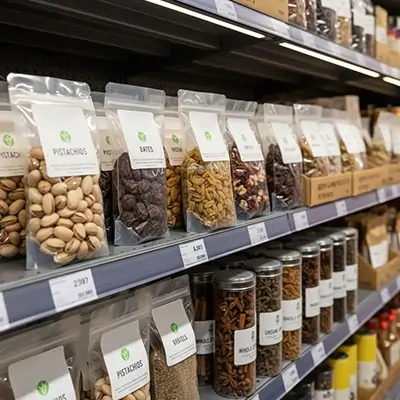
Packaging Standards for the United Kingdom
UK buyers typically expect packaging that protects against moisture ingress, taint/odour transfer, crushing, and contamination. The right answer depends on channel: retail packaging prioritizes shelf appearance and barcode integrity; bulk packaging prioritizes handling efficiency and liner integrity.
packaging approach by channel
Use case | Packaging objective | Common controls (category-dependent) |
Retail | Shelf-ready, label integrity, low complaint risk | Tamper evidence where appropriate; consistent net weight range; barcode/lot readability |
Bulk / ingredient | Protect quality through transit and storage | Food-grade liners; moisture barriers; pallet stability; clear pallet labels |
Private label | Version control + print consistency | Artwork approval records; carton markings aligned to label version and lot |
Logistics & Delivery Planning to the United Kingdom
Route choice is typically a cost-risk decision:
- Air fits high-value, low-weight shipments (e.g., saffron threads) and urgent replenishment. UK cargo commonly flows through major hubs like Heathrow, which positions itself as a leading cargo gateway by value.
- Sea fits heavier products (nuts, dates, raisins, many spices), usually via large container ports such as Felixstowe, Southampton, and London Gateway depending on your forwarder network and inland distribution plan.
Humidity and temperature risk is often underestimated for nuts, dried fruits, and powders. Manage this with: clean, dry containers; liner strategy; desiccants where appropriate; and an evidence approach (container condition photos, stuffing photos, seal records). Incoterms should be chosen based on who can actually control the risk points (booking, export clearance, insurance, UK import clearance, and last-mile).
Arrival Evidence Pack
- Seal numbers + seal photo
- Stuffing photos showing pallet labels and container condition
- Pallet labels (lot IDs, carton counts)
- Any temperature/humidity notes from transit (if tracked)
- Damage/shortage notes recorded at receipt (with photos)
Documentation & Customs Checklist
Customs and food controls do not forgive document inconsistencies. Your broker can only move as fast as the dataset is clean, stable, and internally consistent. The UK customs declaration environment commonly uses HMRC’s CDS through software/agents.
Documentation and process support (UK)
Requirement/document | When needed | Who issues | What process it supports | Typical lead-time risk + mitigation |
Importer identifier (EORI-style) | Before first import | UK importer | Broker onboarding + customs account setup | Delay from missing setup → complete importer onboarding early |
Customs declaration system (CDS via agent/software) | Every import | UK importer/broker | Import declaration + duty/VAT accounting | Data mismatch → lock HS/weights/lots before docs issued |
HS evidence pack | Before quoting + before entry | Importer + supplier | Defensible classification | Late HS changes → approve HS rationale with broker early |
Commercial invoice | Every shipment | Supplier | Valuation + customs entry | Invoice edits late → freeze dataset; use one “single source of truth” |
Packing list | Every shipment | Supplier | Physical reconciliation | Carton/pallet mismatch → packing configuration locked + verified |
COA (category-dependent) | When buyer requires; often per lot | Accredited lab / supplier | Food safety + buyer release gate | COA not tied to lot → define lot + sampling + decision rule |
Health/official certificates (category-dependent) | Only when applicable | Relevant authority | Border/official controls support | Wrong certificate type → confirm route early with broker/authority |
Pre-notification in IPAFFS (category-dependent) | For applicable categories in GB | UK importer/agent | Border pre-alert and controls | Late notification → build into shipping timeline |
Phytosanitary (category-dependent) | Only when applicable | Competent authority | Plant health controls | Timing risk → confirm applicability per product form |
Label artwork approval record | Retail/private label | Buyer + supplier | Claim/label defensibility | Version drift → lock version + store approval archive |
Lot list / packing configuration | Every shipment | Supplier | Traceability + warehouse receiving | Lot/date mismatch → barcode/lot mapping verified pre-dispatch |
Non-negotiable document quality rules
- One master dataset for HS, net/gross weights, carton counts, lot IDs, and dates, used across all
- Lot IDs must appear consistently on: COA, packing list, carton labels, and (where relevant) invoice line mapping.
- Label versions must be frozen: no mid-production edits without change control and re-approval.
Pricing, Payments & Contract Terms
Most disputes are not about price; they are about what was agreed versus what arrived. Prevent that by making the contract reference the technical spec sheet, packing configuration, COA scope, label version, and the buyer’s pass/fail decision rule.
Use staged payments that match risk milestones (e.g., deposit → pre-shipment release → document handover), and add change control: if HS, pack, or label scope changes after quote, the price and lead time are recalculated from a documented baseline. This keeps both sides aligned and avoids “silent scope creep.”
Common Failure Points
- HS code changes after quote → lock HS with a broker-reviewed rationale before pricing.
- Invoice/packing list weight mismatch → one master dataset; reconcile before issuing documents.
- COA not tied to the shipped lot → define “lot” and require COA identifiers to match.
- Label version drift → freeze artwork version and archive approvals.
- Ambiguous pistachio/kernel style → define whole/halves/pieces + calibration ranges in spec.
- Powder authenticity concerns late → pre-agree authenticity testing and chain-of-custody.
- Moisture/taint issues in transit → container condition checks + liner/desiccant strategy.
- Missing packing configuration detail → lock inners/carton and pallet pattern before production.
- Unclear responsibility for pre-notification → assign importer/agent responsibility in the RFQ.
- Date/lot format inconsistencies → standardize lot ID conventions and date formats.
- Claims exceed evidence → limit claims to what can be proven in the shipment file.
- Broker receives documents too late → set a document handover deadline aligned to vessel/flight cutoff.
FAQs
1.What is the single biggest cause of UK clearance delays?
Most delays come from data mismatch: HS code, net/gross weights, lot IDs, dates, or label versions not matching across the Commercial Invoice, Packing List, and COA. Prevention: maintain one master shipment dataset and generate every document from it, no manual re-typing.
2.Do Iranian pistachios and dried fruits require special UK pre-notifications?
It depends on the product category and the applicable risk route. The key is to confirm early whether pre-notification applies and assign responsibility clearly (importer/agent) inside the RFQ and timeline, so “late notification” doesn’t block entry.
3.Where do I check HS codes and duties for the UK?
Use the UK Trade Tariff (Trade Tariff service) as the shared reference before quoting. Lock HS with an HS evidence pack (product form, processing, composition/ingredients for blends, specs, photos) to avoid HS changes at declaration stage.
4.What is the UK customs declaration platform?
UK import declarations are typically handled through HMRC’s Customs Declaration Service (CDS) via a broker or customs software. Practically, fast clearance depends on clean, consistent data (HS, weights, values, packs, lots) because any mismatch creates rework for the broker.
5.What should be on a COA for UK buyers?
A COA should be lot-based (tied to the shipped lot IDs and dates) and category-appropriate (tests, methods, lab identity, sampling statement). Most importantly, it should support a buyer-approved pass/fail decision rule—not a generic “indicative” report.
Understand global markets, choose the right Iranian agri-food products, and learn step-by-step how to source reliably from Iran.
UK-Ready Import Conclusion
Importing Iranian agri-food into the United Kingdom works best when the shipment is engineered for clearance first: HS is locked before quoting, specifications and tolerances are written in buyer language, packing configurations are reconciled carton-to-pallet, and every certificate is tied to a clearly defined lot. The UK market is structured but unforgiving, most delays and disputes come from preventable mismatches in HS, weights, lot IDs, dates, or label versions, not from the product itself.
EvanTrade aligns your order from RFQ to arrival with an auditable control plan: category-dependent QC/COA scope, label version control for retail/private label, document reconciliation, and an evidence pack that supports broker processing and buyer release gates. If your destination differs (GB vs NI) or your product risk profile changes (especially powders/blends), the workflow should be adjusted early, before pricing, printing, or booking freight.
Request a UK-Ready Quote: Send target products, channel (Retail/HoReCa/Industrial/Ethnic), destination (GB or NI), Incoterm, packaging plan, and your required COA scope with pass/fail rules, so the offer is quote-to-clearance aligned.
Request Samples: Ask for sealed, lot-tied samples linked to candidate lots, with a draft COA scope and packing configuration, so approval matches what will actually ship.
- Related content
- Article category