

Iranian Food Export Guide to China
Market Snapshot
China can be “fast” when the importer-of-record and broker file a consistent, evidence-backed packet and the shipment matches it at carton/lot level. It becomes “slow” when any of the core identifiers drift: HS classification, net/gross weights, lot IDs, production dates, shelf-life expressions, label version, or overseas manufacturer registration status. In practice, success is less about finding supply and more about running a disciplined, auditable workflow that aligns product reality to China border and market rules (category-dependent), executed by the importer and customs broker through China’s clearance processes.
Clearance friction typically concentrates in four places: (1) importer readiness and broker filing quality, (2) category-dependent GACC/CIFER overseas manufacturer registration relevance for the production establishment, (3) port-of-entry inspection/quarantine outcomes driven by category and risk profile, and (4) Chinese label compliance against the applicable GB standards for the chosen selling format (especially retail prepack).
If you want a China-ready, repeatable import file for Iran-origin pistachios, saffron threads, dates, raisins/dried fruits, spices, or higher-risk powders, EvanTrade structures the offer around locked HS + locked specs + locked packing configuration + lot-based COA scope + label version control so your broker is filing one coherent story and the shipment physically matches it.
What Sells in China (demand map + buyer use cases by channel)
China’s demand for Iran-origin agri-food is strongest where the product is visually verifiable, grading is standardized, and authenticity risk is manageable: nuts (especially pistachios), premium saffron threads, dates for industrial and ethnic demand, raisins/dried fruits, and whole/cut spices and dried herbs. Powdered spices and blends can sell, but they behave like “high-control” items: authenticity/adulteration risk perception is higher, and testing/traceability expectations are typically heavier (category-dependent).
Retail (prepackaged, label-driven):
Retail favors consistent grades, stable supply, and packaging that can pass Chinese label compliance review and shelf presentation. Pistachios (in-shell and kernels), select dried fruits, and saffron (threads) are common fits when pack specs and label files are controlled to a single approved version.
HoReCa (restaurants, hotels, catering):
HoReCa often prefers larger pack sizes and repeatable flavor/quality profiles. Kernels, raisins/dried fruits, and spices/herbs (whole/cut) fit well when moisture, foreign matter, and sensory specs are locked and each lot is backed by an agreed COA scope.
Industrial (ingredients, processors, food manufacturing):
Industrial buyers optimize around spec sheets, contaminant controls, and batch traceability. Dates, raisins, kernels, and spice materials can fit when the product file includes specification tolerances, lot definition, retention sample plan, and a tight COA/testing matrix.
Ethnic channel (specialty importers/wholesalers):
Ethnic distribution often blends retail and foodservice needs, smaller mixed SKU sets, higher frequency ordering, and faster turnover. The key is preventing document and label drift across small repeat shipments: the same HS, the same label version, and the same carton marking logic each time.
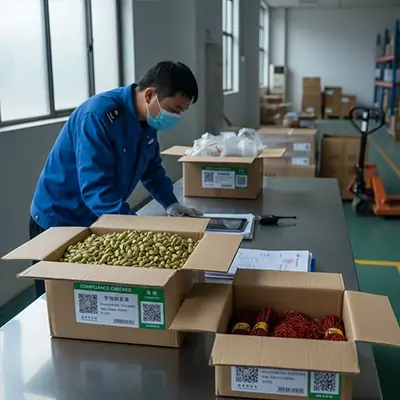
Seasonality & Demand Triggers in China (operational calendar)
China demand is event-driven as much as it is consumption-driven. Plan around (a) promotional retail cycles, (b) gifting seasons, (c) manufacturing cycles for bakery/confectionery, and (d) weather-driven shifts that change nut/dried fruit consumption and inventory strategies. Operationally, what matters is not naming holidays by date, but locking the shipment plan early enough that label approval, sampling, and broker filing are not being rushed.
For pistachios and dried fruits, demand often rises when gifting and snack consumption rise; for kernels and raisins, industrial pulls can increase when manufacturers build inventory for upcoming production runs. Saffron threads behave like a premium ingredient and gifting item: buyers tend to demand stronger documentation discipline (origin story is not the lever—traceability and authenticity controls are).
Build a China calendar as a workflow calendar: “RFQ → HS lock → label scope lock → sample/COA alignment → production slot → pre-shipment release gate → sailing/flight → arrival evidence pack.” The earlier the lock, the fewer surprises at port inspection and market entry.
Best-Fit Iran-Origin Products for China
Table 1 helps buyers choose where Iran-origin products are strongest in China and what must be controlled to avoid border and labeling friction.
Table 1 — Best-fit Iran-origin products for China
Product category | Best-fit Iranian varieties/grades/forms | Demand channels | Winning pack formats + typical net weights (ranges only) | Key compliance/QC risks + China controls (category-dependent) | Where buyers get stuck + EvanTrade prevention |
pistachio in-shell | Commercial grades by size/count and defect tolerance; roasted/salted or raw (spec-defined) | Retail, Ethnic, HoReCa | Retail packs (small–medium); bulk cartons/sacks | Aflatoxin risk perception; foreign matter; moisture; packing/date/lot alignment; labeling for retail | HS/label mismatch; inconsistent net weights; unclear lot mapping → lock spec + packing configuration + carton/pallet map + lot list |
pistachio kernels | Sorted kernels by color/size; mechanically or hand-sorted (declared) | Industrial, HoReCa, Retail | Bulk cartons; retail pouches | Aflatoxin; broken rate; oxidation; allergen statements; COA scope consistency | COA not tied to shipped lot; mixing lots → lot definition + staged release gate + retention samples |
saffron threads | Threads only, grade defined by buyer spec; sealed units | Retail, Ethnic, HoReCa | Small retail units; secondary cartons | Authenticity/adulteration risk; moisture; foreign matter; label claims discipline | Missing authenticity controls; label claims not evidenced → control plan language + claim evidence file + approved artwork version |
dates | Common export types by buyer requirement; industrial paste/processing grades (if used) | Industrial, Ethnic, HoReCa | Bulk cartons; retail packs | Sugar bloom vs spoilage; pests; moisture; storage conditions; date marking format | Storage/shelf-life confusion; pack labeling drift → storage SOP + shelf-life basis file + label version control |
raisins/dried fruits | Sorted raisins; other dried fruit cuts (spec-defined) | Retail, Industrial, Ethnic | Retail pouches; bulk cartons | Sulfur treatment disclosure (if applicable); residues (category-dependent); foreign matter; moisture | Incomplete spec and test scope → align COA matrix to buyer + category route |
spices/herbs (whole/cut) | Whole seeds, pods, leaves; cut/sifted forms | HoReCa, Industrial, Ethnic | Bulk bags/cartons; some retail | Foreign matter; microbial load (category-dependent); pesticide residues (category-dependent); botanical identity | Botanical identity ambiguity; inconsistent cut size → spec sheet + identity controls + sieve/cut tolerance |
spice powders (higher risk) | Single-origin powders; blends only with tight formulation control | Industrial, some Retail | Bulk cartons; limited retail | Higher authenticity/adulteration risk; heavier testing expectations; cross-contamination control | “Powder panic” at onboarding → supplier vetting + formulation lock + expanded COA scope + retention samples |
Market Access & Import Rules
China entry is executed by the importer-of-record and their customs broker, filing through China Customs/GACC clearance processes and operationally common e-systems (broker-operated). The broker files a coherent set of commercial data (HS, quantities, values, weights, origin, parties, and supporting certificates where applicable), and the shipment may be subject to category- and risk-dependent inspection/quarantine outcomes at the port of entry.
A China-realistic plan assumes that overseas manufacturer registration can be relevant depending on product category and route, and that missing or inconsistent registration information can stop shipments before the quality of the product is even discussed. China’s CIFER/GACC overseas establishment registration system is a central reference point in this workflow (category-dependent).
Jurisdiction split (required wording):
Not applicable (central rules; port-of-entry and local enforcement overlays may apply). Port practice, inspection intensity, and local interpretation can vary by entry point and category, so operational risk is managed by pre-locking the file and maintaining strict data matching.
Buyer-controlled responsibilities (importer + broker):
- Confirm product category route and entry prerequisites (including any CIFER/GACC readiness flags if applicable).
- Lock HS classification and tariff logic before RFQ acceptance.
- Own Chinese label compliance for the chosen selling format (especially retail prepack), including claims evidence and artwork approval record.
- Ensure broker filings match commercial documents and physical shipment identifiers (cartons, lots, dates).
Supplier-controlled responsibilities (producer/exporter side):
- Manufacture and pack to the locked specification and packing configuration.
- Produce lot-tied COA/testing evidence per agreed scope (category-dependent).
- Maintain traceability records and ship marks consistent with the approved pack plan.
Mandatory boundary sentence (place once, exactly as written except country name):
“Requirements are shipment- and category-specific; confirm the applicable route with your customs broker and competent authority guidance in China.”
HS Classification & Tariff Readiness
Do not treat HS as an “admin detail.” In China, HS drives not only duty/VAT treatment but also the documentation posture and the inspection conversation. EvanTrade’s approach is to lock HS before quoting and attach a short “classification rationale pack” that stays consistent across Proforma Invoice, Commercial Invoice, packing list, and broker entry data.
Reference tariffs and classification using TARIFF_DATABASE_NAME: China Customs tariff / HS classification resources (China Customs; national tariff schedules). If the importer’s broker proposes an alternative HS, treat it as a controlled change: update all downstream documents and the label/pack file so there is no mismatch at the port.
Pre-Quote Lock Checklist (China)
- HS code proposal + classification rationale pack (product description, form, processing, intended use)
- Locked specification sheet (grade, defects, moisture, foreign matter, size/cut, additives if any)
- Tolerances defined (what can vary, what cannot)
- Packing configuration locked (net weight ranges, inner/outer pack, carton count, pallet pattern)
- Label scope decision (bulk-only vs retail prepack; claims allowed/not allowed)
- COA scope matrix (category-dependent; pass/fail rules defined)
- Incoterm + delivery point + who controls insurance and claims evidence
- Timeline logic (sampling, label approval, production slot, broker filing readiness)
- Category-dependent GACC/CIFER readiness flag (is overseas establishment registration relevant for this product/route?)
Food Safety & Compliance Expectations
China-facing compliance works best when you define the shipment like an auditor would: what is the lot, what evidence belongs to that lot, and how does the carton/pallet map prove it? A “lot” should be a controlled unit tied to production/packing identifiers that can be traced from COA to carton markings to invoice line items, without re-interpretation.
A practical China control plan uses staged QC gates: pre-production spec confirmation, in-process checks (where applicable), pre-shipment inspection against defects/moisture/foreign matter criteria, and a lot-tied COA scope that matches the category risk profile. For higher-risk powders/blends, expand controls: supplier vetting for authenticity, retention samples, tighter batch segregation, and a documented test plan that the buyer and importer approve before production.
Pre-Shipment Release Gate (China)
- COA received for the shipping lot(s) and passes buyer-defined pass/fail rules (category-dependent)
- Label version sign-off complete (exact artwork file name/version controlled)
- Packing reconciliation: net weights, carton counts, pallet pattern, and lot list match the approved pack plan
- Document match: PI/CI/PL all align to HS, quantities, weights, lot IDs, dates, and marks
- Shipment marking alignment: carton labels/pallet labels match the lot list and packing list
- Category-dependent registrations/certificates flagged as “complete and consistent” for broker filing
Labeling & Claims
If you sell prepackaged retail in China, Chinese label compliance becomes a primary success factor. The label is not just marketing it is a regulated data object that must align with the product spec, allergens (where applicable), net content expression, storage conditions, shelf-life/date marking logic, and importer/distributor information requirements under the applicable GB framework (category-dependent). Standards commonly referenced in practice include GB 7718 for prepackaged food labeling and GB 28050 (updated versions may exist) for nutrition labeling rules; use them as category-dependent anchors without assuming one-size requirements.
Claims are the fastest way to create avoidable risk. If a claim cannot be evidenced (spec file + test evidence + documented basis), treat it as “not approved.” This is especially important for saffron and powders, where authenticity narratives can drift into implied health claims; keep claims factual, minimal, and backed by a traceable file.
7-step artwork approval workflow (China-realistic)
- Label scope lock: bulk-only vs retail prepack; bilingual fields required; who is the responsible label owner (importer/brand).
- Data freeze: ingredient list, additives (if any), allergens (if applicable), net content ranges, storage, shelf-life basis, origin statement format.
- GB alignment review (category-dependent): map mandatory fields and nutrition panel requirements if retail prepack applies.
- Claims evidence check: each claim has a supporting document (spec, test, or formal statement); remove anything unsupported.
- Artwork version control: assign version ID; store source files; define “only this version can ship.”
- Pack-to-label reconciliation: carton markings and retail unit label match the packing list and lot logic.
- Approval record: keep a signed/dated approval record (importer/brand + supplier acknowledgment) as part of the Chinese label compliance file.

Packaging Standards for China (retail vs bulk vs private label)
Packaging is a compliance and damage-prevention tool. China routes often cross humidity and temperature swings; packaging must protect against moisture uptake (nuts, powders), aroma contamination (spices), crushing (retail units), and tamper risk (premium saffron). Choose packaging based on channel: retail presentation and label compliance for consumer packs, or bulk efficiency and traceability for industrial/HoReCa.
Packaging choices (China)
Use case | Preferred format | Key controls |
Retail prepack | Consumer units + compliant Chinese label | Artwork version control; net content expression; tamper evidence where relevant |
HoReCa | Medium bulk packs | Moisture barriers; carton strength; clear lot marking |
Industrial | Bulk cartons/bags | Batch segregation; pallet label discipline; retention sample plan |
Private label | Brand-owned artwork + locked spec | Change control: any spec change triggers artwork review and re-approval |
Logistics & Delivery Planning to China (air vs sea; humidity/temp risk; Incoterms guidance; claims evidence pack)
Air can reduce time-in-transit for high-value, low-weight items (e.g., saffron) and reduce exposure to long humidity cycles, but it increases handling touches and requires robust inner packaging. Sea freight is cost-efficient for volume categories (pistachios, dates, raisins, spices) but demands stronger moisture protection, pallet stability, and an arrival evidence pack for claims defense.
Plan logistics as a documentation workflow: booking details, container loading discipline, carton/pallet labeling, and seal control are part of the “evidence trail.” Do not rely on “we’ll sort it at arrival.” In China, importer and broker execution is smoother when the shipment arrives with a coherent evidence set that matches the filed data.
Arrival Evidence Pack
- Container/seal numbers recorded and matched to documents
- Stuffing photos (pallet condition, dunnage, moisture protection)
- Pallet labels visible (lot IDs, carton counts, SKU)
- Temperature/humidity notes where relevant (especially nuts/powders)
- Damage notes at discharge (timestamped) and immediate segregation instructions
Incoterms guidance (practical):
Choose Incoterms that match who can actually control risk. If the buyer/importer controls clearance and local delivery, align the Incoterm so responsibility lines are auditable. Whatever term you choose, attach a claims evidence plan: what photos, what seal records, what packing reconciliation proves the condition and identity of goods at handover.
Documentation & Customs Checklist
China customs success depends on document reconciliation: every number and identifier must agree across PI/CI/PL, COA, labels, and shipping marks. Treat documentation like engineering, no “close enough.” Broker filing through common China clearance workflows requires clean inputs; messy inputs create discretionary delays.
China documentation and process checklist
Requirement/document | When needed | Who issues | What process it supports | Typical lead-time risk + mitigation |
importer identifier / China importer filing info (generic; broker-led) | Always | Importer/broker | Enables broker filing and importer-of-record role | Missing/incorrect importer data → lock importer master data before RFQ acceptance |
customs declaration system (China International Trade Single Window / broker filing) | Always | Broker | Electronic filing and clearance workflow | Data-entry mismatch → provide broker-ready data sheet and freeze changes |
HS evidence (classification rationale pack) | Always (best practice) | Importer/broker with supplier inputs | Defends HS choice, reduces reclassification risk | Late HS changes → change-control process; update all docs + label file |
commercial invoice | Always | Supplier/exporter | Declares value, parties, HS line items | Inconsistent descriptions → standardized item naming + unit definitions |
packing list | Always | Supplier/exporter | Proves quantities, weights, packing config | Carton count/weight drift → packing reconciliation gate before shipment |
COA (category-dependent) | Often expected | Lab/supplier (as agreed) | Supports QC evidence and buyer onboarding | COA not lot-tied → enforce lot definition and retention samples |
health/official certificates (category-dependent) | When required by route/category | Competent authority / issuer | Supports entry and inspection expectations | Assumed but not applicable → confirm route early; keep category-dependent language |
pre-notification / registrations in IMPORT NOTIFICATION SYSTEM (category-dependent; include CIFER/GACC relevance) | When applicable | Establishment/importer/broker (route-dependent) | Establishment readiness and filing completeness | CIFER/GACC status unclear → confirm establishment registration status early |
phytosanitary (category-dependent) | When required | Competent authority | Supports plant-origin entry conditions | Certificate timing risk → align production/inspection booking early |
label artwork approval record (Chinese label compliance file) | For retail prepack / private label | Importer/brand | Defends label compliance and version control | “Label changed last minute” → freeze label version; re-approve if any change |
lot list / packing configuration (carton/pallet mapping) | Always (best practice) | Supplier/exporter | Proves traceability and physical identity | Mixed lots → segregate and map pallets; avoid blending within pallets |
Non-negotiable document quality rules (China):
- One HS per line item, consistent wording across all documents.
- Lot IDs and production/packing dates (where used) must match carton/pallet markings.
- Net/gross weights must reconcile at unit, carton, pallet, and shipment totals.
- Label version ID must be referenced in the shipment file for retail/private label SKUs.
- Any change after PI issuance triggers a controlled re-issue of all dependent documents.
Pricing, Payments & Contract Terms (dispute prevention; staged payments; change control)
China-facing deals fail most often through “silent scope creep”: spec changes, packing changes, label edits, or COA scope changes introduced midstream. Prevent this by writing the commercial offer as a controlled system: locked spec, locked pack, locked HS, locked COA scope, locked label version, and a clear change-control rule.
Use staged payments aligned to objective release gates (samples approved, label approved, pre-shipment release gate passed). Avoid vague promises and avoid tying payment to outcomes no exporter can control (e.g., guaranteed inspection outcomes). Instead, tie payment to deliverables you can audit: documents delivered, COA pass, packing reconciliation complete, evidence pack produced.
RFQ Template + Sample Workflow for China
A China RFQ should read like a broker- and label-ready specification request, not a casual “price please.”
RFQ fields (China):
- Product category + intended use (Retail/HoReCa/Industrial/Ethnic)
- Proposed HS (if known) or request for HS rationale support
- Target grade/spec + tolerances (moisture, defects, cut size, foreign matter, sensory)
- Form (raw/roasted; whole/cut; threads vs powder; single ingredient vs blend)
- Packing configuration (net weight ranges; inner/outer; carton count; pallet pattern)
- Label scope (bulk only vs retail prepack; private label yes/no; claims allowed/not allowed)
- COA scope + pass/fail rules (category-dependent)
- Lot definition requirement and retention sample requirement
- Incoterm + delivery point + preferred mode (air/sea)
- Documentation needs (category-dependent certificates, label approval record)
- Target timeline and any seasonal trigger
Sample workflow (China):
- Sealed, lot-identified samples shipped with draft spec sheet and proposed COA scope.
- Buyer sensory/functional review + importer compliance review (label scope decision).
- If powders/blends: add authenticity controls and expanded testing plan before confirmation.
- Freeze spec/pack/label version and issue PI only after locks are confirmed.
- Produce under controlled lot plan, then run pre-shipment release gate.
Common Failure Points
- HS changes after quoting → Lock HS before quote; enforce change control across all documents.
- Weights don’t reconcile → Packing reconciliation gate; standard templates for net/gross calculations.
- Lot IDs missing or inconsistent → Define “lot” in contract; map lots to pallets and invoices.
- COA not tied to shipped goods → COA must reference shipping lot(s); retention samples stored.
- Retail label edited late → Artwork freeze + version control; any change triggers re-approval record.
- Claims unsupported → Claims evidence file required; remove claims without documentary basis.
- Powder/blend authenticity doubts → Supplier vetting + formulation lock + expanded testing scope.
- Carton marks don’t match packing list → Marking checklist at packing; photo evidence before sealing.
- Category-dependent registrations ignored → Early route confirmation; CIFER/GACC readiness flag in RFQ.
- Mixed lots on a single pallet → Segregate lots by pallet; clear pallet labels and map.
- Storage conditions not respected → Written handling SOP; moisture control for nuts/powders.
- Importer/broker receives incomplete file → Broker-ready “single source of truth” data sheet + document pack audit before dispatch.
FAQs
1.Do Iranian agri-food products need GACC/CIFER overseas manufacturer registration to enter China?
It is category- and route-dependent. Confirm early with your broker and treat establishment registration status as a pre-quote readiness item.
2.What causes most delays at China ports for plant-origin foods?
Data mismatches (HS, weights, lot IDs, dates, label versions) and missing category-dependent prerequisites typically create preventable delays.
3.How should we define a “lot” for China-facing traceability?
Define a lot as a controlled production/packing unit tied to carton/pallet markings and referenced consistently in COA and documents.
4.What labeling standards should we reference for China retail prepack?
Use the applicable GB framework as a category-dependent anchor (commonly GB 7718 for labeling and GB 28050 for nutrition labeling; updated versions may exist).
5.How do we prevent disputes after arrival?
Use staged release gates, keep an arrival evidence pack (seals, photos, pallet labels), and ensure document reconciliation is complete before dispatch.
Understand global markets, choose the right Iranian agri-food products, and learn step-by-step how to source reliably from Iran.
EvanTrade China Import Summary: Iran-Origin Agri-Food, Compliance-Ready
Importing Iranian agri-food into China becomes smooth and repeatable when the import file is locked early (from RFQ stage) in an audit-ready way: fixed HS, fixed specifications and tolerances, fixed packing configuration, a clear lot definition, an agreed COA scope with pass/fail rules, and strict label version control (especially for retail). China’s operational reality is importer + customs broker execution, with port-of-entry outcomes that are category- and route-dependent so success relies on disciplined data matching and full reconciliation between documents and the physical shipment (weights, counts, lot IDs, dates, shipping marks, and label versions).
For China, the most repeatable Iran-origin basket typically includes pistachios (in-shell and kernels), saffron threads, dates, raisins/dried fruits, and whole/cut spices and dried herbs. Powders and blends are commercially possible, but higher-risk due to authenticity/adulteration concerns and often require a stronger control plan (supplier vetting, retention samples, stricter segregation, and an expanded, lot-tied COA/testing matrix). For retail routes, Chinese label compliance under the applicable GB framework (category-dependent) and a controlled artwork approval workflow with version freeze are essential. EvanTrade’s quote-to-clearance approach structures offers so pricing, production, documentation, and clearance readiness stay aligned through locked data, change control, and traceable evidence.
To request a China-Ready Quote, send your target products, channel (Retail/HoReCa/Industrial/Ethnic), destination (shipment-dependent), Incoterm, and packaging plan, plus your required COA scope and pass/fail rules. State whether Chinese retail labeling or private label is in scope, and whether category-dependent GACC/CIFER readiness checks apply to your route.
To request samples, ask for sealed, lot-identified samples with the draft spec sheet, proposed COA scope, and the exact packing configuration intended for shipment, so sample approval matches what will actually arrive in China.
- Related content
- Article category