

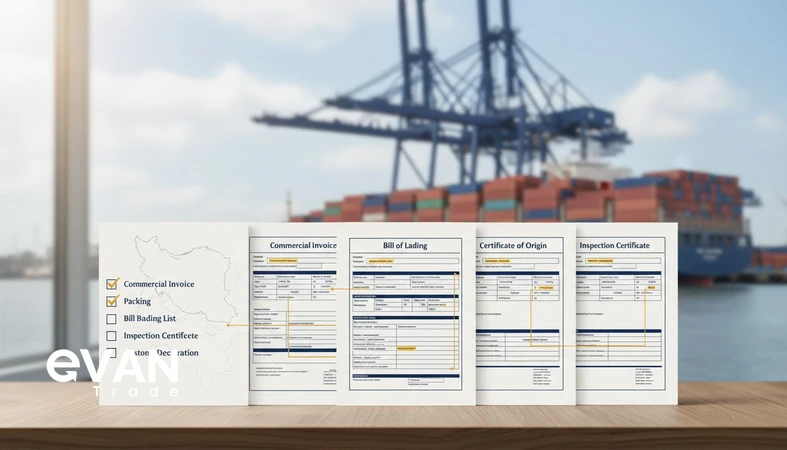
Document consistency check for Iran shipments: the hidden cause of “routine” customs holds
Customs holds rarely happen because one document is “missing.” More often, the cargo is physically ready, but the paperwork set tells slightly different stories. A weight differs by a few kilos, a consignee address is abbreviated on one page and spelled out on another, the HS code varies between invoice and certificate of origin, or the Incoterm on the invoice doesn’t match the booking. These small inconsistencies are exactly what triggers extra scrutiny, amendments, and delays—especially on shipments connected to Iran, where compliance sensitivity, banking checks, and document discipline tend to be stricter.
This article explains what “document consistency” means in international trade and why it matters so much for Iran-related shipments. You’ll get a practical workflow to run before dispatch and again before presenting documents, plus a risk-based checklist for different commodities (with special attention to food and FMCG). The goal is operational: reduce the likelihood of customs holds, lower cost exposure (demurrage, detention, storage), and minimize disputes and payment friction caused by document mismatch.
For reference tools you can standardize internally, build your own export documents checklist and apply it consistently across suppliers and forwarders. The key is not “more paperwork,” but one aligned data set across every document.
What “document consistency” really means—and why Iran shipments are more mismatch-sensitive
Document consistency means that the critical data fields describing the shipment match across every trade, transport, and compliance document. Customs and banks do not “interpret intent”; they validate whether the documentary record is coherent. When fields conflict, the safest path for an authority or counterparty is to pause and request clarification or correction.
Consistency is about data integrity, not formatting
Different documents serve different purposes (pricing vs. transport vs. origin vs. health), so layout differences are normal. What must remain consistent are shared data points:
- Parties (shipper/exporter, consignee/importer, notify party), legal names, and addresses
- Goods description (commercial name, grade/spec, packaging, marks and numbers)
- HS code and country of origin (where required)
- Quantities, net/gross weight, volume, number of packages
- Incoterms, currency, and payment terms
- Shipment identifiers (container number, seal number, vessel/flight, B/L or AWB number)
- Dates (invoice date, shipment date, document issue date) and required stamps/signatures
Why Iran-related shipments are often treated as higher-risk from a paperwork perspective
Even when the goods themselves are straightforward, Iran-linked shipments can face heightened documentary scrutiny due to:
- Compliance and screening intensity: parties, routing, and payment details may be reviewed carefully.
- Banking and payment friction: mismatches can trigger additional questions, re-checks, or refusal to process documents under strict internal controls.
- Multi-actor coordination: supplier, freight forwarder, inspection bodies, and brokers may each generate documents—raising the chance of inconsistent master data.
- Commodity-specific controls: food, cosmetics, and FMCG can require health, phytosanitary, or inspection documentation where a single wrong lot number or net weight can stop clearance.
To avoid Incoterm-related disputes during corrections (who pays amendments, storage, or re-issuance), keep a clear internal reference and apply consistent Incoterms guidance when you draft and approve documents.
The core document set for a typical Iran shipment (and how mismatches trigger holds)
Most customs holds tied to documents come from contradictions inside a standard document pack. Below is the typical core set, with the highest-risk mismatch points to watch.
Commercial Invoice
The invoice is the commercial truth: seller/buyer identities, item descriptions, unit price, currency, Incoterm, and totals. Common triggers include inconsistent consignee details, unclear description (too generic), missing Incoterm, or a mismatch between line totals and grand total.
Packing List
The packing list is the physical truth: packages, net/gross weights, dimensions, and markings. A frequent hold trigger is when the packing list gross weight exceeds the bill of lading weight, or when package count differs from what the carrier recorded.
Bill of Lading (B/L) or Air Waybill (AWB)
This is the transport truth: routing, carrier, shipment identifiers, and often the shipper/consignee/notify party. Holds can result if the B/L shows a different consignee name than the invoice, a different port than other documents, or if container/seal numbers do not match the stuffing report or packing list. For “to order” B/Ls, errors in party fields can complicate endorsement and bank handling.
Certificate of Origin (COO)
The COO supports origin claims and can be essential for duty treatment or regulatory acceptance. Mismatches appear when the COO uses a different HS code, different product description, or conflicting country-of-origin information compared to the invoice and labels.
Insurance Certificate (when applicable)
For CIF/CIP shipments, insurance details should align with invoice value, currency, and goods description. A lower insured value than invoice value, a different consignee, or missing risks covered can create claims issues later—and sometimes compliance questions upfront.
Inspection, Health, Phytosanitary, or Conformity Documents (commodity-dependent)
For food/FMCG and certain controlled goods, these documents often contain batch/lot numbers, production dates, shelf-life, temperature requirements, and lab/authority stamps. Any mismatch with labels, packing list, or invoice (even a single digit in a lot code) can stop clearance until corrected.
Where supplier reliability drives document quality, do not treat paperwork as an afterthought; run a structured supplier due diligence checklist that includes document capability (templates, signatory authority, and turnaround for amendments).
Step-by-step document consistency check workflow (before dispatch and before presentation)
Use a two-gate workflow: one check before cargo leaves the supplier, and a second check before documents are presented to brokers, banks, or customs. The most expensive time to discover mismatches is after the vessel sails and the original B/L has been issued.
Gate 1: Pre-dispatch consistency (stop errors before they become amendments)
- Freeze master data: confirm legal names, registration details (where used), and full addresses for shipper/exporter, consignee/importer, and notify party. Decide one standardized spelling and formatting (including punctuation) and share it with supplier and forwarder.
- Align the goods “golden description”: create one approved description per SKU/line item (commercial name + spec/grade + packaging). Avoid overly generic terms that invite questions.
- Confirm HS code logic: validate HS codes at the appropriate digit level for your lane and commodity, then lock them across invoice/COO/inspection where applicable. If there is uncertainty, resolve it before booking.
- Validate quantity/weight/volume math: reconcile units of measure, package count, net/gross weight, and CBM. Check: line-item totals = sum of cartons; cartons = pallet count; net + tare logic is reasonable; weights match booking request.
- Lock Incoterms, currency, and payment terms: ensure the Incoterm is stated with named place/port (e.g., “CIF Bandar Abbas” or “DAP Tehran”). Keep currency consistent across invoice and payment instructions.
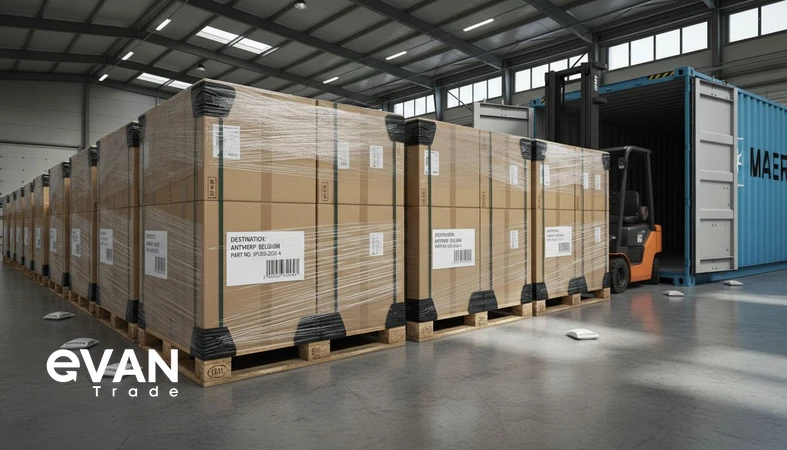
- Review marks and numbers: carton marks, pallet labels, and container marks should match the packing list and be legible.
- Pre-check compliance documents: for food/FMCG, verify that product labels, lot numbers, manufacturing/expiry dates, and health statements align with what will appear on certificates.
Gate 2: Pre-presentation consistency (catch carrier and issuer differences)
- Compare draft B/L or AWB to invoice and packing list: party names, ports, goods description, package count, gross weight, and freight terms.
- Verify shipment identifiers: container number(s), seal number(s), B/L number, vessel/flight details. Confirm seal numbers match the stuffing record.
- Check dates and document sequence: invoice date, shipment date, COO issue date, inspection certificate date. Ensure dates are plausible and comply with any banking/document presentation timelines.
- Confirm required signatures and stamps: some documents must be signed or stamped by authorized bodies. Missing stamps can be treated like a mismatch because the document is “non-valid.”
- Confirm consistency of totals: invoice total, insurance amount (if required), and declared values where relevant should not conflict.
- Keep a correction plan: if you find an error, define who requests amendments (shipper vs. forwarder), expected timelines, and who bears costs under the contract.
When the shipment involves food or FMCG, run a parallel check using food import compliance basics so your certificates, labeling, and lot-level data remain synchronized end-to-end.
Common mismatch culprits—and the real-world cost of “small” errors
Mismatches are rarely dramatic; they are usually mundane. But the consequences can be outsized because corrections often require third parties (carrier, chamber, inspection body, insurer) and may be constrained by timing (vessel departure, document cutoffs).
The usual culprits
- Party names and addresses: abbreviations, different spelling, missing postal codes, or switching the consignee/notify party roles between documents.
- HS code drift: supplier uses one code, broker expects another, COO issuer follows a different convention. The result is inconsistency even if each choice is “defensible.”
- Weight and package count differences: updated packing after final invoice, or carrier “rounding” versus exact weights.
- Incoterms mismatch: invoice says FOB, booking says CFR, insurance certificate suggests CIF—creating confusion about responsibility and cost allocation.
- Container/seal discrepancies: last-minute container change not reflected everywhere, or seal replaced during inspection without updating documents.
- Over-generic product descriptions: terms like “foodstuff” or “chemicals” without grade/spec can trigger requests for more detail.
- Inconsistent currency and totals: invoice in EUR, insurance in USD, or payment instructions in another currency without a clear rationale.
What it costs in practice
- Demurrage and detention: containers held at port or terminal while amendments are issued.
- Storage and handling: for air cargo or LCL, warehouses may charge storage once free time ends.
- Re-issuance delays: corrected COO or inspection certificates can take days, especially if originals must be surrendered.
- Bank compliance friction: discrepancies can slow document checking, payment processing, or acceptance of documents—especially when documents are routed through multiple parties.
- Disputes under the contract: if responsibilities are unclear, parties may argue over who pays amendment fees or delay costs. Clear pricing and contracts terms reduce ambiguity when something goes wrong.
Operational principle: If a field can be copied from one document to another, it should be copied—not retyped. Manual re-entry is one of the biggest sources of mismatch.
Table: common document mismatch types, where they occur, why they happen, and prevention
Use the table below as a quick diagnostic tool during Gate 1 and Gate 2 checks.
| Mismatch type | Where it shows up | Why it happens | How to prevent it |
|---|---|---|---|
| Consignee name/address mismatch | Invoice vs. B/L/AWB vs. COO | Different templates, abbreviations, retyping, last-minute changes | Freeze master data; issue one “party details sheet”; require copy-paste only |
| HS code inconsistency | Invoice vs. COO vs. inspection documents | Different interpretations, different digit level, supplier assumptions | Agree HS code early with broker; lock it; document rationale internally |
| Package count discrepancy | Packing list vs. B/L/AWB | Repacking after booking; carrier records “pieces” differently | Finalize packing before booking; define “package” consistently (carton/pallet) |
| Gross weight mismatch | Packing list vs. B/L/AWB vs. booking | Scale differences, rounding, late updates, tare assumptions | Use one weighment method; reconcile before draft B/L approval |
| Incoterm conflict | Invoice vs. contract vs. booking vs. insurance | Using old templates; misunderstanding Incoterm scope | State Incoterm + named place; approve one commercial template per lane |
| Container/seal number mismatch | B/L vs. packing list vs. stuffing report | Container swap; seal replacement during inspection | Update numbers immediately; require forwarder to re-issue draft for approval |
| Product description too generic | Invoice/COO vs. regulatory docs | Supplier simplifies; translation issues; missing grade/spec | Define a “golden description”; include grade, pack size, and intended use where relevant |
| Lot/batch/date mismatch (food/FMCG) | Labels vs. health/inspection certificates vs. packing list | Multiple production lots; manual typing; label changes after certification | Lock lot list before certification; cross-check against photos of final labels |
Risk-based checklist: what to verify for low-risk vs. high-risk commodities (with food/FMCG focus)
Not every shipment needs the same depth of document validation. A risk-based approach helps you spend time where it reduces real exposure.
Low-risk commodities (typical manufactured goods, stable specs)
Focus on core trade/transport alignment:
- Party names/addresses aligned across invoice, packing list, B/L/AWB
- Consistent HS code (at the level your customs process requires)
- Quantities, gross/net weights, CBM consistent and mathematically reconciled
- Incoterms and named place/port consistent with booking and contract
- Container and seal numbers verified at Gate 2
High-risk commodities (food, FMCG, cosmetics, regulated items)
Add a second layer of consistency checks, because holds often happen at the intersection of labeling and certificates:
- Lot/batch mapping: each lot number on labels must match the certificate set and packing list allocation.
- Date logic: manufacturing and expiry dates should be consistent with shelf-life expectations; certificate issue dates should align with production lots.
- Ingredient/spec statements: where certificates mention composition, ensure it matches product documentation and labeling.
- Temperature/handling requirements: if stated on certificates, ensure shipping mode and packaging can support it and that terms are not contradictory.
- Language and transliteration discipline: keep consistent product naming conventions across documents to avoid “same product, different name” confusion.
A practical way to run risk-based checks in teams
Assign document fields into tiers:
- Tier 1 (must match exactly): party names, addresses, container/seal numbers, B/L number, currency, Incoterm.
- Tier 2 (must reconcile logically): weights/volumes, package counts, dates, line-item totals.
- Tier 3 (must be consistent in meaning): product description language, internal SKU references (avoid putting internal-only codes on external docs unless required).
When a mismatch is found: correction options without turning a delay into a dispute
Even with a strong process, mismatches can appear—especially when carriers and third-party issuers are involved. The difference between a manageable correction and a shipment-stopping problem is speed, documentation control, and clarity on responsibility.
Typical correction paths
- Invoice/packing list re-issue: usually fastest if controlled by the exporter, but ensure version control (old copies should be clearly voided).
- B/L amendment: can be time-sensitive and fee-based; may require shipper authorization and can be limited after sailing.
- COO or inspection certificate correction: depends on the issuing body; may require returning originals or issuing a replacement with a reference note.
- Letter of correction/explanation: sometimes accepted operationally for minor issues, but it is not a universal solution and may not satisfy all parties.
How to keep corrections controlled
- Use one “document owner” internally: one person/team collects drafts, runs checks, and approves final versions.
- Maintain a discrepancy log: field, document, impact, owner, deadline, and evidence of fix.
- Don’t patch inconsistently: if you correct a party name on the invoice, ensure it is corrected everywhere else that carries the same field.
- Clarify cost responsibility early: amendments and storage costs should map to the contract and Incoterm responsibilities, not post-fact negotiation.
In practice, the cleanest corrective action is the one that restores a single coherent dataset across all documents—without creating parallel versions floating across email threads.
FAQ: customs holds and document corrections for Iran shipments
1) What is the most common reason for a customs hold related to documents?
Most holds are triggered by inconsistencies between the commercial invoice, packing list, and B/L or AWB—especially party details, goods description, weights, and package counts. Authorities and brokers treat conflicts as risk signals because they make it harder to confirm what is being imported, by whom, and under which terms. A fast way to reduce holds is to standardize master data and require draft approval before documents are finalized.
2) How strict do names and addresses need to be across documents?
In many cases, they need to match exactly—not “close enough.” Even small variations (abbreviations, different punctuation, missing building numbers, or different spellings) can trigger extra verification or bank compliance questions. Create a single approved “party details” record and share it with the supplier and forwarder. Use copy-paste, not manual retyping, and avoid switching between short and long versions of the same address.
3) Can I fix a mismatch after the cargo has shipped?
Sometimes, but it depends on the document type and timing. Invoice and packing list can often be re-issued quickly if controlled by the exporter. B/L amendments can be time-sensitive, may involve fees, and can be limited after sailing. COO or inspection documents depend on issuing bodies and may require originals to be returned. The practical approach is to catch issues at the draft stage (Gate 2) before documents become “final.”
4) What happens if the HS code differs between invoice and certificate of origin?
A mismatched HS code is a common trigger for customs queries because it affects classification, duties, and sometimes admissibility. Even if both codes seem plausible, the inconsistency can stop clearance until corrected or explained. Align HS codes early with your broker and ensure the same code appears on all relevant documents. If a change is necessary, update the entire set, not only one document.
5) Why do weight differences cause delays even when the goods are correct?
Because weight is used as a cross-check for shipment integrity and valuation plausibility. If gross weight differs between packing list and transport documents, customs or the carrier may request clarification, and your broker may pause submission to avoid rejection. Weight discrepancies often come from rounding, scale differences, or late repacking. Reconcile weights before approving the draft B/L/AWB and keep a clear weight calculation trail.
6) For food and FMCG, what single detail most often creates document problems?
Lot/batch identification and date fields (manufacturing/expiry) are frequent pain points. If certificates mention a lot number that doesn’t match labels or the packing list allocation, clearance can stop until corrected documents are issued. The fix is procedural: lock the lot list before certification, collect photos of final labels, and cross-check every lot and date against certificates prior to dispatch and again before presentation.
Conclusion: consistency is a process, not a final document review
A document consistency check is most effective when it is built into execution—starting with frozen master data, one approved “golden description” for goods, and two formal checkpoints (pre-dispatch and pre-presentation). Iran shipments can be particularly mismatch-sensitive because multiple actors touch the document set and compliance/banking reviews can amplify small discrepancies into delays and cost exposure. The practical takeaway is simple: treat your documents as one dataset that must remain synchronized across invoice, packing list, transport documents, origin, and any health/inspection certificates.
For teams that want to institutionalize this discipline across suppliers and lanes, Evan Trade can be used as a reference partner for documentation readiness, supplier coordination, and shipment compliance workflow design. Learn more about Evan Trade here: Evan Trade.